
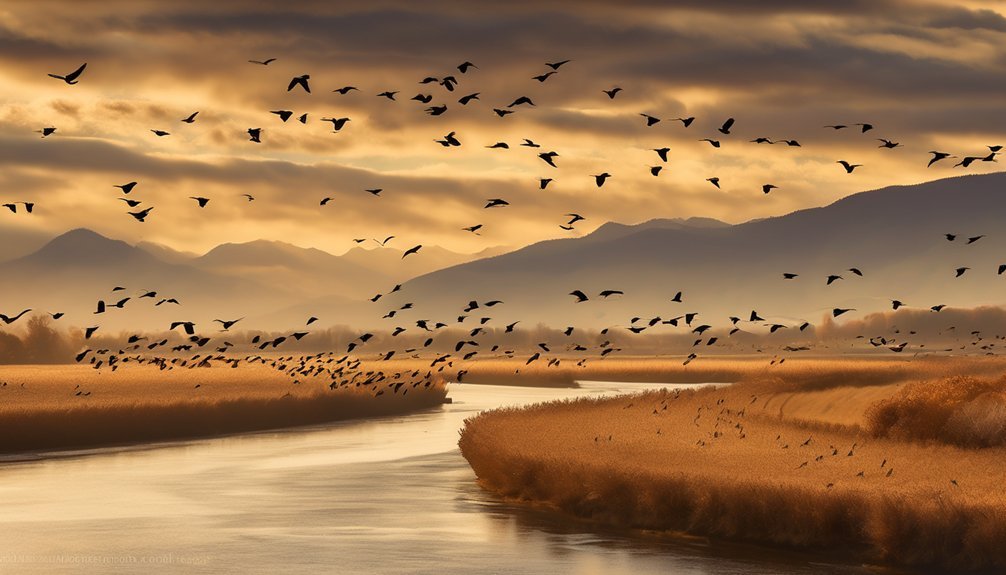
When you look at bird migration, you see a strategy shaped by food, climate, and breeding needs. Birds move thousands of miles to reach areas where resources are more reliable and competition is lower. Their internal clocks, along with day length and weather cues, help trigger departure. But the question isn’t just why they leave; it’s also how they manage such extreme distances and still arrive on time.
Key Takeaways
- Birds migrate thousands of miles to find reliable food, water, and nesting sites as seasons change.
- They travel to breeding grounds with better spring resources and safer conditions for raising young.
- Day length, temperature, and food cues trigger internal biological clocks that time migration precisely.
- Some species fly far because distant habitats require long-distance movement, often with large fat reserves.
- Migration helps birds avoid freezing weather, drought, predators, and crowded habitats by following proven routes.
Why Birds Migrate
Birds migrate when seasonal changes make food, water, or suitable nesting conditions less available in one region. You’re seeing a survival strategy shaped by resource availability, temperature, and day length.
Many species leave temperate areas to reach breeding grounds where spring offers abundant insects, seeds, or open water. Others move to avoid freeze, drought, or crowded habitats that reduce reproductive success.
Migration lets you track conditions that support higher energy intake and safer nesting. You can think of it as a flexible response to environmental variation, not a random journey.

How Birds Know It’s Time to Go
As day length shortens or lengthens, changing light levels trigger internal biological clocks that help birds time migration. You can think of this as a synchronized system linking the brain, hormones, and seasonal rhythms.
Photoreceptors detect shifts in daylight, and your body responds by adjusting activity, fat storage, and restlessness. These biological clocks don’t work alone; they also integrate environmental cues such as temperature, food availability, and wind patterns.
When the signals align, migration readiness rises. You may notice that birds don’t depart at random; they wait until internal timing and outside conditions match. This precise coordination improves survival by reducing risk during departure and ensuring that movement begins when the season’s demands are changing.
Why Some Birds Travel So Far
Once birds are ready to migrate, the next question is why some species travel immense distances while others move only a short way. You can trace the answer to ecology and physiology.
If your breeding grounds lie far from year-round food sources, selection favors longer flights that link seasonal habitats. You’ll see this most in birds that raise young in high latitudes, where summers offer abundant insects or seeds but winters turn harsh.
Longer migrants often store more fat, navigate with high precision, and tolerate greater energy costs. Short-distance migrants face less risk and may stay closer when local conditions remain usable.
In both cases, migration matches the balance between survival, reproduction, and the timing of resources across the year.
Famous Bird Migration Routes
Some migration routes are so consistent and extensive that they’ve become landmarks in ornithology, linking breeding and wintering areas across continents and oceans.
You can trace the East Atlantic Flyway from Arctic breeding grounds to West African coasts, and the Pacific Flyway from Alaska to South America.
You’ll also see the Mississippi and Central Flyways guiding waterfowl through North America, while the East Asian-Australasian Flyway connects Siberia with Australia and New Zealand.
These migration landmarks follow predictable seasonal patterns, because birds time departures and arrivals with food availability and daylight.
When you study them, you notice that species often reuse the same corridors each year, refining routes through inherited orientation and local experience.

This regularity lets you compare populations and identify shifts in timing across climates.
Main Challenges of Migration
Migration is demanding because birds must maintain energy balance while navigating long distances, often across deserts, oceans, mountains, and urbanized landscapes.
You face shifting weather conditions that can stall flight, increase dehydration, and force detours. Food scarcity along the route reduces fat reserves, so every stop matters.
Shifting weather can stall flight, increase dehydration, and force detours, while scarce food makes every stop count.
You also contend with predator avoidance, since exhausted birds are easier targets during rest and feeding. Habitat loss at stopover sites can remove the cover and resources you need.
Your navigation skills must stay accurate despite magnetic, celestial, and landmark changes. Social behavior can help you locate resources and coordinate movement, but crowding may intensify competition.
Together, these pressures make migration a high-risk process that tests physiology, behavior, and timing.
How Birds Survive Long Migrations
Birds survive long migrations by combining physiological endurance with efficient behavior and precise timing. You can see this in how they build fat reserves before departure, then burn them steadily to power flight.
They reduce wingbeats when winds help, fly in formation when possible, and rest at stopover sites that restore muscles and water balance.
Your view of migration should also include navigation skills: birds use the sun, stars, Earth’s magnetic field, landmarks, and even smell to stay oriented.
They time travel to favorable weather and daylight, which cuts risk and improves energy conservation.
Frequently Asked Questions
How Do Scientists Track Bird Migration?
Scientists track bird migration with tracking technology like GPS tags, geolocators, and radar. You can analyze migration patterns by following signals, measuring routes, and comparing timing, which reveals where birds fly, stop, and return.
Do All Birds Migrate Every Year?
No, you don’t see every bird leave like clockwork each year; some stay, guided by migration patterns and breeding habits. You’ll notice crisp seasonal shifts, but species vary, and many birds remain year-round.
Can Birds Get Lost During Migration?
Yes, you can see birds get lost during migration when storms, habitat loss, or pollution disrupt navigation techniques and migratory patterns. You’d notice detours, delays, or strandings, though most birds still correct course using cues.
How Does Weather Affect Migration Timing?
Weather can shift your migration timing by altering temperature changes and food availability. You’ll often depart when cooling cues and scarce resources signal movement, and you’ll delay if storms, winds, or unusual warmth increase energetic costs.
Are Urban Lights Dangerous for Migrating Birds?
Yes—urban lights can disrupt your birds’ nocturnal navigation, increasing collision and exhaustion risks. As the saying goes, “better safe than sorry.” You’ll see urban light pollution confusing stars, altering routes, and delaying arrivals.
Conclusion
You’ve seen that migration is both risky and essential: birds leave stable grounds for uncertain skies, yet gain food, nesting sites, and safer climates. Their internal clocks and environmental cues push them onward, while distance tests their endurance. In contrast to remaining in place, migration lets them avoid scarcity and competition. So when you ask why birds travel thousands of miles, you can answer clearly: they move to survive, reproduce, and thrive.