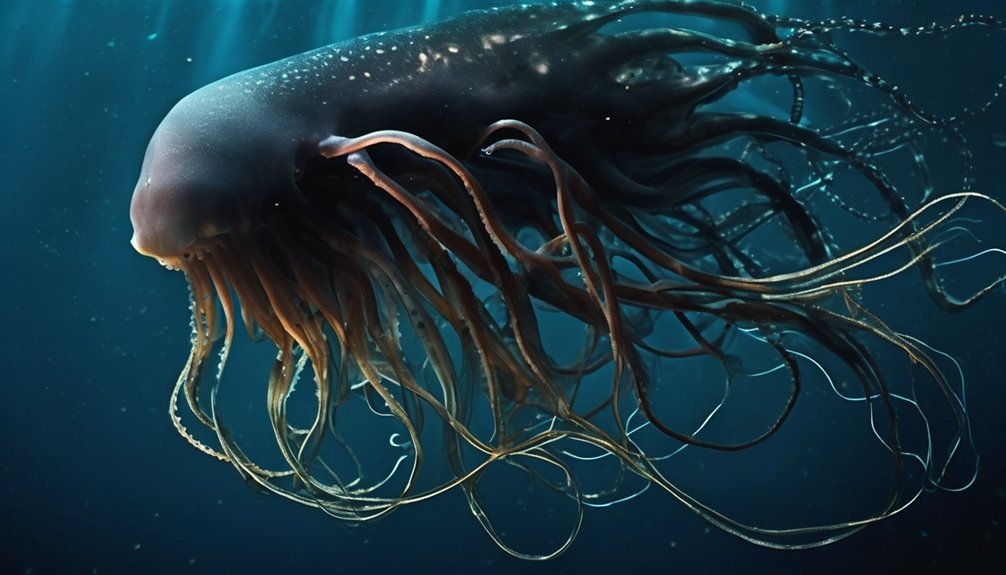
Like something out of a shipwrecked legend, you find the deep ocean’s creatures shaped by pressure, darkness, and scarcity. You’ll meet anglerfish that use light to trap prey, giant squid that still evade full study, and vampire squid that defend themselves in unusual ways. Their strange forms aren’t random; they’re precise adaptations. Yet many of these animals remain only partly understood, and the most unusual one may be waiting in the next trench.
Key Takeaways
- Deep-ocean creatures survive extreme darkness, pressure, and cold with elongated bodies, reduced eyes, and energy-saving adaptations.
- Bioluminescence helps many species lure prey, attract mates, confuse predators, and communicate in the dark abyss.
- Anglerfish, gulper eels, and siphonophores use unusual feeding strategies to capture scarce prey efficiently.
- Vampire squid defend themselves with red camouflage, sticky mucus, and threat displays that deter predators.
- The deep ocean remains largely unexplored, so many mysterious species and adaptations are still being discovered.
Why Deep-Sea Creatures Look So Strange
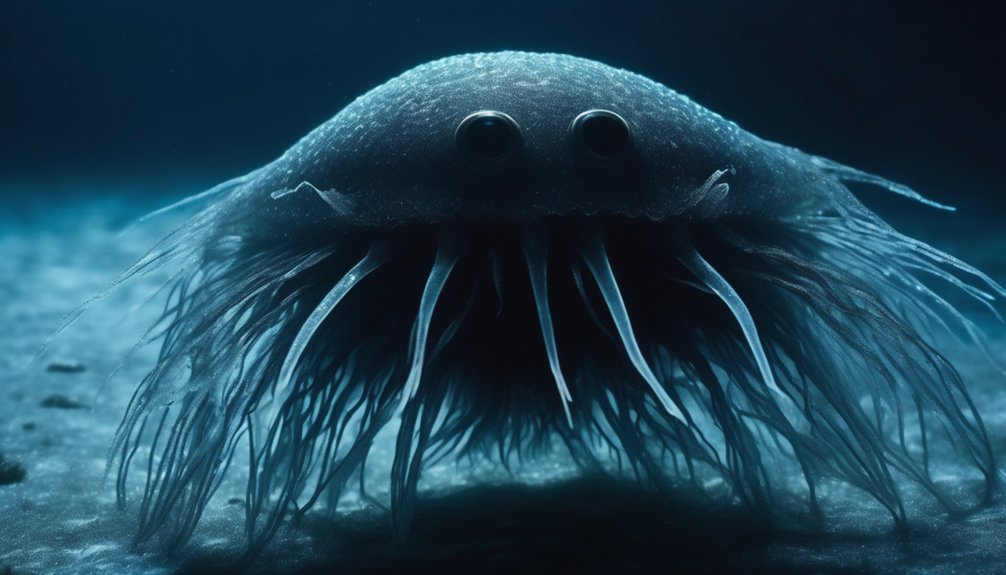
In the deep ocean, where sunlight barely reaches and pressure is extreme, creatures have evolved bodies that look unlike most surface animals. You see elongated forms, reduced eyes, and soft tissues because these traits help them conserve energy and withstand crushing force.
Many species also have expanded jaws, flexible spines, and pale skin, features shaped by evolutionary survival strategies in a low-food world. Since darkness dominates, you’ll notice bioluminescent adaptations in many lineages, which help them detect mates, communicate, or confuse predators.
Their strange outlines aren’t random; natural selection has tuned each body for temperature, scarcity, and darkness. When you study them closely, you’re seeing efficient design, not monstrosity, and every adaptation reflects the ocean’s harsh demands.
Anglerfish and the Glow That Lures Prey
Among the deep sea’s most striking predators, the anglerfish uses a built-in lure to turn darkness into an advantage.

You can picture the modified dorsal spine extending above its head like a fishing rod, ending in a glowing bait produced by symbiotic bacteria. This bioluminescent adaptation lets the fish attract curious prey in near-total blackness.
When smaller animals approach, the anglerfish opens its large mouth and strikes with startling speed, relying on flexible jaws and sharp teeth. Its predatory strategies conserve energy, which matters in a habitat where meals are rare.
You see a creature shaped by scarcity, yet perfectly equipped to exploit it. In the abyss, light isn’t comfort; it’s a trap that helps the anglerfish survive.
Giant Squid: The Deep Ocean’s Elusive Giant
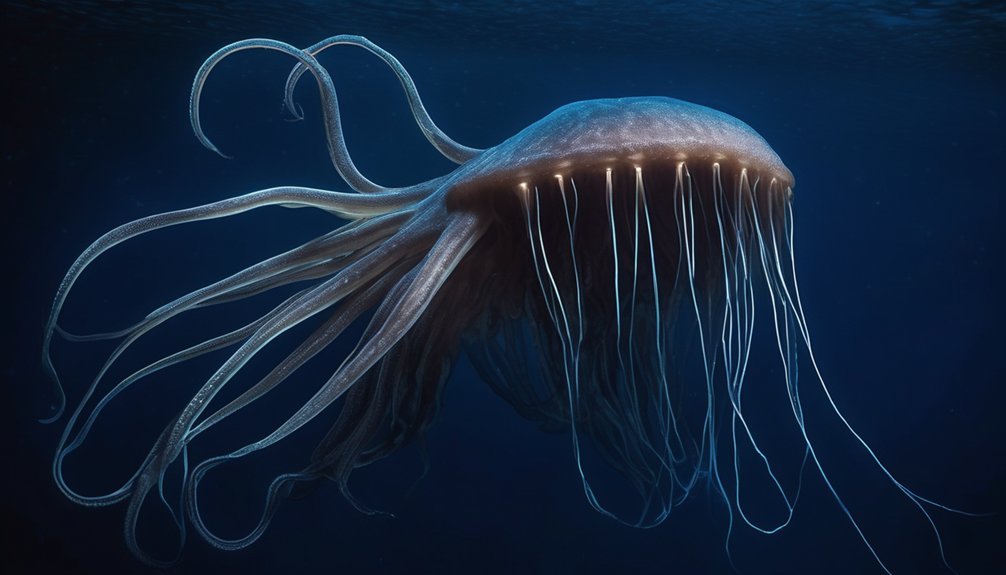
Where the anglerfish relies on light to draw victims close, the giant squid rules a different kind of deep-sea mystery: vast size, powerful muscles, and near-total isolation.
You encounter it in the giant squid habitat, typically along steep continental slopes and deep ocean waters where sunlight fails. Its giant squid behavior remains hard to observe because it spends most of its life far below your reach.
You can infer that it moves with jet propulsion, using a muscular mantle and long arms to seize prey such as fish and other cephalopods. Huge eyes help you understand how it detects faint bioluminescent signals in darkness.
Though rare at the surface, this animal’s presence reveals how life adapts to pressure, cold, and scarcity.
Vampire Squid and Its Red Defense
Unlike its name suggests, the vampire squid isn’t a true squid but a strange deep-sea cephalopod with a striking red body and webbed arms. You can think of its color as a useful disguise in the twilight zone, where red light fades quickly and shadows dominate.
When threatened, the vampire squid folds its arms around its body, exposing spines and dark surfaces that confuse predators. It can also release sticky mucus and flash bioluminescent signals from specialized organs, creating brief bursts of light that may startle attackers or mask its escape.
You’ll notice that this animal lives slowly, conserving energy in cold, oxygen-poor water. Its red defense isn’t aggressive; it’s a careful, elegant strategy for survival.
Frilled Shark and the Ancient Deep Ocean Predator
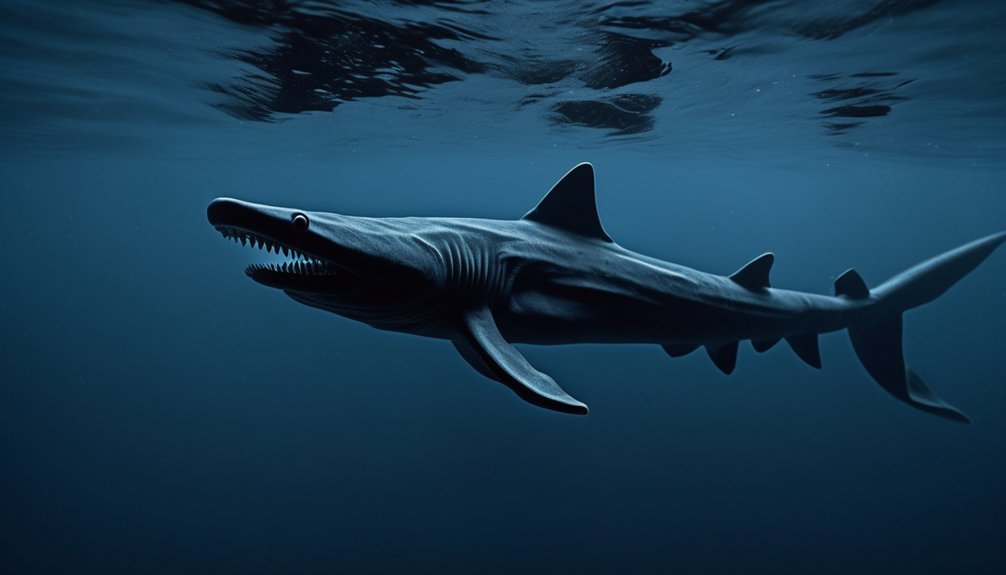
Though it looks like a creature from another era, the frilled shark is a living deep-ocean predator with a long, eel-like body, a broad head, and rows of needlelike teeth.
You can see how its ancient adaptations help it survive in dim waters: six pairs of gill slits frame its throat, and its jaw opens wide to seize slippery prey.
It moves with slow, sinuous strokes that conserve energy, then strikes in sudden bursts during elusive hunting.
You’re looking at a shark that’s rarely observed, because it spends most of its life far below the surface, where light fades and food is scarce.
Its form reflects a lineage that has changed little over millions of years, giving you a rare glimpse into deep-ocean history and predatory specialization.
Blobfish and Life Under Crushing Pressure
Far below the sunlit surface, the blobfish endures a world where pressure is intense enough to shape its body in unusual ways.
You’d see a soft, gelatinous fish built for deep water, where its low-density flesh helps it hover with little effort. Its skeletal structure stays light, and its muscles remain reduced, both adaptive features that support pressure survival.

Because you don’t need rapid swimming in this habitat, the blobfish conserves energy and drifts near the seafloor, feeding on small invertebrates that pass within reach.
In its native depth, the animal looks far more compact than the distorted form people often photograph at the surface. You can think of it as a specialist, finely tuned to a stable environment that would crush most other fish.
Barreleye Fish and Its Transparent Head
If the blobfish is built for stillness near the seafloor, the barreleye fish shows another extreme adaptation to deep-ocean life. You can see its dome-like head, which stays transparent and lets light reach internal eyes.
| Feature | Function |
|---|---|
| Transparent head | Shields soft tissues |
| Upward-facing eyes | Track faint prey |
| Green eye pigment | Filters sunlight-like glow |
| Small body | Conserves energy |
| Delicate fins | Aid precise hovering |
These transparent adaptations give you a rare view of organs usually hidden in fish. Its unique vision lets it scan above while it drifts below, watching silhouettes of jellyfish and crustaceans. In the dim mesopelagic zone, you’re looking at a specialist shaped by pressure, darkness, and scarcity, not by speed or aggression.
Gulper Eel and the Expandable Jaw
The gulper eel takes deep-ocean feeding to an extreme with a jaw that can open far beyond its narrow body, creating a huge pouch-like mouth that helps it seize scarce prey.
You can see how its jaw mechanics rely on highly flexible ligaments, loose joints, and a skull built for extraordinary expansion. This design lets the eel gulp fish, crustaceans, and other small animals in one rapid strike, even when food is rare.
Its feeding strategies depend on surprise and volume, not speed or strength. In the dark midwater, you’d notice that the lower jaw and throat stretch like a net, then compress after swallowing.
That ability gives the gulper eel a precise advantage in an environment where every meal matters.
Siphonophores: The Deep Ocean’s Living Chains
Like the gulper eel’s oversized mouth, siphonophores solve deep-sea feeding with extreme specialization, but they do it as a colony rather than a single animal. You can think of siphonophore colonies as living chains, each unit handling one task while others manage swimming, stinging, or prey capture.
Their unique adaptations let them stretch for meters, drift in darkness, and coordinate as one organism-like body.
- You’ll notice transparent tissues that reduce visibility.
- You’ll see specialized zooids linked in repeating sections.
- You’ll find long tentacles built for capturing small prey.
This design helps them survive where food is scarce. When you picture them, imagine a delicate, precise architecture that turns many tiny bodies into a single efficient hunter in the deep sea.
The Science Behind Deep-Sea Mysteries
Beneath the sunlit surface, deep-sea mysteries begin to make sense when you look at the physics and biology that shape life in extreme darkness.
You’ll find that crushing pressure, cold temperatures, and scarce food drive deep sea adaptations in every organism. Cells use pressure-stable proteins, flexible membranes, and slow metabolisms to keep working where light can’t reach.
You can see how bioluminescent communication helps animals attract mates, lure prey, and warn rivals in a silent world. Sensory organs often grow larger or more sensitive, letting creatures detect faint vibrations and chemical traces.
These traits don’t just reveal survival; they show you evolution’s precision. In the abyss, mystery remains, but science gives you clear mechanisms behind each remarkable form.
Frequently Asked Questions
How Do Deep-Ocean Creatures Find Mates in Total Darkness?
You’d find mates in total darkness through bioluminescent signals and pheromone communication; you can emit flashes or scent trails that attract partners, guide courtship, and let species recognize each other with remarkable precision.
What Do Deep-Sea Creatures Eat When Prey Is Scarce?
You’d think they’d starve instantly, but they don’t; many deep-sea creatures eat falling detritus, carcasses, smaller animals, and microbes, using extreme adaptations and bioluminescent signals to locate rare meals in darkness.
How Far Below the Surface Do These Mysterious Creatures Live?
You’ll find them from about 200 meters down to over 6,000 meters, where sunlight fades completely. Their bioluminescent adaptations and pressure resistance let them survive in crushing darkness, cold, and extreme deep-sea conditions.
Can Deep-Ocean Animals Survive in Aquariums or Captivity?
No, you usually can’t keep deep-ocean animals alive long in aquariums. Aquarium challenges include pressure, temperature, and darkness; Captivity limitations also stress feeding, reproduction, and behavior, so you’ll rarely maintain them successfully.
How Do Scientists Study Creatures They Rarely See Alive?
You study them with remote sensing, deep-sea cameras, trawls, and DNA from water samples; you also track bioluminescent signals and pressure-adapted specimens, letting you infer behavior, diet, and habitats without seeing them alive often.
Conclusion
As you look into the deep ocean, you see not monsters, but masterpieces shaped by pressure, darkness, and scarcity. You see strange bodies that conserve energy, glowing organs that attract prey, and transparent tissues that hide from predators. You see ancient lineages that persist, adapt, and endure. And you see how much remains unknown, reminding you that the abyss isn’t empty—it’s active, alive, and still waiting to reveal its secrets.