
If you track the most amazing animal migrations ever recorded, you see how far survival can push a species. You’ll follow bar-tailed godwits crossing oceans without stopping, wildebeest shifting with rainfall, and Arctic terns linking pole to pole each year. These movements aren’t random; they depend on energy budgets, magnetic cues, and seasonal resources. What’s less obvious is how each route is maintained, and that question opens the next layer.
Key Takeaways
- Bar-tailed godwits and Arctic terns make record-breaking nonstop journeys, crossing thousands of kilometers using celestial cues, magnetism, and wind.
- Wildebeest migrate in massive Serengeti herds, tracking rainfall and grass growth in a flexible circular route that supports grazing and calving.
- Monarch butterflies travel from Canada and the U.S. to Mexico, guided by sunlight, circadian timing, and magnetic cues across connected habitats.
- Arctic terns complete nearly 40,000 kilometers annually, moving between polar regions to exploit seasonal light and abundant marine prey.
- Humpback whales migrate thousands of kilometers between feeding and breeding grounds, often fasting during travel and conserving energy for reproduction.
Record-Breaking Animal Migrations
Among the most remarkable examples of animal migration are journeys that span entire oceans, continents, and even hemispheres, driven by breeding, feeding, and seasonal climate changes.
You can see record-breaking animal migrations as precise biological responses to environmental triggers, not random wanderings. Birds such as bar-tailed godwits and Arctic terns follow migratory patterns that link polar feeding grounds with distant breeding sites, often crossing thousands of kilometers without stopping.
You’ll notice these routes rely on internal navigation, celestial cues, geomagnetic sensing, and changing wind systems.

Marine species also travel extraordinary distances, with whales and sea turtles returning to specific regions after long intervals.
In each case, your understanding improves when you view migration as an adaptive strategy shaped by selection, energy efficiency, and survival demands.
Wildebeest Migration Across the Serengeti
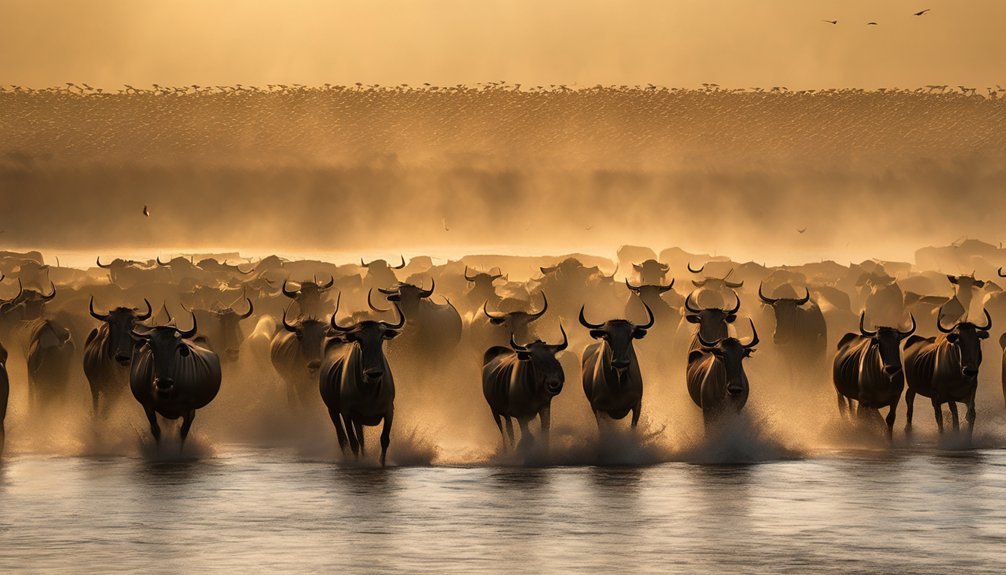
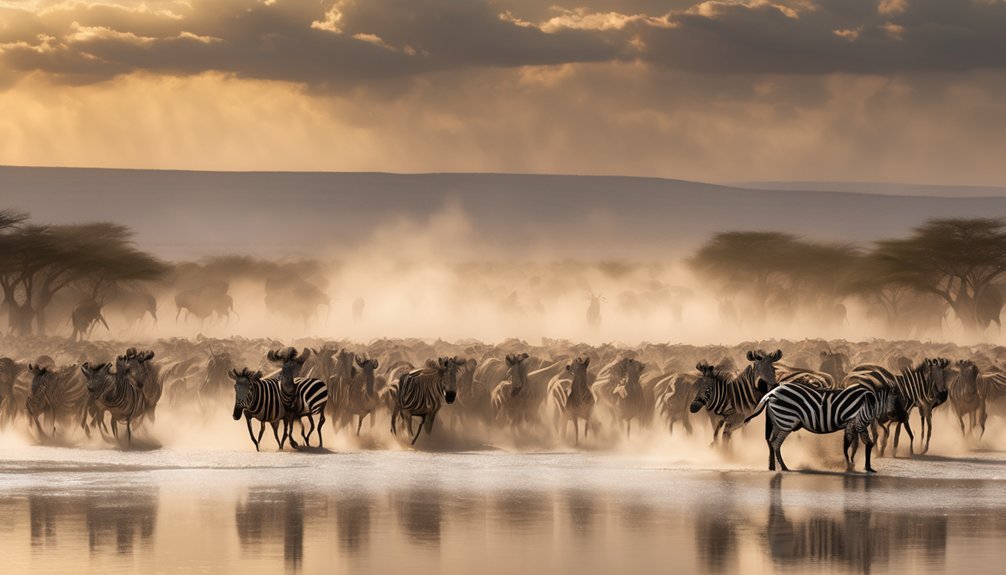
When seasonal rains shift across the Serengeti, more than a million wildebeest begin a circular migration shaped by rainfall, grass growth, and predator pressure.
You can track this movement as herds spread into short-grass plains, then converge toward river corridors when forage declines. Their wildebeest behavior is highly responsive: individuals adjust direction, speed, and grouping density to exploit fresh grazing while reducing calf vulnerability.
Migration timing depends on local precipitation, not a fixed calendar, so herds can advance or pause for weeks.
You’ll notice synchronized calving, intense social cohesion, and frequent crossings of dangerous waters, all of which reflect adaptive decision-making.
This system sustains population health, disperses nutrients, and links habitats across the ecosystem with remarkable precision and endurance.
Monarch Butterfly Migration Across North America
Like large mammal migrations, the monarch butterfly migration across North America is driven by shifting seasonal resources, but it operates through a far more delicate biological program.
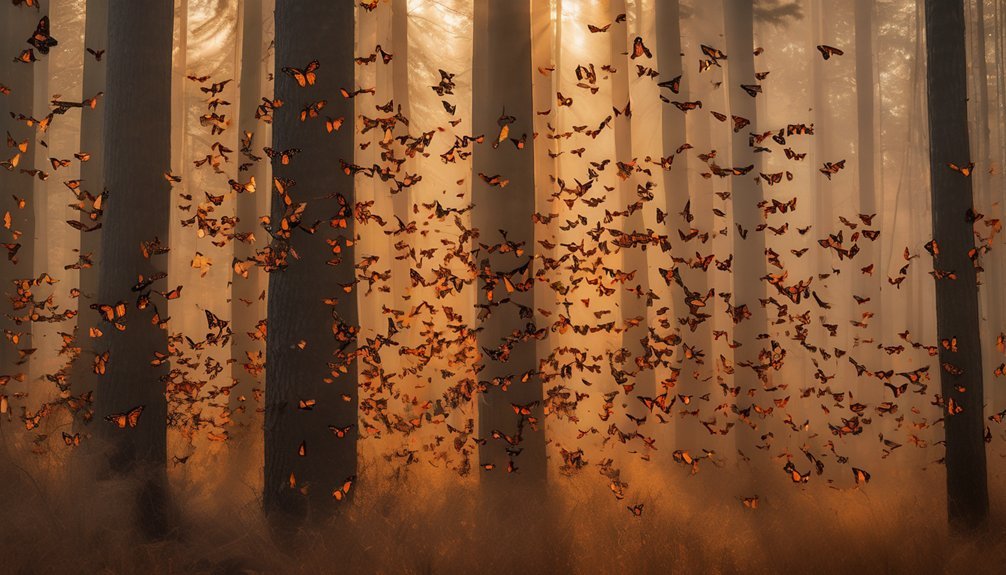
You can trace this journey from breeding grounds in the United States and southern Canada to overwintering forests in central Mexico, where cool, stable conditions reduce energy loss.
The monarch lifecycle shapes the route: summer generations reproduce quickly, while late-season adults delay reproduction and enter a migratory state.
You’ll notice that navigation depends on sunlight, circadian timing, and magnetic cues, all guiding a flight of remarkable precision.
Because this system is fragile, habitat preservation matters; milkweed supports larvae, and nectar plants sustain adults across the corridor.

Without connected landscapes, you’d lose the migration’s continuity and resilience.
Arctic Tern Migration From Pole to Pole
Arctic terns complete one of the longest annual migrations on Earth, traveling from Arctic breeding colonies to Antarctic feeding grounds and back again each year. You can trace their route across nearly 40,000 kilometers, guided by celestial cues, wind patterns, and perhaps Earth’s magnetic field.
In summer, you watch them exploit abundant light and rich marine prey near their breeding grounds; in winter, they follow the Antarctic pack ice edge, where productivity stays high. Their journey demands extreme endurance, efficient flight, and precise timing.
You should note that environmental challenges, including storms, changing sea-surface temperatures, and shifting prey distributions, can alter their energy budgets and survival. This migration links two polar ecosystems and reveals how finely tuned long-distance movement can be.
Humpback Whale Migration Through the Oceans
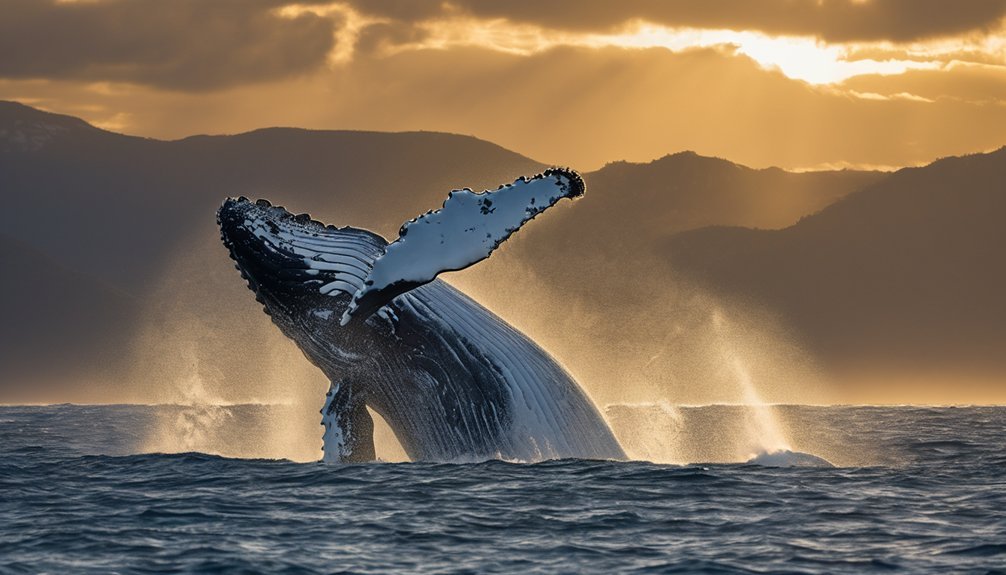
Humpback whales undertake seasonal migrations that can span thousands of kilometers between high-latitude feeding grounds and tropical or subtropical breeding areas. You can trace this cycle in two main phases.
| Phase | Key feature |
|---|---|
| Feeding | High-latitude waters |
| Migration | Long-distance travel |
| Breeding | Warm, low-latitude waters |
| Behavior | Reduced feeding |
| Communication | Humpback song patterns |
You’ll notice that adults accumulate energy in rich feeding grounds by consuming krill and small fish, then move toward warmer seas to breed and calve. During this journey, they often travel alone or in loose groups, and they may fast for extended periods. Their humpback song patterns change seasonally, with males producing elaborate vocal sequences in breeding areas. This migration reflects strong energetic trade-offs and supports reproduction across ocean basins.
How Animals Navigate Long Distances
To travel across oceans, deserts, and continents, animals rely on a combination of sensory cues and internal navigation systems that help them maintain direction over long distances.
You can observe celestial navigation in birds, sea turtles, and insects, which use the sun and stars as stable references. Environmental cues such as wind, currents, odors, and landmarks refine each route, while magnetic fields give many species an added compass.
Your animal traveler also uses topographical awareness to track coastlines, rivers, and mountain ranges. Seasonal triggers synchronize movement with food, breeding, and climate.
Much of this skill comes from instinctual behavior, but social learning can improve accuracy in young animals. Through sensory adaptation, their nervous systems stay tuned to changing conditions, allowing precise, efficient migration.
Frequently Asked Questions
Which Migration Is the Fastest on Record?
The fastest recorded migration is likely the Arctic tern’s, and you’ll find its migration speed astonishing. It flies from pole to pole yearly, demonstrating exceptional animal endurance through vast, energy-intensive, long-distance travel.
Do Any Animals Migrate Without Sleeping?
Yes—you can find animals that migrate with little or no sleep, like some birds and marine species. They use nocturnal travel and energy conservation to stay alert, limiting rest while sustaining long-distance movement.
How Do Young Animals Learn Migration Routes?
You’d see young animals learn routes through instinctual navigation, which guides initial orientation, and social learning, where parents or herds reinforce paths, landmarks, timing, and stopovers, improving accuracy as experience accumulates over successive migrations.
What Migration Is Most Dangerous for Animals?
You’d find the most dangerous migrations vary, but you’d often see river crossings or long ocean passages posing extreme risk, with predator encounters, environmental hazards, food scarcity, and navigational challenges sharply increasing mortality.
Can Climate Change Alter Migration Timing?
Yes—climate change can shift migration timing. Like a drummer missing one beat in a 1,000-mile journey, warming alters seasonal shifts, reshapes migration patterns, and changes animal behavior; you’ll see climate impact ripple through ecosystems.
Conclusion
When you trace these migrations, you see evolution working like a precise mapmaker, refining endurance, timing, and navigation. A bar-tailed godwit can fly more than 11,000 kilometers without landing, while an Arctic tern may travel about 40,000 kilometers each year. You can think of each journey as a biological equation, where energy, environment, and behavior must balance exactly. In that balance, you find not just survival, but the measurable architecture of life on Earth.