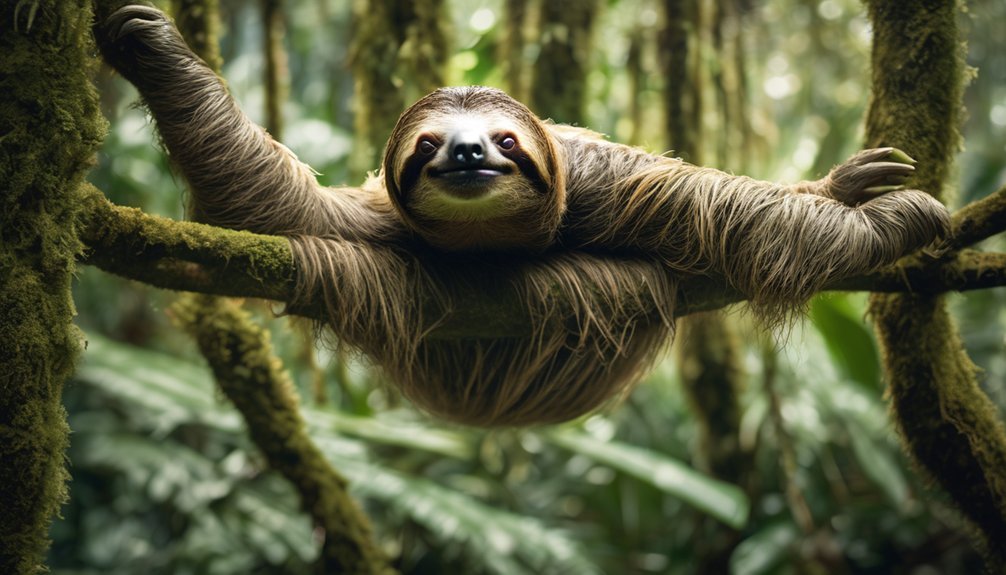
If you watch a sloth move, you see a body tuned for saving energy, not for speed. Its low metabolic rate, weak muscle power, and leaf-heavy diet all limit how fast it can act. You might think this makes it vulnerable, but its slow, quiet motion also helps it avoid predators. The real reason becomes clearer when you look at how its anatomy works in the canopy.
Key Takeaways
- Sloths are built for conserving energy, with low metabolic rates that reduce the need to move quickly.
- Their leafy diet provides little energy, so they must move slowly to avoid wasting calories.
- They have fewer fast-twitch muscle fibers, making deliberate climbing and movement less powerful.
- Slow, quiet movement helps them avoid predators by staying less noticeable in the canopy.
- Their long limbs and curved claws are adapted for hanging and gripping trees, not for speed.
Why Sloths Move So Slowly
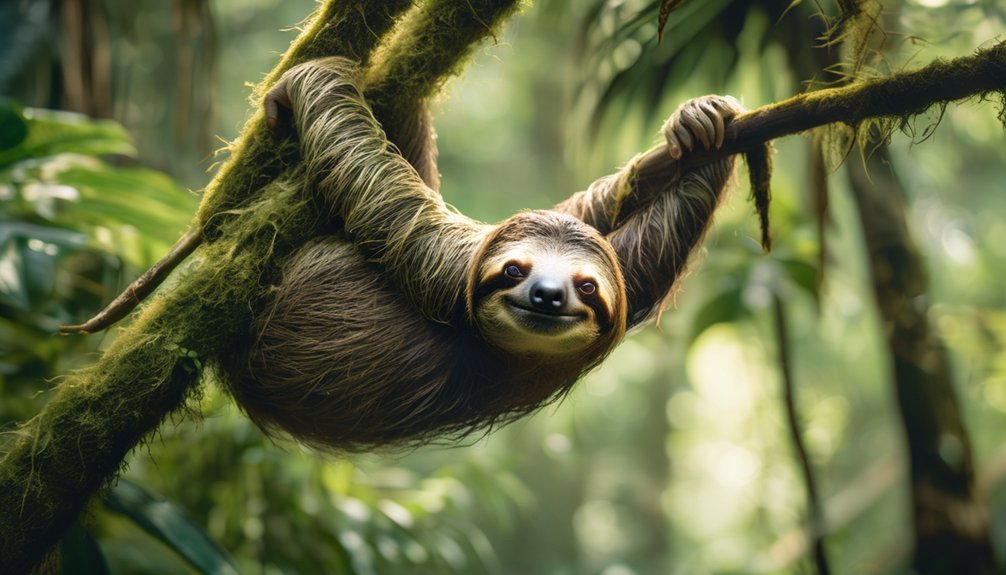
Sloths move slowly because their bodies are built for conserving energy rather than for speed. You can see this slow movement in their muscles, which generate limited force and suit deliberate climbing.
Sloths move slowly because their bodies are built for conserving energy, with muscles suited to deliberate climbing.
Their long limbs, curved claws, and low muscle mass help them hang securely in trees, but they don’t support rapid motion. This evolutionary adaptation matches a lifestyle centered on leaves, which provide little energy and nutrient value.

When you watch a sloth, you’re seeing an animal shaped by selection to move just enough to survive, not to chase, flee, or roam widely.
Even their cautious steps reduce risk on thin branches, where a sudden movement could cost them balance, safety, and precious energy.
How Sloths’ Bodies Save Energy
With a low metabolic rate and tightly controlled body temperature, they conserve energy throughout the day. You can see how your body would benefit from this strategy:
- Your metabolic rate stays unusually low, so cells demand less fuel.
- Your muscle structure contains fewer fast-contracting fibers, which reduces power output and energy use.
- Your organs work slowly, matching a minimal daily budget.
- Your nervous system limits unnecessary movement, so you don’t waste calories.
This design lets you remain suspended in trees with little strain, and it keeps oxygen use modest.
You may notice that every trait supports efficiency, not speed. Together, these adaptations make sloths experts at saving energy while living in a challenging canopy environment.
Why a Sloth’s Diet Keeps It Slow

A sloth’s slow pace also comes from what it eats. You’re looking at an animal that survives mostly on leaves, and leaves supply very little usable energy. Your body would need far more fuel to move quickly, but a sloth’s digestive system is built for leaf digestion, not speed.
It breaks down tough plant fibers slowly, so nutrients enter the bloodstream at a measured rate. Because the diet is low in calories, the animal must practice strict energy efficiency and avoid wasting fuel. You can think of each movement as an investment it can’t afford to rush.
Even its metabolism stays low to match this limited intake. That tight match between diet and metabolism helps keep a sloth deliberate, calm, and remarkably slow.
How Slowness Helps Sloths Avoid Predators
Although sloths move slowly, that pace can reduce their chances of being noticed by predators in the canopy. You can see this as a key part of sloth adaptations: less motion means fewer visual cues for hawks and other hunters to track.

Their deliberate movements also lower vibration and noise, which supports predator avoidance.
- You stay still longer, making detection harder.
- You move in smooth, predictable ways that don’t draw attention.
- You conserve energy, so you can remain inactive when danger is near.
- You reduce sudden signals that might trigger a chase.
This strategy isn’t perfect, but it gives you a measurable survival advantage. By blending slow behavior with camouflage and minimal movement, sloths limit risk without needing speed.
How Sloths Live in the Canopy

Sloths spend nearly their entire lives in the canopy, where they hang, climb, and feed among tree branches high above the ground. You can think of this canopy habitat as a three-dimensional network that offers food, shelter, and safety.
Their curved claws and strong grip show a clear tree adaptation, letting them move efficiently without dropping to the forest floor. You’ll notice they select leaves, buds, and tender shoots from nearby branches, conserving energy by minimizing movement.
Their slow pace also reduces detection by predators and helps them match their body temperature to the surrounding air. In this elevated world, you’re seeing a mammal specialized for life overhead, where anatomy, behavior, and habitat fit together with remarkable precision.
Frequently Asked Questions
Do Sloths Sleep All Day?
No, you don’t sleep all day; sloths typically sleep 15–20 hours daily. You’ll see sleep patterns shaped by energy conservation, low-calorie diets, and slow metabolism, which help them survive in rainforest canopies.
How Long Do Sloths Live?
You’ll usually find a sloth lifespan of 20 to 30 years in the wild, while captive animals can live longer. Their sloth habitat, health, and predation risk strongly influence survival and longevity.
Can Sloths Swim Fast?
No, you won’t see a sloth sprinting through water, but imagine its slow strokes? In sloth swimming, you’ll find surprisingly efficient aquatic adaptations: they can outswim many mammals, using long limbs and buoyant bodies.
Are Sloths Related to Armadillos?
Yes, you’ll find sloths are related to armadillos: both belong to Xenarthra. During sloth evolution, armadillo similarities include specialized vertebrae, reduced teeth, and ancient South American ancestry, though each lineage adapted differently.
How Do Baby Sloths Learn to Climb?
You’d watch a baby sloth cling like a tiny green scarf, learning climbing techniques through instinct, muscle practice, and infant bonding with its mother, who guides grips, branch choice, and safe movement in the canopy.
Conclusion
So, you can see why sloths take life at such a measured pace. Their bodies are tuned to save energy, their leaf-heavy diet provides only modest fuel, and their muscles are built for endurance, not haste. That unhurried movement also helps keep them out of sight and sound from predators. In the canopy, their long limbs and hooked claws fit a tree-dwelling life perfectly, making slow and steady a smart survival strategy.