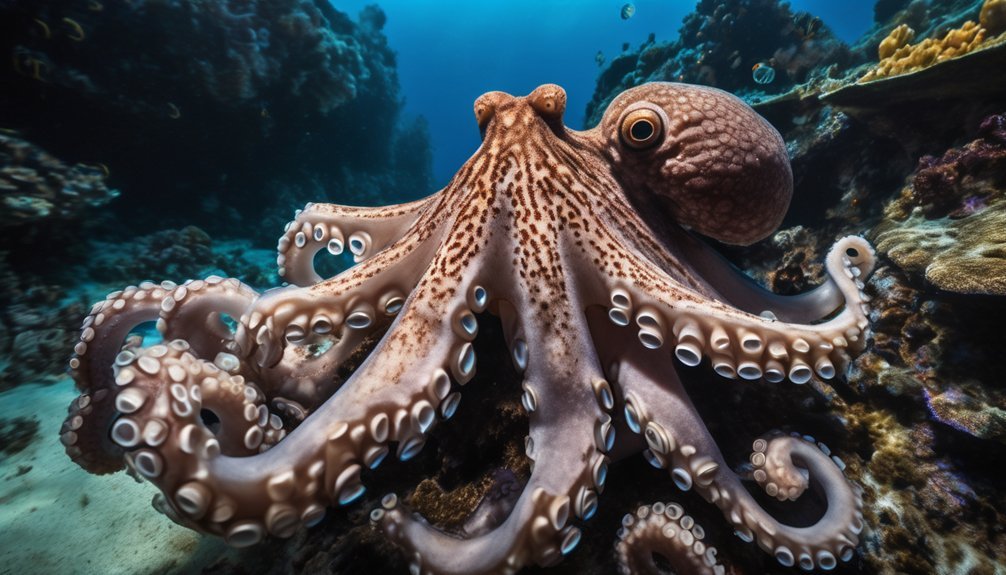
If you watch an octopus under threat, you’ll see a defense system that works fast and in layers. It can change color and texture to match its surroundings, fire an ink cloud, and slip into gaps that seem far too small for its body. You’ll also notice how its arms move independently, helping it probe, distract, and escape. But these tactics only begin to explain why so few predators catch it.
Key Takeaways
- Octopuses use rapid problem-solving and flexible bodies to slip through tiny gaps and evade capture.
- They change color and skin texture instantly to blend into their surroundings and avoid being seen.
- Specialized skin cells and muscle control let them match light, patterns, and textures in real time.
- They release ink clouds to confuse predators, masking vision and chemical tracking while they escape.
- They combine camouflage, jet propulsion, and sudden behavior changes to outmaneuver different predators.
Why Octopuses Are So Hard to Catch
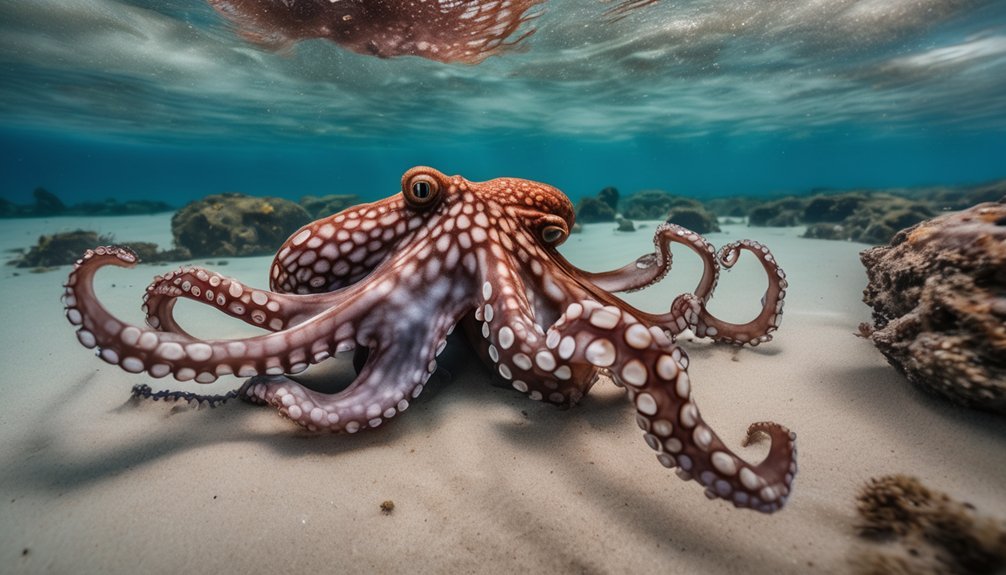
Octopuses are hard to catch because they combine rapid problem-solving with an unusually flexible body. You face an animal that can squeeze through gaps barely larger than its beak, shift shape in seconds, and exploit every opening in a reef or seafloor.
Its nervous system supports fast decisions, so it can adjust hunting strategies and escape routes while it’s still in motion. You also meet strong predator awareness: the octopus detects pressure changes, touch, and movement, then reacts before a threat closes in.
Each arm acts with partial independence, letting the animal probe, anchor, and pull itself free with remarkable control. That mix of intelligence, body compliance, and sensory vigilance makes capture difficult for you, even when you know where it’s hiding.
How Octopuses Use Camouflage to Disappear
With remarkable speed, these animals alter both color and skin texture to match their surroundings, making them hard to detect on coral, sand, rock, or algae-covered surfaces.

With remarkable speed, these animals change color and texture to blend seamlessly into coral, sand, and rock.
You can think of this camouflage as a precise defense that reduces predator detection before an attack begins. Their color adaptation depends on specialized skin cells that reflect light in ways that mimic nearby patterns, while visual perception helps them assess the background in real time.
When you watch an octopus in place, you’re seeing a body that blends with the environment so effectively that edges, shadows, and outlines fade.
This strategy doesn’t hide them perfectly, but it lowers the chance that a predator will notice movement, shape, or contrast soon enough to strike.
How Octopuses Change Color and Texture
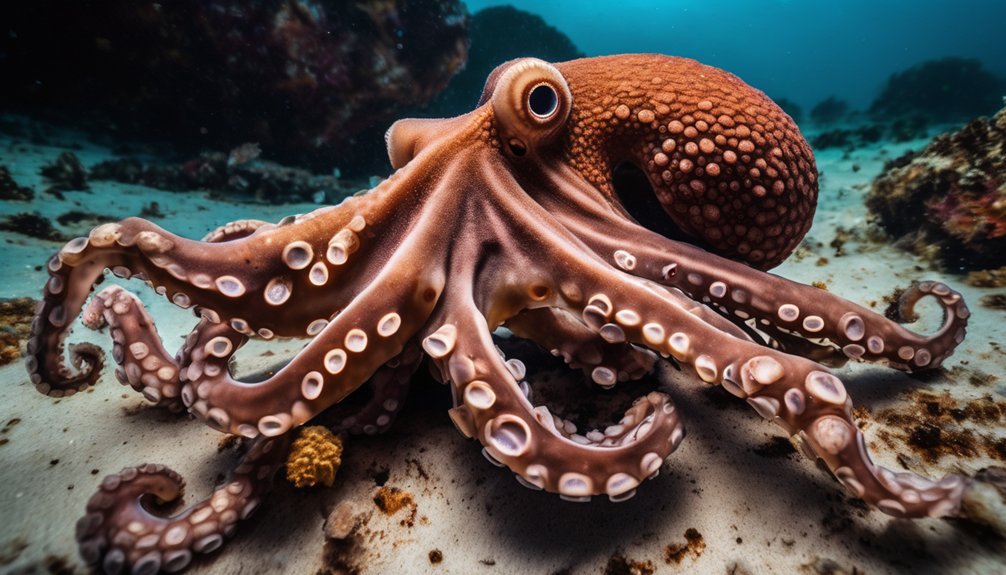
To change color and texture, an octopus uses a layered system of skin cells that respond in fractions of a second. You can see its color changing mechanisms begin with chromatophores, pigment sacs that expand or contract under neural control.
Beneath them, reflective cells and light-scattering layers fine-tune brightness and hue. At the same time, muscular control reshapes the skin into bumps or smooth fields, giving you texture adaptation that matches rock, coral, or sand.
- Chromatophores shift pigment rapidly.
- Reflective cells alter light return.
- Muscles raise papillae for texture.
This coordinated system lets you read an octopus’s body as a dynamic surface, not a fixed pattern. You’re seeing precise biology, not trickery.
The Ink Cloud Escape Tactic
When threatened, an octopus can eject a dense cloud of ink from an ink sac near the digestive tract. You see a dark plume spread through the water, and it briefly obscures the predator’s vision and chemosensory cues.
The ink cloud contains melanin-rich particles and mucus, which help it stay coherent for a short time. You can think of this as an escape strategy that buys seconds, not minutes, for the octopus to retreat.
It often coordinates the release with a jet of water, so the animal moves away while the predator’s attention stays fixed on the cloud. This tactic doesn’t stun or poison the attacker; it simply disrupts detection and creates a narrow window for survival.
How Octopuses Slip Into Tiny Hiding Spots
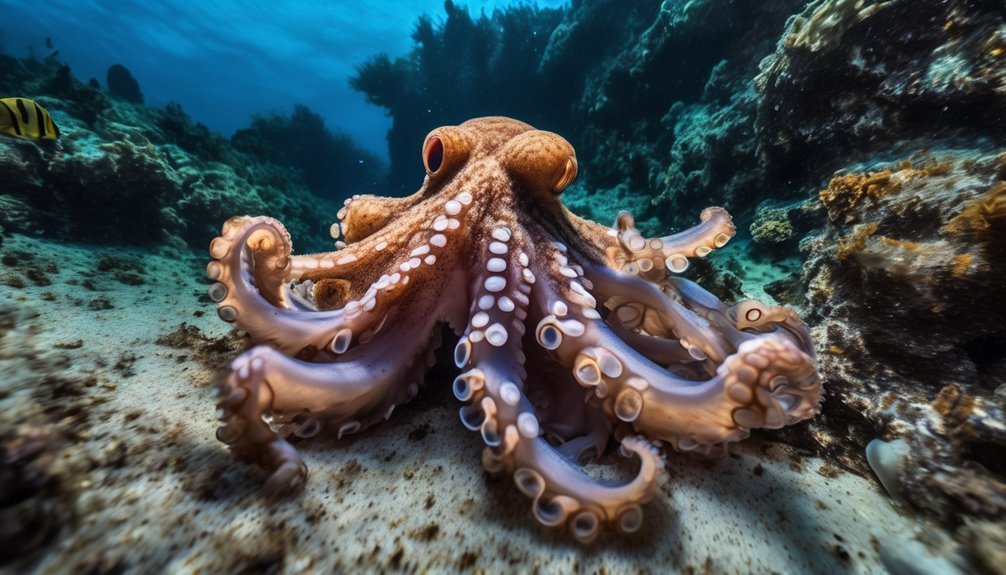
Octopuses can compress their soft, boneless bodies to enter crevices, shell fragments, and other narrow refuges that would exclude most predators. You can watch their flexible bodies flow through gaps only a few millimeters wide, because they lack rigid support and control each arm with remarkable precision.
Octopuses compress their boneless bodies to slip through tiny gaps, flowing into refuges most predators cannot enter.
Their sneaky movements help them slide under rocks, into empty gastropod shells, and deep inside coral rubble. This tactic works best when:
- the opening fits the widest part of the mantle,
- the substrate provides firm edges for leverage,
- the octopus stays motionless after entry.
Inside, you’re harder to detect, and your body can conform tightly to the cavity. This concealment reduces exposure, limits attack angles, and gives you time to remain safe.
How Octopuses Use Decoys and Distraction
Beyond hiding in tight spaces, octopuses also mislead predators with fast, controlled displays that shift attention away from their bodies.
You can watch them jet water, flash contrasting colors, or release ink to create a temporary visual screen. These decoy strategies don’t rely on force; they exploit a predator’s brief uncertainty.
When you see an octopus curl an arm or move a mantle edge, it may present a secondary target, encouraging a strike away from vital tissue.
Their distraction techniques work because they change what a hunter notices first, and they do it within seconds.

How Octopuses Outsmart Predators
Predators fail to catch octopuses because these animals combine concealment, speed, and behavioral flexibility in a coordinated defense.
Octopuses evade predators by blending concealment, speed, and quick behavioral shifts into one coordinated defense.
You can see octopus intelligence in how they read threats, match surroundings, and shift tactics within seconds. Their skin cells alter color and texture, letting them vanish against rock, coral, or sand.
When detection happens, they sprint by jet propulsion, then squeeze through gaps you’d think were impossible.
- Blend in before contact.
- Escape with rapid propulsion.
- Change posture or route instantly.
This predator avoidance strategy reduces attack success without wasting energy.
You’re observing a nervous system that links perception and action tightly, giving the octopus a precise, adaptive edge in dangerous waters.
Which Predators Octopuses Outsmart Most Often
Among the most frequent threats octopuses outsmart are fish such as moray eels, groupers, and wrasses, along with seabirds, sharks, and crustaceans.
You’ll notice these predators most often in shallow reefs, kelp edges, and tide pools, where octopuses forage and remain exposed.
Moray eel strategies usually involve probing crevices, yet octopuses often evade them by retreating into narrow shelters and changing posture quickly.
During shark encounters, you can see the octopus relying on its small size and brief bursts of movement to avoid being detected.
Groupers and wrasses target slower juveniles, while seabirds attack near the surface.
Crustaceans, especially large crabs, threaten arms and soft tissue.
In each case, the octopus responds with rapid, precise escape behavior.
How Octopus Defense Tactics Work Together
Those escapes work best because octopuses rarely depend on just one defense at a time. You see a coordinated sequence: camouflage slows detection, body flexibility squeezes you through narrow gaps, and ink release disrupts a predator’s tracking. Together, these tactics create time and confusion, which increases survival odds.
- Camouflage matches the background and reduces visual targeting.
- Body flexibility lets you compress, twist, and exit quickly.
- Ink release forms a chemical and visual screen that masks movement.
When you observe the response closely, you notice each tactic complements the others. If one fails, another still protects you.
This layered system makes the octopus a remarkably effective escape specialist in close encounters with fish, eels, and larger cephalopods.
Frequently Asked Questions
How Long Can an Octopus Stay Hidden From Predators?
An octopus can stay hidden from predators for minutes to hours, sometimes longer, depending on habitat and threat level. You’ll see it use camouflage techniques and predator evasion to remain undetected.
Do All Octopus Species Defend Themselves the Same Way?
No, you won’t see all octopuses defend alike; like one painter choosing different brushes, species vary. Camouflage techniques, Ink release, Behavioral adaptations, and Predator awareness differ by habitat, size, and threat, so tactics aren’t universal.
Can Octopuses Recognize Specific Predators?
Yes, you can say octopuses show predator awareness, recognizing specific threats and adjusting camouflage techniques accordingly. They don’t identify every predator equally, but they often learn from experience and respond more precisely to repeated danger.
How Do Octopuses Learn Their Escape Strategies?
You learn through octopus intelligence: you observe threats, test routes, and refine problem solving after each escape. Like a clockwork scholar, you adapt quickly, using memory, sensory cues, and trial-and-error to evade predators.
Do Young Octopuses Use the Same Defenses as Adults?
Yes, you’ll see young octopus defenses differ somewhat from adults. Young octopus defenses rely heavily on juvenile camouflage, rapid hiding, and ink release; adults also use posture changes, threat displays, and stronger escape tactics.
Conclusion
In the end, you can see that octopuses outsmart predators by combining camouflage, rapid movement, ink release, and remarkable flexibility. These defenses do more than hide them; they create multiple, overlapping chances to survive. You might think such tactics are purely instinctive, but octopuses also show learned, adaptive behavior that improves their responses. Together, these traits make them unusually difficult for predators to detect, capture, or удержать.