
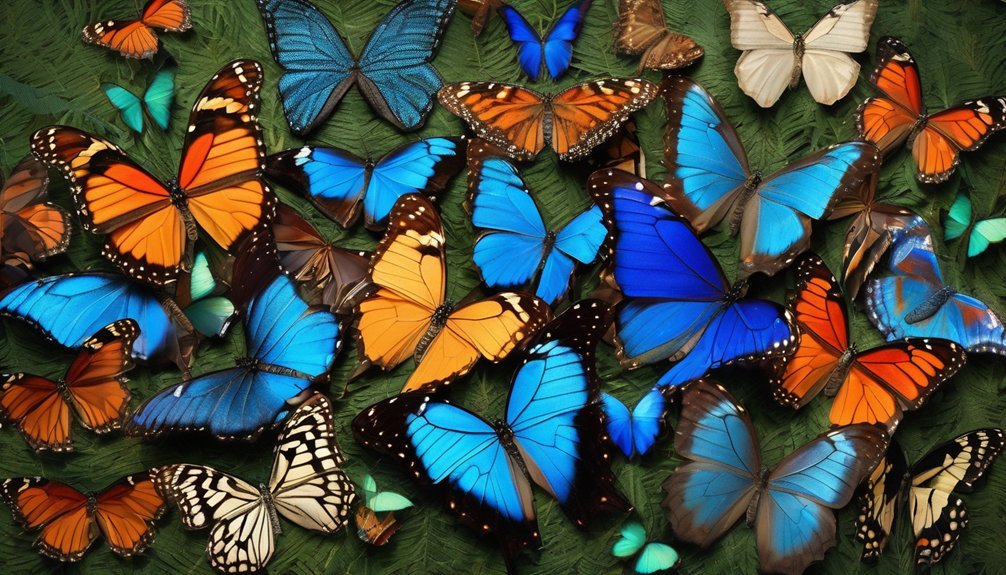
Around 20,000 butterfly species exist worldwide, yet only a handful consistently rank among the most visually striking. You can spot beauty in the Blue Morpho’s iridescence, the Monarch’s warning colors, and the Glasswing’s transparent wings, but each species uses its patterns for more than display. Their colors signal adaptation, habitat, and survival. As you compare these forms, one question remains: which butterfly truly defines beauty in nature?
Key Takeaways
- Butterfly beauty comes from vivid colors, symmetry, wing shapes, and striking contrasts that make many species visually extraordinary.
- The Blue Morpho stands out with electric blue, iridescent wings that flash brilliantly in tropical forest light.
- Monarch butterflies are famous for orange-and-black wings and their remarkable long-distance migration.
- Glasswing butterflies look unique because their transparent wings help them blend into humid forest habitats.
- Asian Birdwing butterflies are prized for their large size, bold patterns, and dramatic appearance, especially in females.
What Makes Butterflies Beautiful?
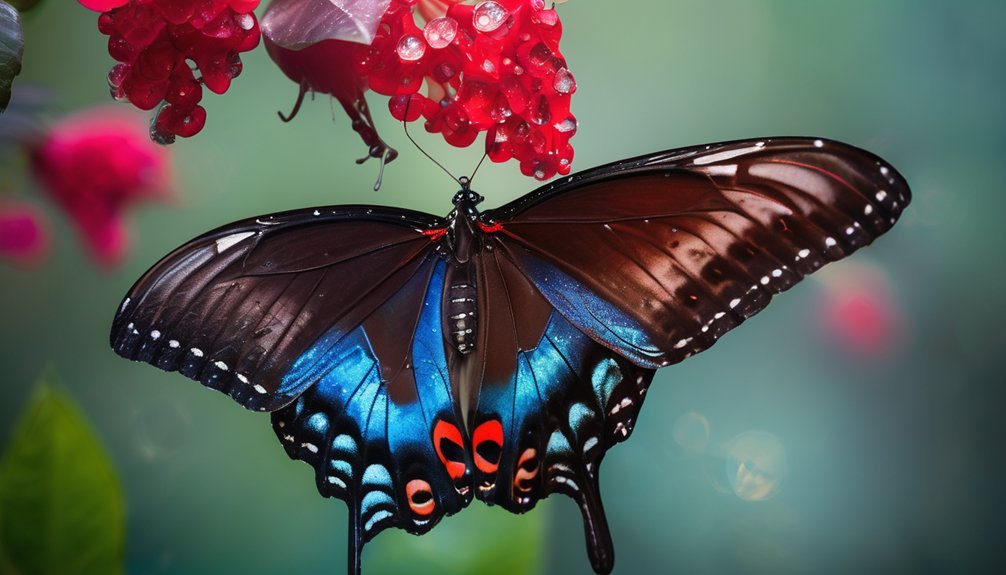
Butterflies are beautiful because of the striking combination of color, symmetry, and motion in their wings. You notice that color patterns come from pigments and microscopic scales that reflect light in precise ways. These scales create sharp contrasts, gradients, and iridescence, so each wing can seem vivid from close up.
You also see how wing shapes influence beauty: rounded, angular, or elongated outlines change how a butterfly appears in flight and at rest. Symmetry matters too, because matching left and right wings gives you a sense of balance and order.
When a butterfly moves, its wings flash briefly, and that motion intensifies visual appeal. Together, these traits make butterflies scientifically fascinating and personally captivating.

Blue Morpho Butterfly
Among the world’s most striking butterflies, the Blue Morpho stands out for its electric blue wings and broad, reflective scales. You’ll notice that the color isn’t pigment; microscopic structures scatter light, so the sheen shifts as it moves.
In the morpho habitat, you’ll usually find humid tropical forests where the canopy filters sunlight and supports host plants for larvae. Its morpho behavior is cautious: it often stays high, gliding with slow wingbeats, then flashes its wings to startle predators.
- You can spot it by the sudden blue flash.
- You’ll see it rest with wings closed, showing brown undersides.
- You may admire how its flight conserves energy in dense forest air.
Monarch Butterfly
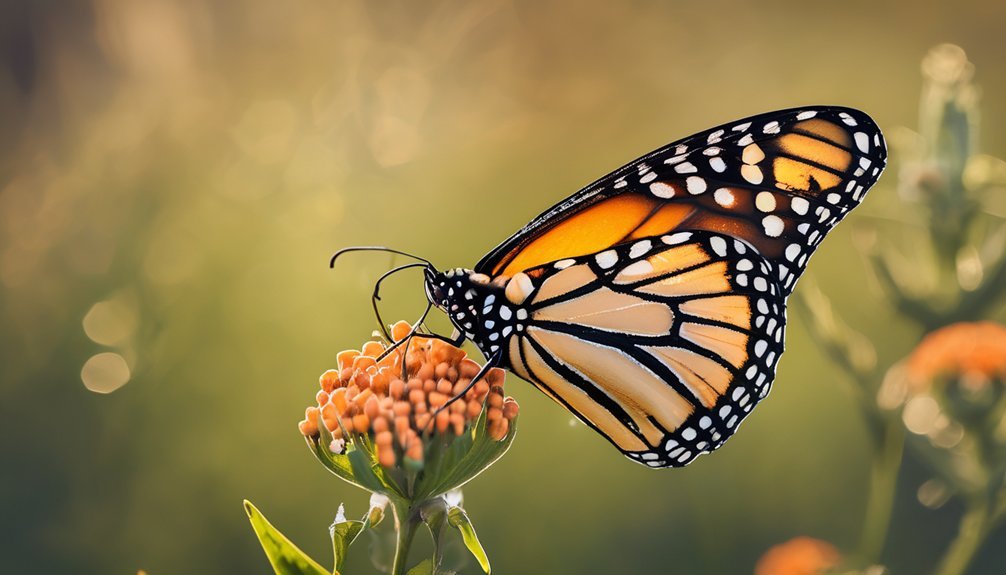
The Monarch butterfly is one of the most well-known migratory butterflies, recognized by its orange wings bordered with black and dotted with white spots. When you watch one glide by, you’re seeing a species shaped by long-distance travel and seasonal change.
During monarch migration, adults can journey thousands of kilometers, using environmental cues to orient themselves with remarkable accuracy.
You’ll also notice that the monarch lifecycle includes egg, larva, pupa, and adult stages, each essential to survival and reproduction. Caterpillars feed on milkweed, which provides the chemicals that help protect them from predators.
Because of this specialized relationship, monarchs depend on healthy habitats across their range. Their beauty isn’t only visual; it reflects adaptation, endurance, and ecological precision.
Glasswing Butterfly
With its transparent wings edged in soft brown, the Glasswing butterfly offers a striking example of how structure can shape survival.
You’ll find this species in humid forests, where the glasswing habitat provides filtered light and dense understory cover. Its clear wings reduce visibility, helping it avoid predators while it feeds on nectar and moves slowly among leaves.
Glasswing behavior is calm and deliberate; you won’t see rapid, erratic flight. Instead, it glides carefully, conserving energy.
- You can spot it resting with wings closed, nearly invisible.
- You may notice larvae feeding on toxic plants for protection.
- You’ll appreciate how camouflage supports its delicate life cycle.
Asian Birdwing Butterfly
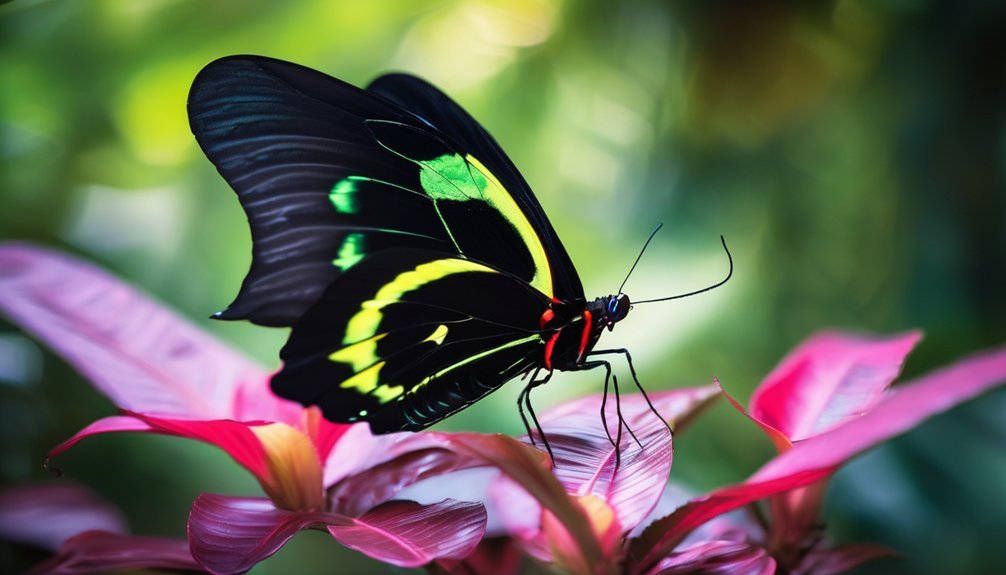
Although many butterflies rely on subtle camouflage, the Asian Birdwing butterfly stands out for its large size and vivid wing patterns. You’ll notice females can exceed many relatives in wingspan, while males show strong iridescent contrast. In Asian Birdwing Habitats, you’ll find them in lowland forests, forest edges, and river valleys with host vines. Their larvae feed on specific Aristolochia plants, so habitat quality matters.
| Trait | Note | Value |
|---|---|---|
| Wingspan | Female often larger | Up to 180 mm |
| Coloration | Bold black, green, yellow | High visibility |
| Habitat | Forest margins | Moist tropical zones |
| Diet | Larvae on Aristolochia | Specialized |
| Status | Sensitive to loss | Asian Birdwing Conservation |
For Asian Birdwing Conservation, you should protect host plants and limit deforestation.
Purple Emperor Butterfly
Perched high in European woodlands, the Purple Emperor butterfly often seems to vanish into the canopy until sunlight catches its wings, revealing a rich violet sheen in males and a brown, more cryptic pattern in females.
When you watch a purple emperor, you’ll notice strong flight and a preference for oak-rich forests, where sap runs, damp soil, and aphid colonies support its life cycle. Its habitat preferences include tall trees, sunny clearings, and sheltered rides that warm quickly.

- You may spot males descending to feed on mineral-rich mud.
- You’ll often find them circling treetops rather than flowers.
- You can identify them by their assertive, gliding flight and pale wing bands.
Emerald Swallowtail
Among the most striking tropical swallowtails, the Emerald Swallowtail glows with iridescent green wings edged in black, making it one of the most recognizable butterflies in Southeast Asia.
You can identify its emerald coloration by the way microscopic scales reflect light, producing a metallic sheen that shifts with your viewing angle. This species belongs to the genus Papilio and often inhabits tropical habitats such as lowland forests, mangroves, and woodland edges.
You’ll notice its strong flight and broad wings, which help it move efficiently through warm, humid air. Adults feed on nectar, while larvae rely on citrus family plants.
If you observe one closely, you’ll see a butterfly finely adapted to bright, dense environments, where camouflage and display work together beautifully.
Common Jezebel Butterfly
The Common Jezebel butterfly is a vivid pierid found across South and Southeast Asia, where its pale yellow or white wings are marked with bold black and red patterns.
You’ll notice its Jezebel Behavior includes quick, graceful flight and frequent nectar feeding, which supports its high energy needs. Its Habitat Preferences favor gardens, open woodlands, forest edges, and lightly disturbed areas with flowering plants.
- You can identify it by the striking crimson patches on the hindwings.
- You’ll often see it basking with wings half-open, regulating body temperature efficiently.
- You may also observe females selecting host plants with care, showing precise reproductive behavior.
This butterfly’s vivid colors likely signal unpalatability, helping deter predators while enhancing its scientific appeal.
Where to Find Them in the Wild
You can find Common Jezebels in warm, lowland habitats across South and Southeast Asia, especially where flowering plants are abundant and host plants are available for breeding.
You’ll often see them along forest edges, roadside verges, gardens, and open scrub where sunlight reaches nectar sources. In these butterfly habitats, they feed close to treetops and return regularly to favored perches.
Watch for their steady, gliding flight at dawn and late afternoon, when activity peaks. Their migration patterns can shift with seasonal rains, so local abundance may change through the year.
If you’re searching in the field, scan for red, yellow, and white wing flashes near lantana, ixora, or other blooms. Careful observation of plants and weather will improve your chances.
Frequently Asked Questions
How Do Butterflies Develop Their Colorful Wing Patterns?
You see butterfly wing patterns develop from genes controlling wing pigmentation and scale structure during metamorphosis. These patterns can signal mates, warn predators, and aid camouflage, giving them strong evolutionary significance.
What Do Butterflies Eat Besides Nectar?
You’ll find butterflies also eat fruit sources, plant sap, decaying matter, and mineral sources like wet soil or puddles. These foods supply sugars, amino acids, and salts they need for energy, reproduction, and survival.
How Long Do the Most Beautiful Butterflies Live?
Under the weather? You’ll find most beautiful butterflies live about 2–4 weeks, though some species reach 6 months. Your butterflies’ mating behaviors and habitat preferences strongly shape survival, feeding, and reproduction.
Are Butterfly Colors Affected by Climate?
Yes, climate can affect butterfly colors. You’ll see climate adaptation shaping pigments and patterns through color evolution, helping butterflies regulate temperature, camouflage, and communicate more effectively in different environments.
Can Butterfly Wings Heal After Damage?
No, you generally can’t expect full wing regeneration. During the healing process, you may see minor membrane repair, but damaged scales and structural tears usually remain. You’ll still observe reduced flight efficiency afterward.
Conclusion
When you look at these butterflies, you see beauty shaped by evolution, not chance. You can observe how iridescence, camouflage, and warning colors each serve distinct ecological functions. For example, about 17,500 butterfly species exist worldwide, yet only a small fraction match the Blue Morpho’s brilliance or the Glasswing’s transparency. If you spot them in the wild, you’re witnessing both visual artistry and vital pollinators that help sustain healthy ecosystems.