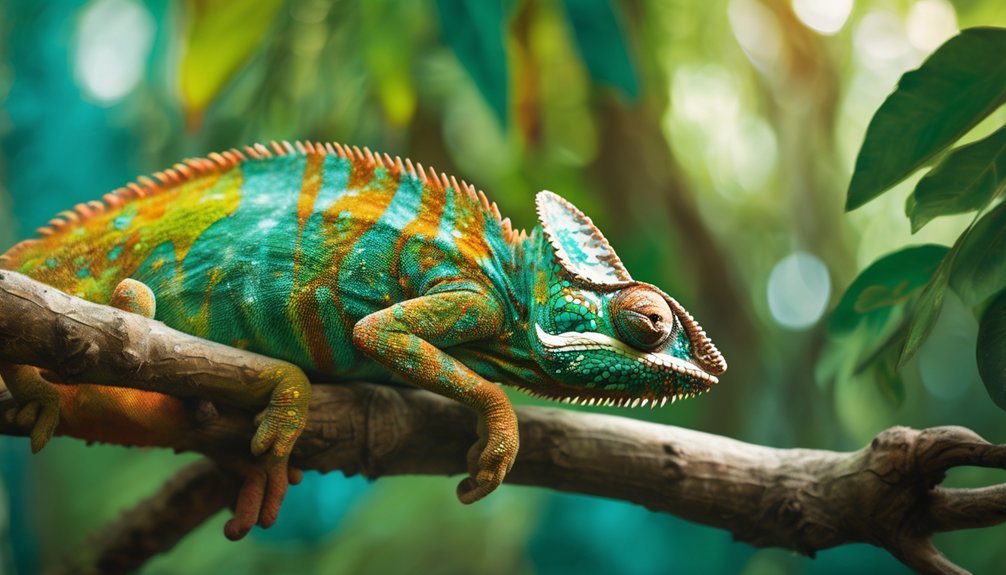
You probably don’t know that a chameleon’s color shift comes mostly from nanostructures in its skin, not just pigment cells. You can see the effect when iridophores and melanophores alter how light reflects and absorbs, while hormones and nerve signals adjust the process. These changes help with temperature control, signaling, and camouflage, but the real mechanism is more specific than most people think.
Key Takeaways
- Chameleons change color through specialized skin cells called chromatophores, iridophores, and melanophores that alter light reflection and pigment distribution.
- Color changes are triggered by temperature, light, stress, social interactions, and hormonal signals from the nervous system.
- Darker colors help absorb heat in cool conditions, while lighter colors reflect sunlight and prevent overheating.
- Chameleons use color to communicate during courtship, dominance displays, territorial threats, and predator deterrence.
- They do not perfectly match backgrounds on demand; color change is mainly for physiology and communication, not instant camouflage.
What Triggers Chameleon Color Change?
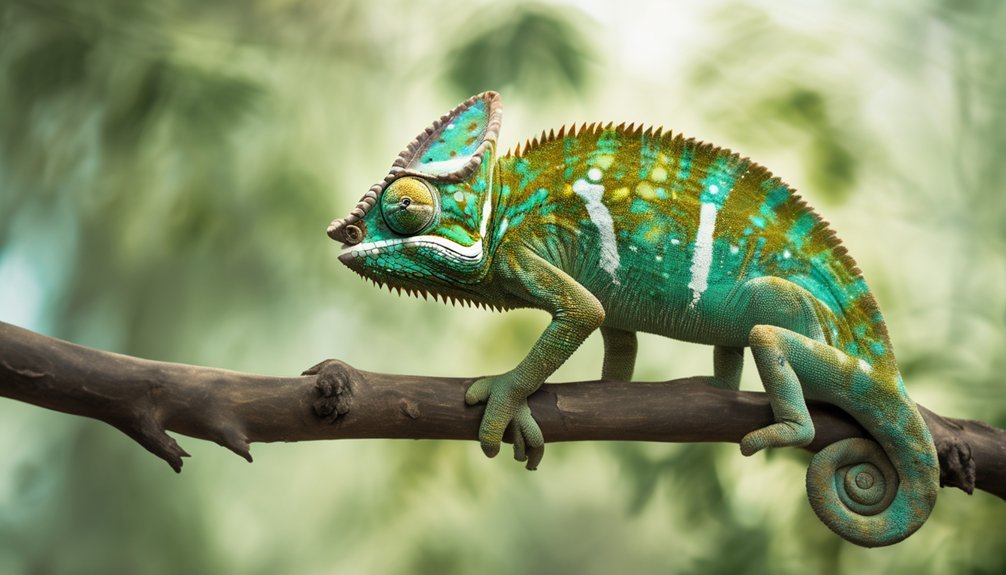
Chameleons change color in response to specific stimuli, not to match every background they encounter. You should think of color change as a regulated physiological response driven by color perception, environmental factors, hormonal changes, emotional responses, social interactions, and temperature regulation.
When light, shade, or thermal conditions shift, your chameleon’s nervous system can alter its skin state to manage heat balance. During courtship, rivalry, or stress, hormones and neural signals can intensify vivid patterns.
If another chameleon approaches, social interactions may trigger rapid display changes. Emotional responses, including threat or arousal, also contribute.

You’re seeing an integrated sensory and endocrine process, not random decoration. Each shift reflects internal status and external pressure, creating a precise signal that supports communication and homeostasis.
How Chameleon Skin Creates Color
Under the skin, specialized cells called chromatophores, iridophores, and melanophores work together to produce a chameleon’s visible color. You see color emerge as pigment cells in upper skin layers absorb and redistribute wavelengths, while deeper iridophores alter light reflection through nanoscale structures.
Environmental factors, including surrounding foliage and lighting, shape color perception by changing which wavelengths dominate. Melanophores add contrast, sharpening patterns and increasing visual precision.
This layered system gives you evolutionary advantages: camouflage, social signals, and rapid display without changing body form. Because the skin acts as an optical filter, each shift reflects a measured cellular response rather than simple pigment mixing.
You’re watching a finely tuned biological interface where structure, optics, and signaling converge.
How Chameleons Use Color to Control Temperature
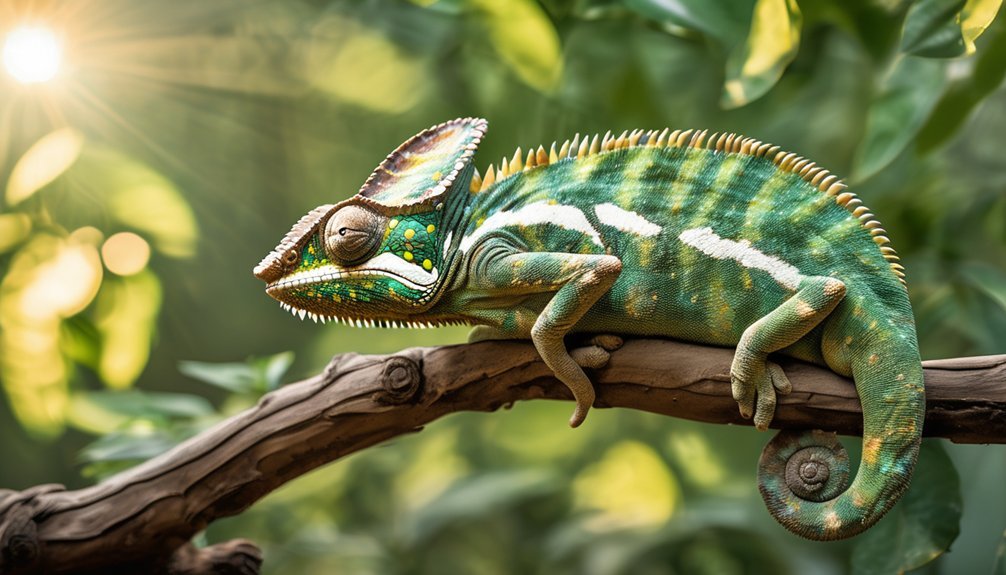
When sunlight shifts, a chameleon can adjust its skin color to help manage body temperature. You’re seeing temperature regulation in action: darker skin absorbs more radiant energy, while lighter skin reflects more. This behavioral adaptation lets you fine-tune heat gain without moving far from cover.
- Darken skin in cool morning air to raise tissue temperature faster.
- Lighten skin under intense sun to limit overheating and reduce thermal stress.
- Pair color shifts with posture changes, such as basking or shading, for precise control.
Your chameleon doesn’t rely on color alone; it integrates external heat, activity level, and ambient conditions. That tight control supports enzyme function, muscle performance, and overall survival in changing microclimates, all with remarkable efficiency.
How Chameleons Use Color to Communicate
Even more than temperature control, a chameleon’s color shift can signal its internal state to other animals. You read these color signals as part of its social interactions, because pigments and structural skin changes create precise visual cues.
During mating displays, males often intensify contrast to advertise fitness, while territorial displays can sharpen pattern edges to warn rivals. These shifts also help establish a dominance hierarchy, letting you infer which individual holds priority without direct contact.
In many species, subtle hue changes coordinate emotional states with body posture, so the message stays coherent. You can also see predator deterrence when bold patches flash abruptly, disrupting an attacker’s estimate of size or intent. In this way, color becomes a fast, efficient communication channel.
Do Chameleons Change Color When Stressed?
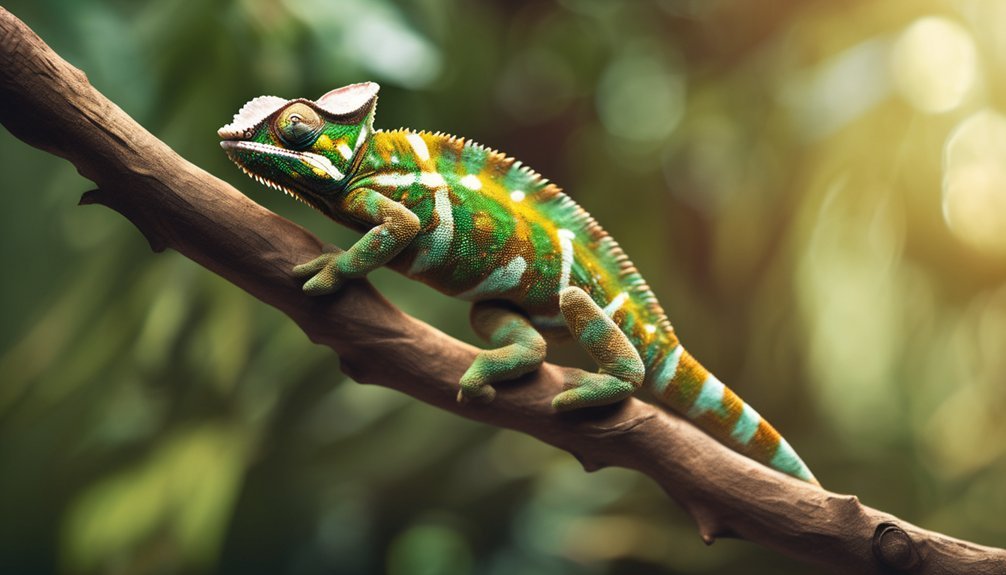
Yes—stress can trigger a chameleon color change, but the response depends on the species, the stimulus, and the animal’s physiological state. You’ll often see a stress response when body temperature, hydration, or threat level shifts.
In your chameleon, chromatophores adjust pigment dispersion, so skin tone can darken or lighten within seconds. This isn’t color psychology in the human sense; it’s a regulated physiological signal, not an emotional performance.
- Acute handling may elicit rapid darkening.
- Sustained stress can reduce vivid patterning.
- Hormonal and neural input modulate the change.
If you watch closely, you can read these shifts as diagnostic cues, helping you assess welfare with precision and care.
Do Chameleons Match Their Background?
Chameleons don’t perfectly match their background on demand, although some species can shift toward colors that improve concealment under certain conditions.

When you see one blend in, you’re often watching background adaptation shaped by light, temperature, mood, and social signals rather than a direct copy of nearby surfaces. Your eye may expect a leaf-for-leaf match, but chameleon color perception depends on internal skin cells and sensory input, not simple camouflage mimicry.
They sample their environment and adjust contrast, brightness, and hue to reduce visibility or communicate status.
How Fast Do Chameleons Change Color?
Color change in chameleons can happen surprisingly quickly, but the speed varies by species, context, and the type of change involved. You’ll often see noticeable shifts in seconds to minutes, because specialized skin cells rapidly alter reflected light. This color change speed helps you read chameleon adaptability under stress, temperature shifts, or social signaling.
- Neural input triggers pigment movement fast.
- Hormonal effects can sustain slower adjustments.
- Structural skin changes fine-tune brightness and hue.
You shouldn’t expect instant camouflage, though; deeper physiological transitions take longer than simple shade changes.
When you watch closely, you can see the animal’s skin respond like a dynamic optical system, balancing control, energy use, and communication. The result feels immediate, but it’s a measured biological process, not magic.
How Chameleon Color Change Varies by Species
Although all chameleons can alter skin color, the range, speed, and purpose of that change vary substantially by species. When you compare species differences, you’ll see that some display broad, rapid shifts, while others change more subtly.
Environmental factors such as temperature, light, and humidity shape the expression of color patterns, but each species filters those cues through its own sensory and pigment architecture. You may notice that territorial males often show vivid contrasts, whereas cryptic species rely on muted tones.
These behavioral adaptations reflect habitat demands, social signaling, and thermoregulation. In your observations, avoid assuming one mechanism fits all chameleons; their skin cells, neural control, and hormonal responses differ enough to produce distinct, species-specific outputs.
Common Myths About Chameleon Color Change
Many popular claims about chameleon color change are inaccurate. You need myth debunking, not folklore: chameleons don’t match every background, and camouflage beliefs overstate concealment. Their color shifts often reflect social signaling, stress, and light exposure, not simple invisibility.
- Color misconceptions: pigment cells and iridophore nanostructures alter reflected wavelengths.
- Temperature myths: warming or cooling can influence hue, but it isn’t the sole driver.
- Emotional triggers: threat, courtship, and dominance cues can rapidly change coloration.
You shouldn’t assume habitat assumptions explain every pattern; species, physiology, and context matter.
When you watch closely, you’ll see a precise physiological display system, not a magical mood ring.
Frequently Asked Questions
What Do Chameleons Eat?
You’d feed chameleons mainly insects—crickets, roaches, flies, moths, and grasshoppers—plus occasional small lizards. Their chameleon diet reflects strict carnivory, and their feeding habits rely on rapid tongue projection to capture prey accurately.
Where Do Chameleons Live?
You’ll find chameleons in lush treetop sanctuaries, arid scrub, and warm forests, where their habitat preferences and environmental adaptations suit climbing, camouflage, and thermoregulation. They don’t wander far, staying close to moisture and cover.
How Long Do Chameleons Live?
You’ll usually see a chameleon lifespan of 2-10 years, depending on species and conditions. Factors affecting longevity include diet, hydration, temperature, stress, and veterinary care; captive individuals often live longer than wild ones.
Do Chameleons Blink Independently?
Yes, chameleons can move each eye independently, giving you independent vision and precise eye movement control. You’ll see one eye scanning while the other focuses elsewhere, helping them detect predators and prey with remarkable efficiency.
Are Chameleons Good Pets?
No, chameleons aren’t easy pets: 60% of captive deaths stem from husbandry errors. You’ll need strict chameleon care, exact habitat requirements, UVB, humidity, and live prey. If you can’t maintain precision, you shouldn’t keep one.
Conclusion
You can now see chameleon color change as a living system, not a trick of the eye. Beneath the skin, chromatophores, iridophores, and melanophores shift reflected light like a controlled prism. You’ll notice their colors warming for heat, flashing for social signals, or darkening under stress. They don’t simply blend in; they respond. In each quick, shimmering transition, you’re watching biology, behavior, and survival working together in real time.