In the dark, not all eyes are equal. You can see how animals with exceptional night vision rely on rod-rich retinas, enlarged pupils, and tapetum lucidum to maximize photon capture at low luminance. Owls, cats, and other species use these adaptations to improve navigation, prey detection, and threat avoidance. Their visual systems raise a simple question: how far can biology push sight before daylight becomes unnecessary?
Key Takeaways
- Owls have extreme rod-dominant retinas and large pupils that maximize light capture in darkness.
- Cats use reflective tapetum lucidum and wide pupils to see and hunt effectively in low light.
- Many nocturnal animals, including bush babies and tarsiers, rely on dense rod cells for scotopic vision.
- Reflective eye layers boost sensitivity by sending photons back through the retina.
- Night vision helps animals navigate safely, avoid predators, and detect prey after sunset.
What Is Animal Night Vision?
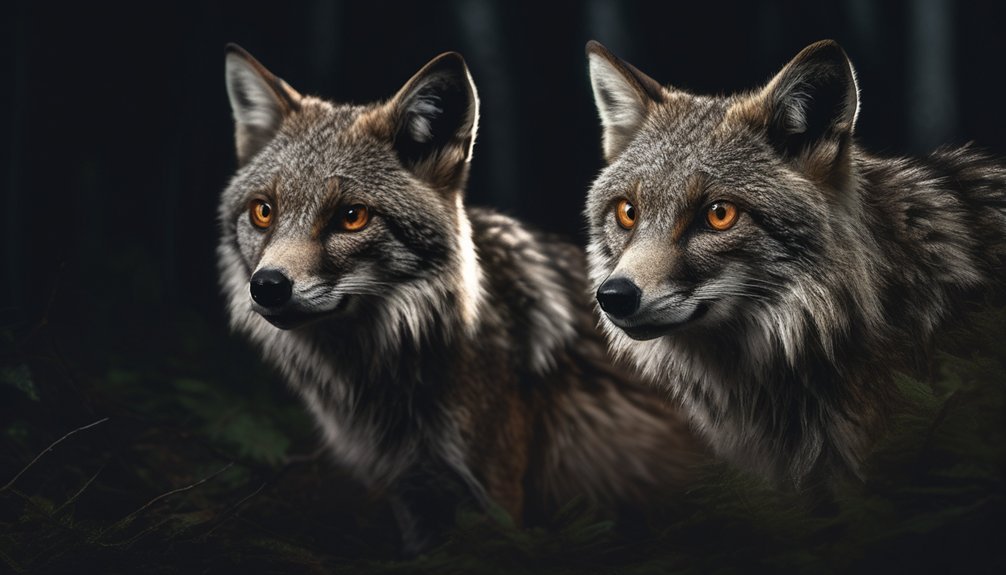
Animal night vision is the ability of an animal’s visual system to detect and process low levels of light efficiently, allowing it to navigate, forage, and avoid predators in dim or nocturnal conditions.
You’re seeing a specialized adaptation that increases light sensitivity through retinal and neural mechanisms. When you observe nocturnal behaviors, you’re watching this system support function under constrained illumination.
Rod-dominant retinas, enlarged pupils, and reflective ocular layers can improve photon capture, but the core effect is enhanced visual performance at low luminance.

In clinical terms, this adaptation reduces visual threshold and preserves spatial awareness when ambient light falls. You can think of it as a precision sensory adjustment that lets you move with confidence through darkness while maintaining close, intimate awareness of your environment.
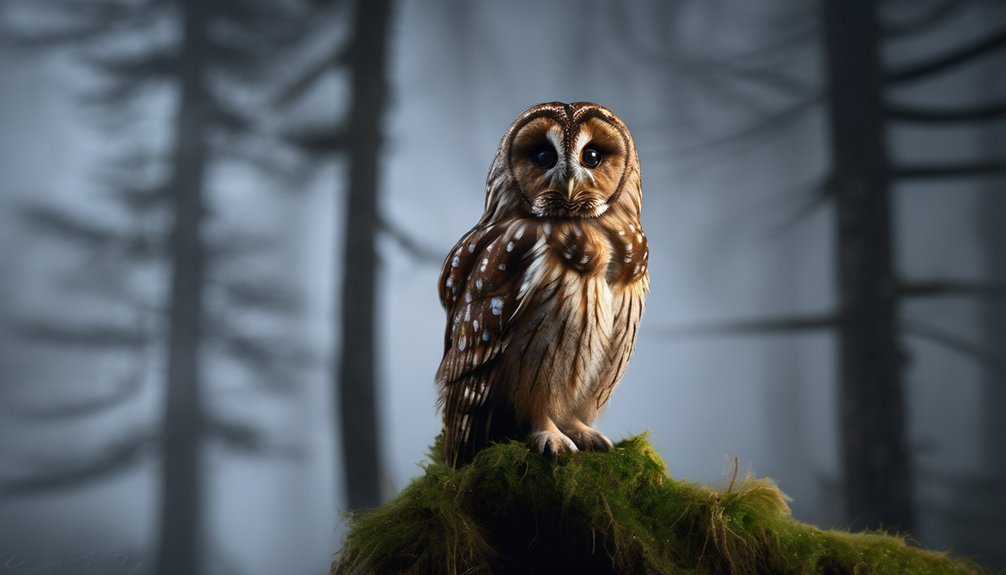
How Owls See in Near Darkness
Owls push night vision further than most birds by combining extreme rod dominance, a high-density retinal architecture, and large corneas with wide pupils that maximize photon capture in near darkness. You benefit from owl anatomy that channels scarce light onto rod-rich photoreceptors, while a reflective layer boosts retinal sensitivity. Their nocturnal behavior pairs with a tubular eye shape, which improves image reach but reduces mobility. | Feature | Function | Benefit |
| — | — | — |
|---|---|---|
| Rods | Detect dim light | Better sensitivity |
| Cornea | Collect photons | More input |
| Tapetum | Reflect light | Signal amplification |
In practice, you’re seeing a system tuned for detection, not detail, and that tradeoff lets owls navigate, orient, and strike with exceptional precision when illumination falls to nearly nothing.
How Cats Hunt in Low Light
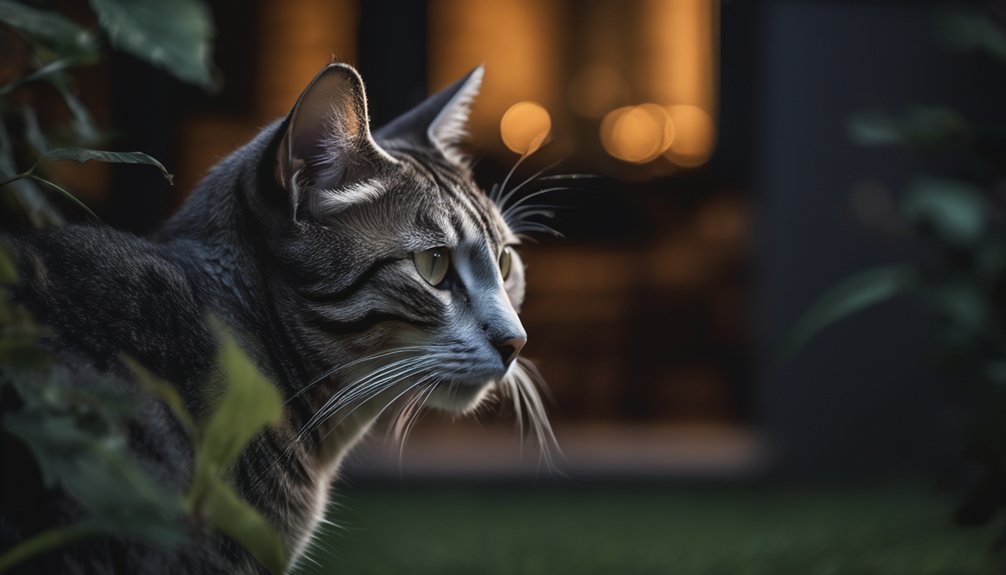
When light levels drop, cats preserve hunting efficiency by combining a rod-rich retina, a reflective tapetum lucidum, and a wide pupil that rapidly dilates to admit more photons.
Cats hunt efficiently in low light, using rod-rich retinas, reflective tapetum lucidum, and wide pupils to gather more photons.
You’ll notice their nocturnal behavior stays quiet and deliberate. Their hunting techniques rely on sensory integration:
- subtle whisker input
- acute motion detection
- low-noise foot placement
- brief visual fixation
- rapid pounce timing
You can see how these adaptations let them track prey with minimal illumination, even when contrast is poor.
Your cat’s musculature supports explosive acceleration, while flexible joints enhance traction and directional change.
Pupillary control and retinal sensitivity improve target acquisition, so each movement stays efficient, precise, and intimate.
Other Animals With Powerful Night Vision
Beyond cats, several other species show highly optimized nocturnal vision through specialized retinal anatomy, pupil morphology, and optical filtering.
You’ll notice that nocturnal mammals such as owls, bush babies, and tarsiers often carry dense rod photoreceptors, which increase sensitivity to minimal light. Their retinas typically reduce cone dominance, favoring scotopic performance over color discrimination.
In some species, the tapetum lucidum reflects photons back through the photoreceptor layer, improving capture efficiency. Large pupils also widen the aperture, letting more ambient light reach the retina.

You can think of these adaptations as a tightly tuned visual system, built for precision in darkness. When you examine them closely, you’ll see that each structure works together, producing extraordinary low-light acuity without sacrificing anatomical efficiency.
Why Night Vision Helps Animals Survive
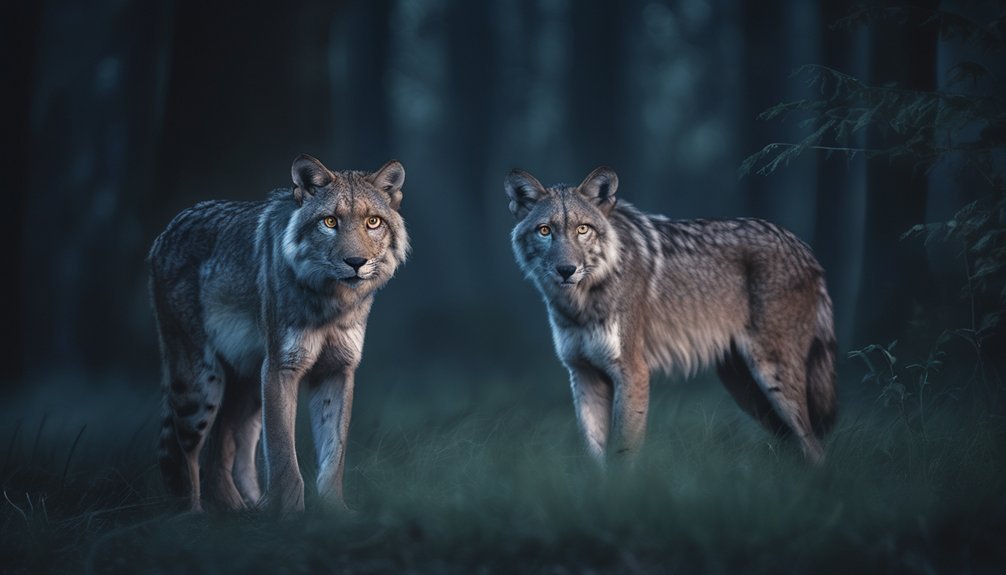
Night vision improves survival by extending visual function into periods of low photon availability, allowing animals to detect predators, locate prey, and navigate without relying on daylight. You gain a clear advantage when retinal output stays usable after sunset, because every second counts.
Night vision extends visual function after sunset, helping animals detect threats, find prey, and navigate when daylight disappears.
This supports:
- predator avoidance through earlier threat recognition
- prey detection at greater distances
- safer movement across unfamiliar terrain
- efficient foraging when competition drops
- reduced dependence on daytime activity
In clinical terms, this visual competence lowers injury risk and conserves energy. You can remain active when others can’t, which improves access to food and escape routes.
For many species, that nocturnal window isn’t optional; it’s a survival determinant shaped by ecological pressure.
Eye Adaptations That Improve Night Vision
To function in dim light, many animals rely on ocular adaptations that maximize photon capture and retinal sensitivity. You can see this in a specialized retinal structure dominated by rod cells, which outnumber cones and boost light sensitivity while reducing color detail.
In many species, a tapetum lucidum reflects unabsorbed photons back through the retina, giving you a second chance to detect them and enhancing visual acuity in darkness. Larger pupils and a broad cornea also let more light reach the photoreceptors.
These changes support nocturnal behavior, letting you hunt, navigate, and avoid predators when illumination is poor. You won’t get sharp daytime color vision, but you gain a highly efficient visual system tuned for low-light survival and intimate awareness of your environment.
Frequently Asked Questions
Which Animal Has the Best Night Vision?
You’d likely choose the owl, especially a great horned owl, for best night vision. Its owl adaptations—large pupils, high rod density, and retinal sensitivity—create predator advantages, letting you detect faint movement in near-darkness.
Can Animals See Colors in the Dark?
Not exactly—you’ll find many animals lose color perception in dark environments. You might assume they see like you do, but rods dominate vision there, while cones need more light to detect colors accurately.
Do Nocturnal Animals Have Better Eyesight Than Humans?
Yes, you usually do; nocturnal adaptations and eye structure let nocturnal animals gather more light than your eyes can, improving low-light acuity, though your daytime vision often remains sharper and more color-accurate.
How Does Moonlight Affect Animal Vision?
Moonlight boosts your vision by increasing ambient illumination, improving contrast, but excessive moonlight intensity can alter photoreceptor adaptation, reducing sensitivity in dark-adapted eyes. You’ll detect motion better, though some species’ nocturnal advantages shrink.
Are Some Animals Blind in Daylight?
Yes—some animals are effectively blind in daylight; doesn’t that surprise you? You’ll see that poor daylight adaptation and nocturnal behavior can saturate retinal receptors, reducing acuity, so bright light leaves them functionally vision-impaired.
Conclusion
When you study animals with incredible night vision, you’re seeing a near-superhuman sensory system in action. Their rod-dominant retinas, dilating pupils, and tapetum lucidum can amplify meager photons into usable visual data, letting them detect movement in conditions that would leave you completely blind. In effect, they’re built to dominate the dark, hunt with surgical precision, and navigate hostile terrain with astonishing accuracy—an almost unreal biological advantage.