You may be less than surprised to learn that a mirror can reveal more than appearance. When you test self-recognition, you’re not just watching animals look back; you’re measuring whether they can link the reflection to their own body. Great apes, dolphins, elephants, and a few other species have shown this capacity, while many others do not. The difference raises a harder question than the test itself can answer.
Key Takeaways
- The mirror test checks whether an animal uses a reflection to investigate a hidden mark on its own body.
- Great apes, including chimpanzees, bonobos, orangutans, and some gorillas, are classic mirror-recognition species.
- Dolphins, elephants, magpies, and orcas have also shown self-directed behavior in mirror studies.
- Cleaner wrasse fish have produced surprising mirror-test results, though their self-recognition is still debated.
- Mirror-test outcomes depend on species, motivation, and context, so failing does not mean an animal lacks intelligence.
What the Mirror Test Shows
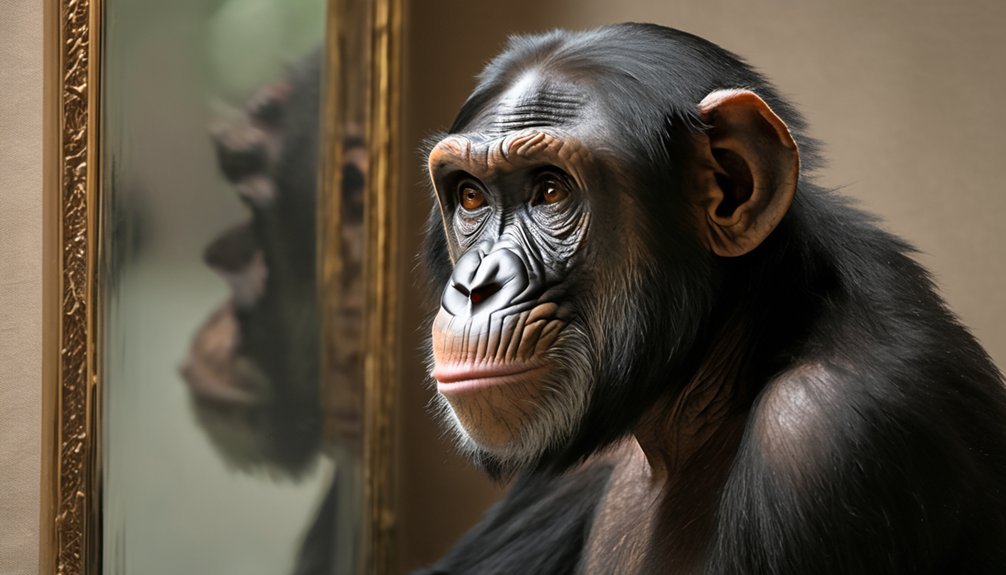
The mirror test shows whether an animal can recognize that the reflection in a mirror is its own image rather than another individual. When you observe this response, you gain a measurable sign of self-awareness indicators in species that rely on visual cues.
You can treat a successful result as evidence that the animal distinguishes self from other, a capacity tied to cognitive complexity. Researchers use this finding cautiously, because passing or failing doesn’t define an animal’s full mental life.
Still, the test offers a controlled way to compare species and assess higher-order perception. If you’re studying animal behavior closely, you see that mirror recognition can reveal how an individual processes identity, bodily awareness, and social information in a precise, observable manner.
How the Mirror Test Works
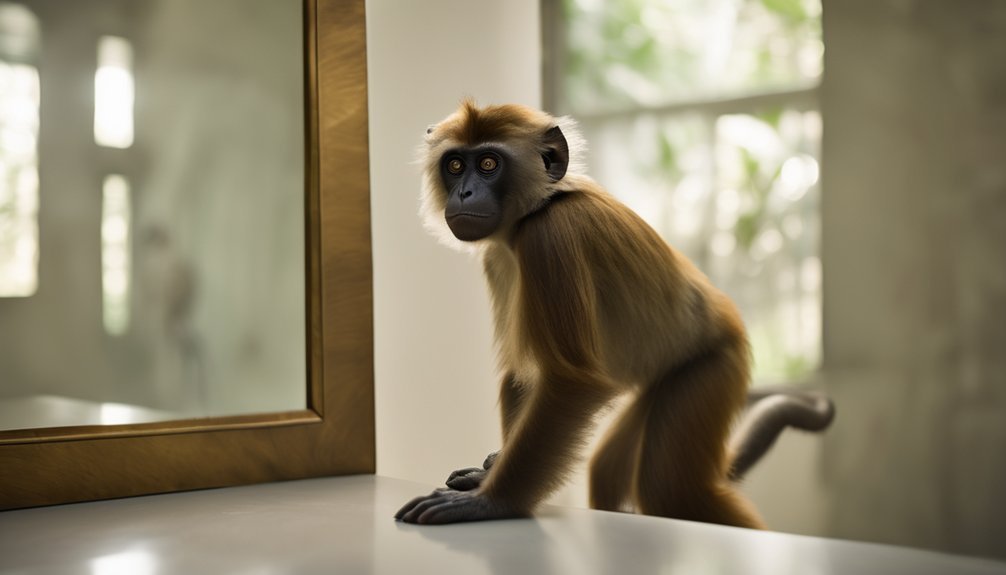
To run the mirror test, researchers place a visible mark on an animal’s body in a location it can’t see directly, then observe its behavior in front of a mirror. You watch for signs that the animal uses the reflection to inspect, touch, or investigate the marked area, rather than treating the image as another individual.

Scientists usually first allow mirror familiarity, so the animal can learn that the image stays linked to its own movements. Then they compare reactions before and after marking. A positive response suggests self-directed behavior, which can inform studies of cognitive development.
A negative response doesn’t prove lack of awareness; it may reflect vision, motivation, or species-specific differences. The method gives you a controlled way to assess self-recognition.
Great Apes and the Mirror Test
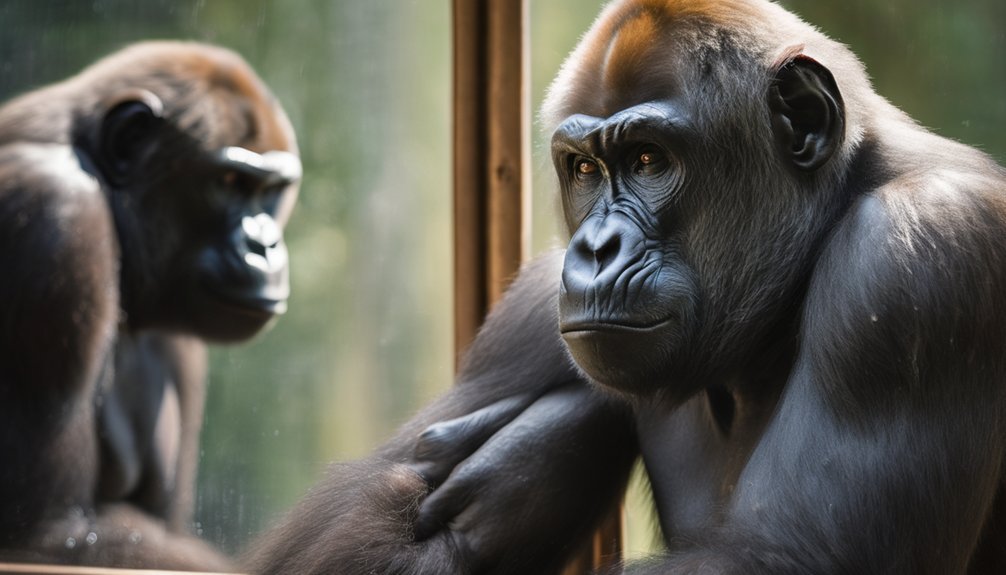
Great apes are the best-known nonhuman animals to pass the mirror test, with chimpanzees, bonobos, orangutans, and some gorillas showing mark-directed behavior after mirror exposure.
When you examine their responses, you see evidence that vision can support self recognition in species with advanced cognitive abilities. Researchers interpret this performance as a sign that these apes use the mirror to inspect their own bodies rather than treat the reflection as another individual.
Results vary across individuals, age, and testing conditions, so you shouldn’t treat the outcome as absolute.
Results vary across individuals, age, and conditions, so the mirror test should not be treated as absolute.
Still, the pattern matters for self awareness evolution because it suggests a gradual link between social intelligence, perception, and self-monitoring.
You can view the mirror test as one informative measure, not a complete account of ape cognition.
Dolphins That Pass the Mirror Test
Bottlenose dolphins are among the few nonhuman animals that have shown mirror self-recognition, and researchers have used the mirror test to study how these marine mammals inspect their own bodies. You can see this behavior when dolphins twist, turn, and position themselves to view marks on hard-to-see areas.
| Observation | Evidence | Meaning |
|---|---|---|
| Repeated mirror viewing | Self-directed postures | Possible self-recognition |
| Mark inspection | Focus on body areas | Visual checking |
| Social play | Cooperative interactions | dolphin intelligence |
| No aggression | Calm mirror response | social behaviors |
These results suggest that dolphin intelligence includes a capacity to link visual feedback with body awareness. In controlled studies, you can compare individual responses carefully, and the pattern remains consistent: dolphins treat the mirror as information about themselves, not as a rival.
Elephants and the Mirror Test
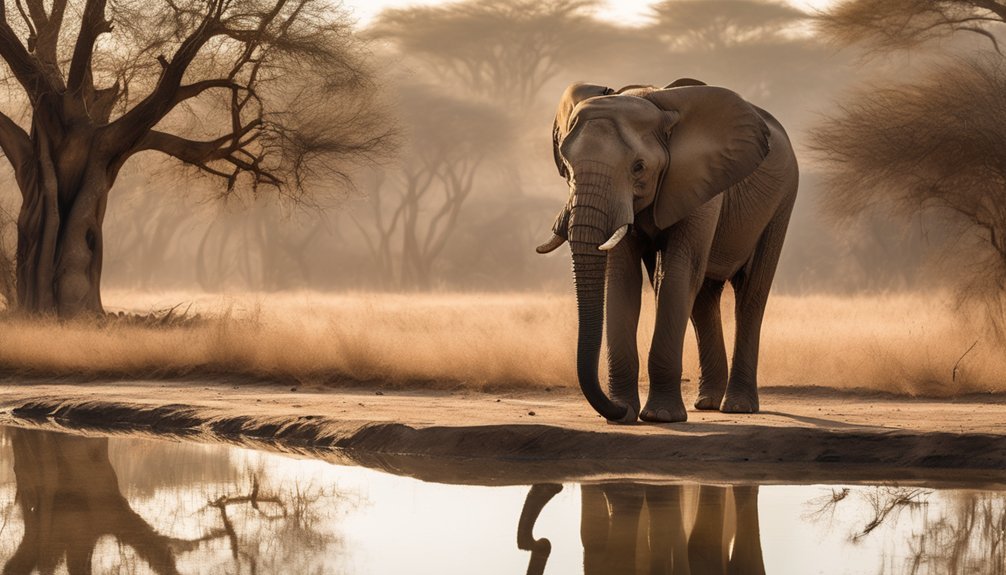
Elephants have also shown mirror self-recognition in carefully controlled studies, especially when you observe how they use a mirror to examine marked parts of their bodies.
In these tests, you can see mirror behavior that suggests they understand the image reflects their own form, not another elephant. Researchers have reported that individuals touch visible marks with their trunks after looking in a mirror, which supports evidence for elephant intelligence.
Researchers have reported elephants touching visible marks with their trunks after mirror viewing, suggesting self-recognition and elephant intelligence.
You should note that the result depends on repeated observation, appropriate mirror placement, and careful controls.
The findings matter because they add to your understanding of self-awareness across species. They also show that large-brained mammals can use visual feedback in flexible ways.
In scientific terms, the evidence remains strong, though it isn’t limitless.
Magpies and Self-Recognition
Magpies provide one of the most discussed examples of mirror self-recognition outside mammals. You can view their performance as evidence that magpie intelligence includes a rare level of self-directed processing. In experiments, researchers placed a colored mark on feathers that magpies couldn’t see directly. When you gave them access to a mirror, some birds inspected and removed the mark, suggesting they recognized the reflection as their own body.
| Observation | Meaning |
|---|---|
| Bird checks reflected throat | Possible self-directed attention |
| Bird pecks at marked area | Response to visible alteration |
| Bird ignores unmarked reflection | Control behavior |
These findings don’t prove humanlike awareness, but they do support advanced cognitive abilities in a species with a complex social life and flexible problem-solving skills.

Orcas and Mirror Recognition
Although direct mirror self-recognition tests are less common in marine mammals than in primates, orcas have shown behaviors that suggest they can use visual feedback to inspect their own bodies.
You can observe them approaching reflective surfaces, adjusting posture, and lingering near glass or polished tank walls in ways that imply curiosity about body position. These patterns don’t prove full self-recognition, yet they align with orca intelligence and advanced sensory processing.
In social behavior, you may notice that orcas coordinate movement, learn from one another, and respond flexibly to new stimuli, which supports the idea that they can integrate visual information with experience.
Researchers still need controlled studies to separate exploratory behavior from true mirror recognition, but the evidence suggests a high level of cognitive sophistication.
Cleaner Wrasse and Fish Self-Recognition
Cleaner wrasse provide one of the most debated examples of mirror-related behavior in fish. You can observe them inspecting marked areas on their bodies after mirror exposure, and researchers link that response to possible self-directed attention. Their social behavior matters, because these fish routinely interact with clients and rivals, so a mirror may tap familiar visual processing. Their cognitive abilities remain under study, yet the pattern has fueled careful experiments rather than casual claims.
| Observation | Meaning | Evidence |
|---|---|---|
| Mark-directed rubbing | Possible body inspection | Experimental trials |
| Mirror near display | Visual engagement | Repeated responses |
| Controlled tests | Scientific comparison | Peer-reviewed data |
You should read the findings cautiously, but you can still appreciate how clean, intimate contact with evidence keeps the question alive.
Why Some Animals Fail the Mirror Test
Animals can fail the mirror test for several reasons that don’t necessarily imply a lack of intelligence. You may see poor results when an animal relies more on scent, sound, or touch than vision, because the test mainly targets visual self-directed behavior.
Social behavior also matters: species that rarely inspect their own bodies or use mirrors in daily life may not treat the reflection as relevant.
Species that rarely inspect their own bodies or use mirrors may not find the reflection relevant.
Environmental factors can further shape performance, since stress, unfamiliar settings, or a mirror placed at the wrong height can reduce attention.
Some animals react to the image as if it were another individual, while others ignore it entirely. In each case, the outcome reflects testing conditions and sensory biology, not a simple measure of mental ability.
What Self-Recognition Means for Cognition
Self-recognition in a mirror is often treated as evidence that an animal can distinguish its own body from other objects and individuals.
You can view this as one of several self awareness indicators, but it doesn’t prove humanlike introspection. Instead, it suggests that your subject can integrate visual input with body representation, attention, and memory.
In cognition research, that matters because it links perception to a more flexible self model.
- It may support goal-directed behavior.
- It may reflect memory for bodily state.
- It may indicate social comparison skills.
- It may inform cognitive development studies.
You should interpret the result cautiously, because mirror behavior can vary with species, motivation, and context.
Still, self-recognition gives you a measurable window into how cognition organizes the self.
Frequently Asked Questions
Which Animals Besides Those Listed Can Pass the Mirror Test?
Besides the listed animals, you’d mainly consider dolphins, elephants, magpies, and some fish; evidence varies by self recognition criteria and species variations. You’ll find mirror-test results remain debated, species-specific, and method-dependent across studies.
At What Age Can Animals First Recognize Themselves?
You can’t assign a single age; it varies by species. In some animals, self-recognition emerges after developmental milestones and cognitive abilities mature, often in juveniles or adolescents, when neural circuits support mirror-guided behavior.
Does Mirror Self-Recognition Mean an Animal Has Self-Awareness?
No, you can’t assume that. Mirror self-recognition suggests some self awareness definition elements, but it doesn’t prove full self-awareness. You’d see cognitive abilities involved, yet scientists treat it as one indicator, not definitive proof.
Can Training Improve an Animal’s Mirror Test Performance?
Yes, you can sometimes improve an animal’s mirror test performance with training techniques that shape attention and behavior, but gains don’t necessarily indicate self-recognition. You should interpret results cautiously, because cognitive development may vary widely.
Are There Alternatives to the Mirror Test for Animals?
Yes, you can use alternatives like mark tests, perspective-taking tasks, and problem-solving assays to assess cognitive abilities. You’ll also measure sensory perception, social behaviors, and environmental influences, giving a broader, more objective picture.
Conclusion
So, if you were hoping the mirror would expose a simple ranking of “smart” versus “not smart,” nature has politely ignored you. Great apes, dolphins, elephants, orcas, magpies, and cleaner wrasse all suggest that self-recognition evolves in different forms, for different lives. You’ve seen that passing the mirror test doesn’t make one species superior; it just means cognition is more inventive, and far less obedient to human expectations, than you might like.