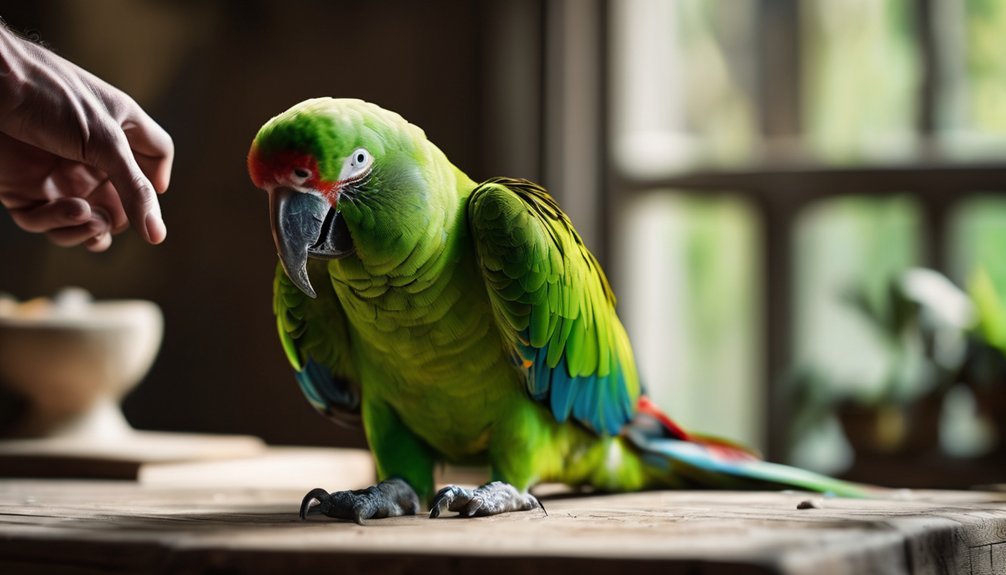
If you hear a parrot say “hello” and then whistle like a phone, you’re seeing a social brain at work. Parrots don’t copy human speech by accident; you’re watching vocal learning, a rare ability that lets them absorb sounds from their environment. They use this skill to bond, adapt, and signal social flexibility. But whether they truly grasp the words is still the key question.
Key Takeaways
- Parrots mimic human speech because they are vocal learners adapted to copy and store sounds from their environment.
- Mimicry helps parrots communicate socially, especially in the complex flock structures they naturally live in.
- They practice sounds through repetition and feedback, refining pitch, timing, and rhythm over time.
- Many parrots do not fully understand words; they often learn associations between sounds, actions, and contexts.
- Human speech is a novel sound source that can strengthen social bonds, gain attention, and support bonding behaviors.
Why Parrots Mimic Human Speech
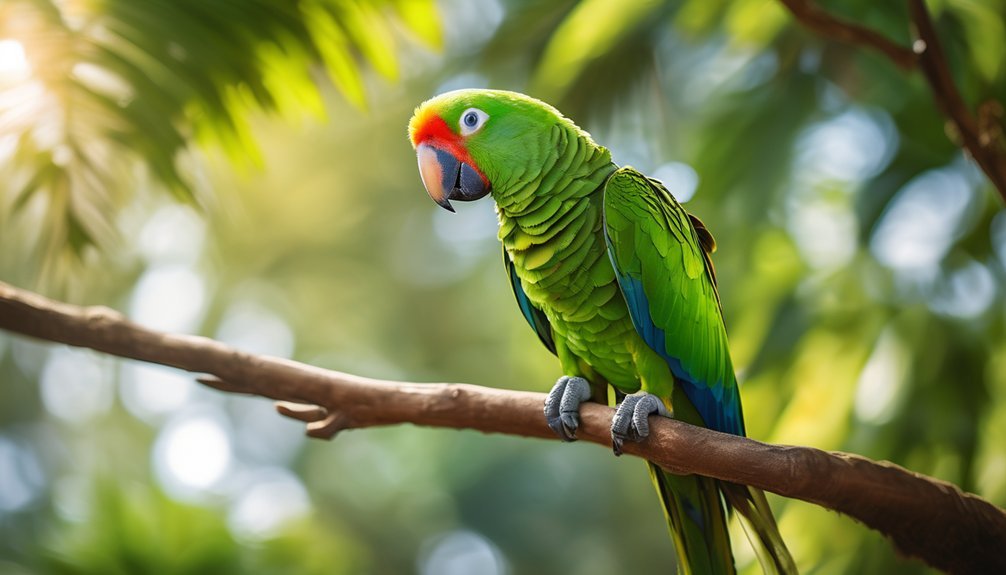
Parrots mimic human speech because their brains are specialized for vocal learning, a trait they use to acquire sounds by hearing and repeating them. You’re seeing vocal imitation shaped by social selection, not random noise.
In the wild, parrots live in complex flocks where recognizing companions, rivals, and calls helps you stay connected and safe. Human speech can fit this system because it offers novel acoustic patterns that your parrot can integrate into its vocal repertoire.
Mimicry may also provide an evolutionary advantage by strengthening social bonds, attracting attention, or signaling flexibility to potential mates. When your parrot copies speech, it isn’t “talking” like you; it’s using a sophisticated communication tool that reflects its highly social, adaptive biology and your close proximity.

How Parrots Learn to Copy Sounds
When a parrot copies a sound, it does so through vocal learning, a process in which the bird hears an acoustic pattern, stores it, and then practices matching it with its own vocal organs.
You can see sound recognition at work as the parrot compares what it hears with what it produces. Its brain then adjusts pitch, timing, and rhythm until the match improves. Vocal mimicry develops through repetition, feedback, and refinement.
- Hear: the parrot detects a distinct sound.
- Store: it encodes the pattern in memory.
- Practice: it repeats and corrects errors.
You’re watching a precise biological skill, not random noise. Each attempt strengthens the neural pathway, making the copied sound clearer, more stable, and more accurate over time.
Do Parrots Understand the Words They Say?
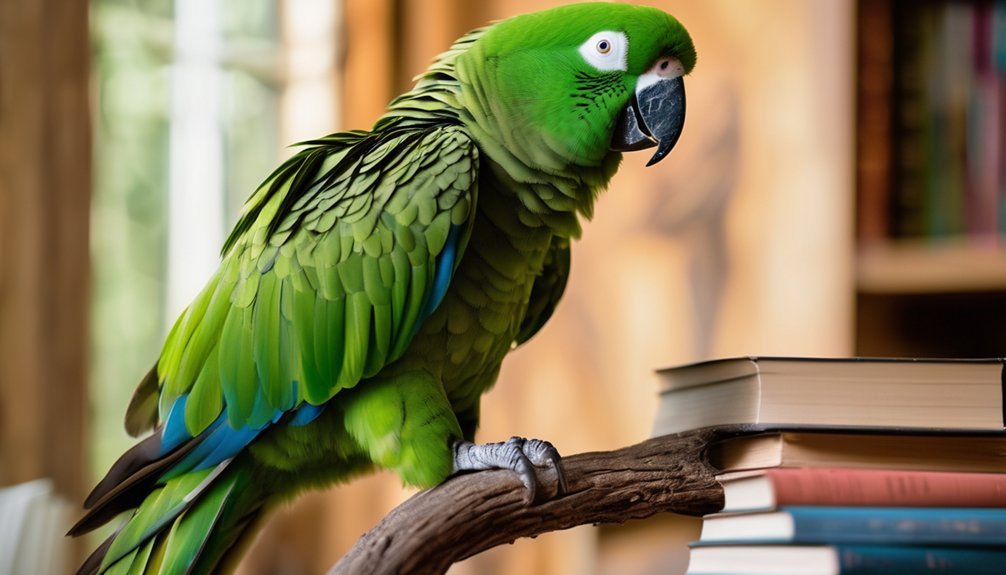
A parrot’s ability to speak doesn’t automatically mean it understands every word it repeats. You should expect mixed results in parrot cognition: some birds link specific sounds to objects, people, or routines, while others repeat phrases without clear semantic mapping.
In studies of vocal communication, parrots have shown they can learn labels, request items, and use words in context, especially when training reinforces meaning. Still, you can’t assume a spoken word reflects human-like understanding. Your parrot may respond to cues, tone, and situation more than abstract definitions.
When you observe consistent word use, you’re seeing a learned association, not necessarily full language comprehension. Careful testing helps you distinguish routine mimicry from genuine informational use, and that distinction matters for interpretation.
What Parrot Mimicry Means
Parrot mimicry is vocal copying: the bird reproduces sounds it has heard, including human speech, without necessarily attaching the same meanings humans do. You’re observing vocal learning, a form of sound imitation shaped by auditory processing and cognitive abilities. This skill can refine communication skills, but it doesn’t prove humanlike language use.
- Environmental influences supply the sounds your parrot hears.
- Behavioral adaptation helps it practice and store patterns.
- Social interaction can encourage repeated vocal output.
When you hear a phrase repeated, you’re seeing a learned acoustic pattern, not a semantic translation. Precise imitation may reflect attention, memory, and species-specific flexibility.
In your bird, mimicry often signals how the brain maps sound, not what the sound means.
Why Social Bonding Drives Parrot Speech
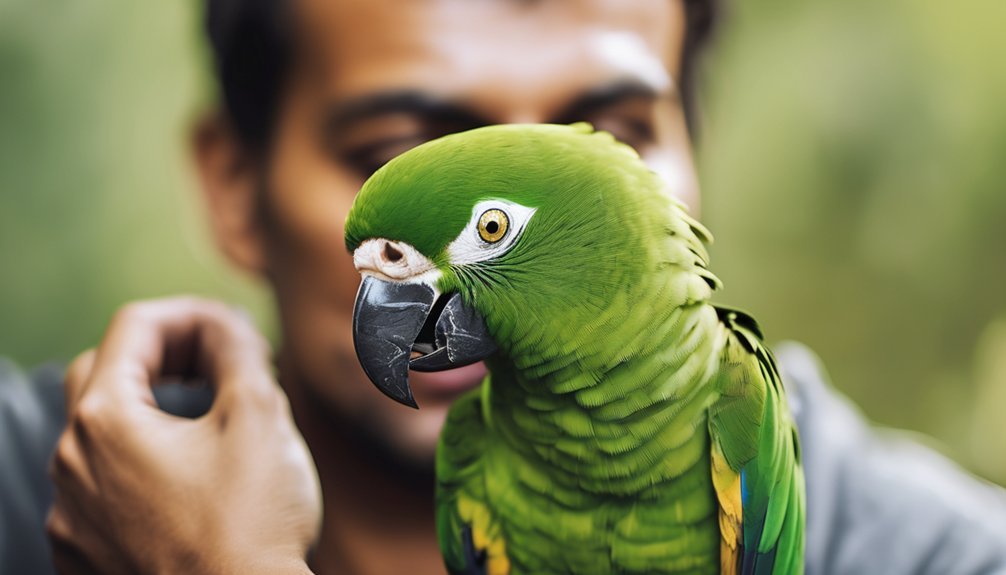
Because parrots are intensely social animals, they often copy speech to strengthen bonds with their flock, including human caregivers. You can view this as a form of social interaction that supports group cohesion and reduces separation stress.
When a parrot repeats your words, it’s not just imitating sound; it’s engaging in vocal communication that can reinforce an emotional connection with you. This behavioral adaptation helps the bird fit into a human social environment by responding to cues it hears often.

In close contact, your voice becomes part of the bird’s daily context, so speech learning can function as a relationship signal. Parrots don’t speak to replace instinctive calls; they use learned sounds to maintain proximity, attention, and mutual trust in a shared social setting.
Which Parrots Mimic Human Speech Best?
Among parrots, the African grey is widely regarded as the most accomplished human speech mimic, with amazons, Eclectus parrots, Indian ringnecks, and budgerigars also showing strong vocal-learning ability.
You’ll notice the African Grey excels at accurate phoneme copying and contextual use. Amazon Parrots often produce louder, clearer phrases, while Eclectus Parrots show stable, deliberate articulation.
Quaker Parrots and many Budgerigar Types can learn large repertoires despite smaller bodies. Cockatoo Species vary, but some individuals match words impressively.
- African Grey: highest precision.
- Amazon Parrots and Eclectus Parrots: strong clarity.
- Quaker Parrots, Budgerigar Types, Cockatoo Species: variable but capable.
Your best predictor isn’t species alone; it’s individual vocal plasticity, hearing acuity, and social history.
How to Encourage Healthy Talking
To encourage healthy talking, give your bird frequent, calm social interaction, short training sessions, and consistent reinforcement for clear vocal attempts. You should speak clearly, repeat target words, and reward accurate sounds immediately with a favored treat or gentle praise.
Keep sessions brief so your parrot stays attentive and emotionally secure. Offer vocal exercises in a quiet area with stable light and low background noise, because stress can reduce learning and distort sounds.
Rotate interactive toys to prevent boredom and support cognitive engagement without overwhelming your bird. Avoid shouting, forcing repetition, or using punishment, since these can weaken trust and vocal performance.
Track progress by noting pitch, timing, and clarity, and adjust your approach as your bird’s responses improve over time.
Frequently Asked Questions
Can Parrots Mimic Languages They Have Never Heard Before?
No, you can’t expect parrots to mimic languages they’ve never heard. Your parrot’s cognitive abilities support sound imitation, not language acquisition. It learns vocal patterns only from exposure to specific voices, rhythms, and phonemes.
Do Parrots Imitate Accents or Just Individual Words?
Parrots often imitate accents, rhythm, and intonation, and they also copy individual words. You’ll see vocal mimicry in parrot communication when they match your tone, your cadence, and your specific sounds, not just vocabulary.
Can Parrots Learn to Mimic Sounds From Other Animals?
Yes, you can find parrots mimicking other animals’ sounds; their vocal learning and sound recognition let them copy diverse calls. Social interaction and environmental influences shape which sounds they learn, and how accurately they reproduce them.
At What Age Do Parrots Start Copying Human Speech?
Usually, you’ll notice parrots start copying human speech around 3 to 12 months old, as vocal development and social interaction accelerate. Early, eager, echoing juveniles often learn best, but individual species and birds vary.
Does the Environment Affect How Much Parrots Talk?
Yes, you’ll notice environment strongly affects how much you hear your parrot talk. More social interaction, environmental stimulation, and consistent training techniques usually increase vocalization frequency, while isolation and stress often reduce speech.
Conclusion
You can see that parrots mimic human speech because their brains are built for vocal learning, and social living rewards flexible communication. When you interact with them, they may copy sounds to bond, attract attention, or fit into their flock-like world. They don’t always grasp every word, but they can link sounds to outcomes. In this way, parrot speech is a mirror of social intelligence, not just a simple parlor trick.