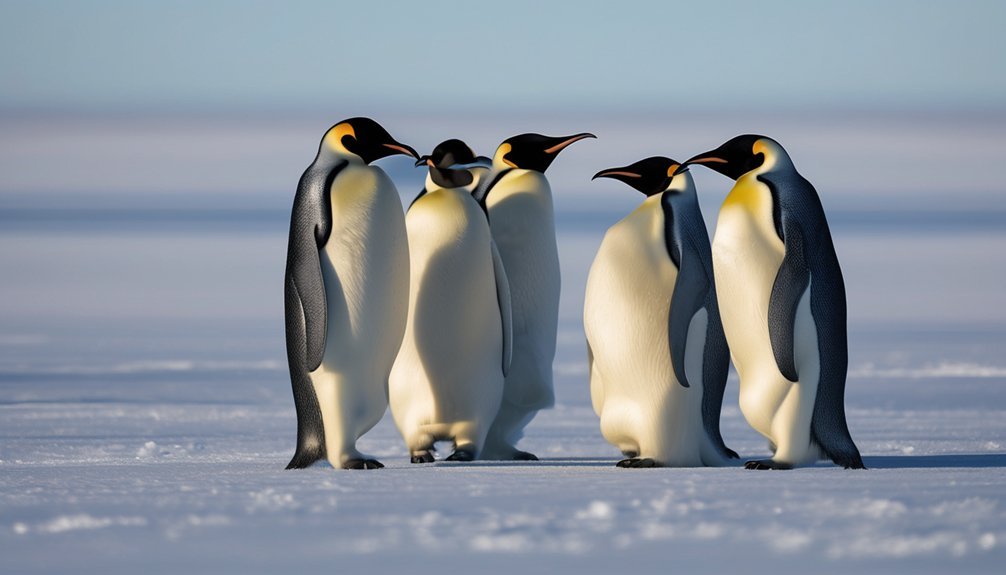
If you look at penguins in Antarctica, you’ll see a survival system shaped by cold, wind, and ice. You can trace their success to dense feathers, thick fat, tight huddles, and efficient swimming that keeps food within reach. Their breeding and chick-care strategies also help them endure the season’s harshest shifts. But these adaptations only tell part of the story, because climate pressure is starting to test their limits.
Key Takeaways
- Penguins conserve heat with dense feathers, insulating fat, and compact bodies that reduce heat loss in wind and water.
- Waterproof plumage traps air and stays dry, improving insulation during freezing Antarctic conditions.
- Penguins huddle together, sharing warmth and reducing exposed surface area in the cold.
- They forage efficiently using sharp underwater vision, strong swimming, and seasonal migrations to reach prey-rich waters.
- During breeding, parents share egg and chick care, keeping offspring warm and fed despite harsh weather.
How Penguins Stay Warm in Antarctica
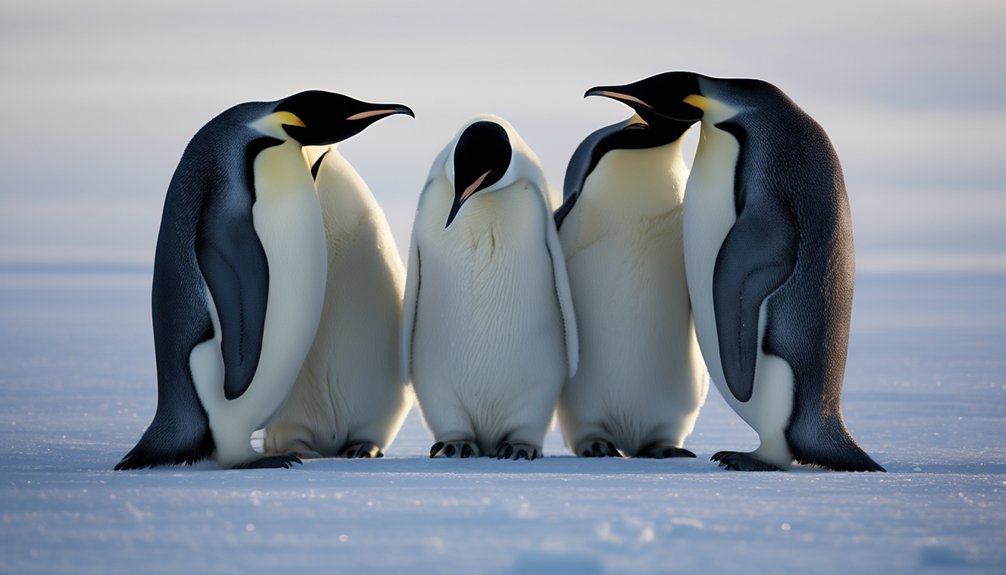
Penguins stay warm in Antarctica by combining dense plumage, a thick layer of insulating fat, and tightly controlled behavior that reduces heat loss.
You can see penguin insulation at work when each bird traps a still layer of air near the skin, limiting conduction and convection.
During thermal regulation, penguins huddle closely, rotate positions, and face away from the wind, so you lose less body heat in the open air.
Their compact bodies also reduce exposed surface area, which helps conserve energy in freezing conditions.
When you watch this system closely, you notice it’s not one trick but an integrated strategy.

Every movement, from standing still to crowding together, supports survival and keeps core temperature stable.
Penguin Fat, Feathers, and Waterproofing
Beyond body heat conservation, penguins rely on a tightly integrated outer and inner shield. You can think of their body fat as a dense layer of fat insulation that slows heat loss in frigid water and wind.
Beneath the surface, your attention should turn to feather structure: short, stiff feathers overlap with remarkable feather density, trapping a still air layer against the skin. Penguins also preen oils across each plume, strengthening waterproof adaptations that keep feathers from soaking.
When water beads off efficiently, your bird maintains thermal regulation more effectively, because dry plumage insulates far better than wet plumage. This combination of body fat, feather density, and waterproof adaptations lets penguins conserve energy while they dive, swim, and move through Antarctic conditions with impressive precision.
How Huddling Helps Penguins Stay Warm
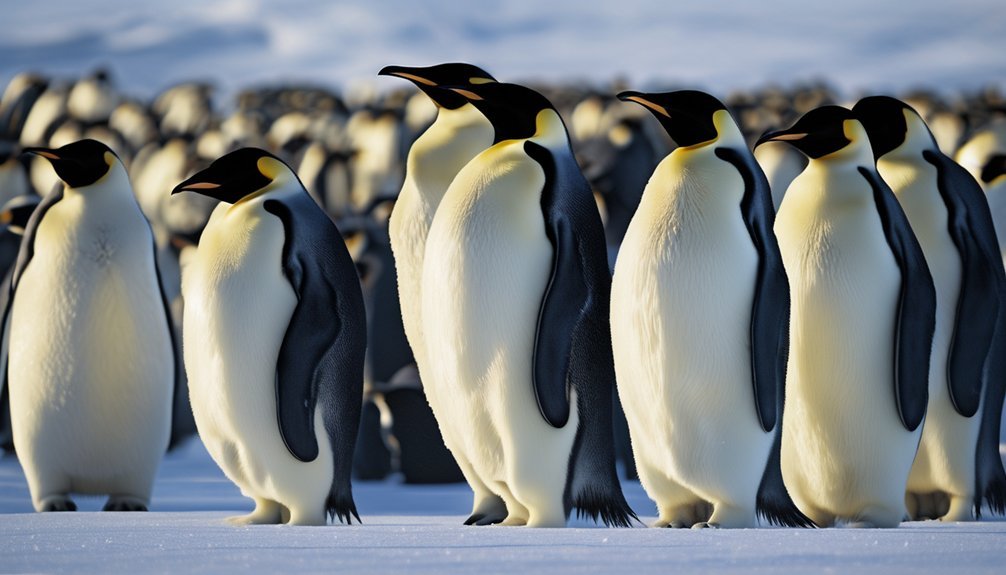
When temperatures plunge, penguins conserve heat by clustering tightly in a huddle that reduces each bird’s exposed surface area.
You can think of this huddling behavior as a moving thermal system: birds on the outer edge absorb the cold first, then rotate inward as others shift outward, sharing the burden of exposure. This exchange helps maintain a steadier core temperature without wasting energy.
You also benefit from social warmth, because close body contact limits convective heat loss and creates a warmer microclimate inside the group.
Each penguin contributes to and receives heat from its neighbors, so the colony functions like a cooperative insulating unit.
In this way, huddling lets you survive intense cold while conserving valuable metabolic fuel.
How Penguins Survive Antarctic Winds
Even in brutal Antarctic winds, penguins reduce heat loss by lowering their profile and turning their bodies so the narrowest surface faces the gusts. You can think of this as built-in wind resistance: their compact shape lets air stream around them with less drag and less convective cooling.
Their feather structure also matters. Dense, overlapping feathers trap a thin insulating air layer, and the outer contour feathers shed wind before it reaches the skin. When you stand close to a penguin, you’d notice that it stays remarkably still, conserving energy while minimizing exposed surface area.
This posture works with their stiff flippers held tight against the body, creating a streamlined form that helps them endure gale-force conditions without losing critical body warmth.
How Penguins Find Food Under the Ice
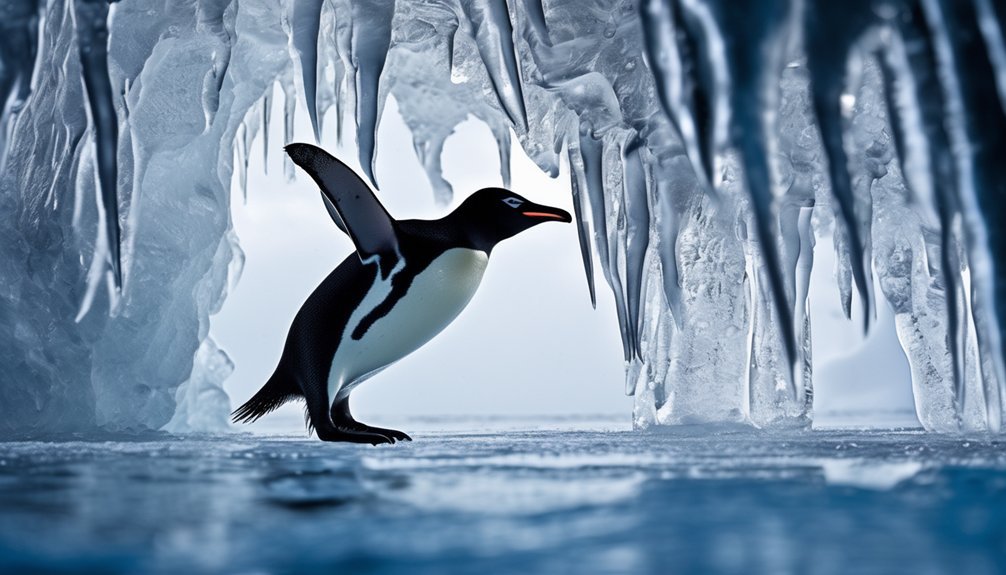
To find food beneath Antarctic sea ice, penguins rely on sharp underwater vision, efficient swimming, and precise diving control. You can see how their underwater foraging targets krill, fish, and squid that concentrate near the ice edge.
In these ice shelf ecosystems, food sources shift with light, currents, and prey availability, so penguins adjust their hunting techniques quickly. They use ice fishing routes along cracks and openings, where prey often gathers.
During seasonal migrations, you’ll notice colonies tracking richer waters and timing feeding strategies to match peak abundance. This lets them conserve energy while maximizing intake.
During seasonal migrations, colonies track richer waters and time feeding to match peak abundance.
Their success depends on reading the seascape closely, because small changes in ice cover can reshape feeding opportunities across the continent.
How Penguins Dive to Hunt in Antarctica
Powered by dense muscles and streamlined bodies, penguins dive with remarkable control to hunt beneath Antarctic waters. You can observe them exhale before submerging, then regulate buoyancy by trapping air in feathers and lungs.
Their wings act like stiff flippers, generating thrust on the downstroke and upstroke, while their feet steer and stabilize each turn. You’ll see them use diving techniques that match prey depth, often shortening strokes to conserve oxygen.
Their hunting strategies depend on rapid bursts, sharp vision in dim water, and coordinated pursuit of fish or krill. By slowing heart rate and redirecting blood flow to vital organs, they extend each dive and maximize capture success in icy, food-rich currents.

How Penguins Breed in Freezing Weather
When Antarctic winter intensifies, penguins time breeding to exploit the brief, resource-rich summer and choose nesting strategies that shield eggs and chicks from cold, wind, and snow.
You’ll see breeding rituals that help pairs recognize each other, synchronize mating, and defend territories in dense colonies. Many species use pebbles, shallow scrapes, or sheltered rock ledges, and these nesting strategies reduce heat loss while keeping eggs off wet ice.
By breeding together, you lower predation risk and improve timing, because chicks hatch when food is more available. Even in brutal weather, you can observe precise coordination shaped by evolution.
- Steady courtship builds trust.
- Shared timing strengthens survival.
- Protected nests limit exposure.
- Tiny eggs carry immense hope.
How Penguin Parents Keep Chicks Warm and Fed
After hatching, penguin chicks depend on constant parental care, because adults must both conserve body heat and deliver enough food to sustain rapid growth.
You’ll see one parent shelter the chick beneath its brood pouch, where dense feathers reduce heat loss and block wind. The other parent usually returns from sea with regurgitated prey, making chick feeding efficient even in harsh weather.
This shared parental care lets the chick stay warm while energy intake remains steady. Adults also coordinate shifts so one can forage while the other guards the nest, limiting exposure to cold and predators.
As chicks grow, they spend less time under cover, but they still rely on frequent meals and close supervision to maintain healthy development.
Which Penguin Species Survive Antarctica Best
Penguin survival in Antarctica varies by species, with the emperor penguin standing out as the best adapted to the continent’s extreme cold and long winter darkness.
You can see emperor resilience in dense feathers, fat reserves, and tight huddles that conserve heat.
Adélie adaptations help them thrive on sea ice, where short foraging trips support breeding success.
Adélie adaptations let them thrive on sea ice, where short foraging trips help breeding success.
Gentoo habitats usually lie farther north, in milder coastal zones with open water and easier access to food.
Chinstrap behavior favors steep rocky slopes and active swimming, but they’re less tolerant of severe winter conditions.
- You may feel awe at their endurance.
- You may notice the precision of each adaptation.
- You may sense the harsh beauty of their world.
- You may admire how survival stays species-specific.
How Climate Change Threatens Antarctic Penguins
As Antarctic warming accelerates, penguins face shrinking sea ice, shifting prey fields, and more frequent rain-on-snow events that can damage nests and reduce chick survival.
You can see climate impacts first in habitat loss, because ice melt removes the stable platforms many species need for resting, moulting, and breeding.
You’ll also notice food scarcity when warming seas move krill and fish beyond efficient foraging range, forcing adults to travel farther and return less often to chicks.
Ocean acidity can weaken the food web from below, while temperature fluctuations destabilize nesting conditions and increase breeding challenges.
As predator dynamics shift, seals and skuas may gain access to exposed colonies.
Together, these pressures narrow survival margins and make Antarctic penguins more vulnerable.
Frequently Asked Questions
How Do Penguins Sleep Without Freezing?
They sleep by huddling, tucking bills, and standing on insulated feet. Their sleeping habits conserve heat, and insulation mechanisms in feathers and fat keep you warm, so they don’t freeze during Antarctic nights.
Do Penguins Ever Drink Freshwater in Antarctica?
Yes, they do. You’ll see penguins drink meltwater from freshwater sources, and their ice adaptation helps them conserve water, but they mainly rely on food for hydration in Antarctica’s harsh, frozen environment.
How Long Can Penguins Stay on Land?
You can keep penguins on land for hours, days, or weeks, depending on breeding behaviors and land adaptations. During breeding, you’ll see them remain ashore longer; otherwise, they return to sea regularly.
Do Penguins Recognize Each Other by Sound?
Yes, you can see penguins recognize each other by sound; they use vocal recognition to identify mates and chicks amid crowds. This supports social bonding, helping them reunite accurately in noisy colonies.
What Predators Threaten Penguins in Antarctica?
You’d think Antarctica’s villains would be subtle; they’re not. Seal threats, especially leopard seals, hunt penguins in water, while avian predators like skuas and giant petrels steal eggs and chicks. You should watch both.
Conclusion
You can see that penguins survive Antarctica by combining insulation, teamwork, and efficient foraging. Their feathers and fat help you understand how they retain heat, while huddling shows that strength often lies in numbers. They also swim skillfully to find food and protect their chicks through harsh winters. Yet climate change is increasing stress on these birds, so if you want them to endure, you’ll need to protect the Antarctic systems they depend on.