Animal intelligence is a mosaic, not a mirror, and you can see the pattern most clearly when you compare it with your own mind. Many species outperform humans in memory, navigation, or sensory judgment, yet they usually stop short of the abstract reasoning, language, and cumulative culture you rely on. The real question is where those differences come from, and what they reveal about intelligence itself.
Key Takeaways
- Animal intelligence is often specialized, with many species excelling in navigation, memory, sensing, or tool use rather than broad reasoning.
- Humans generally outperform animals in abstract thinking, flexible planning, and integrating information across different tasks.
- Many animals learn through imitation, trial, and reinforcement, but their cognitive abilities are usually shaped by specific ecological needs.
- Social animals can show empathy, cooperation, and cultural transmission, though usually less complex than human social learning.
- Brain size alone does not determine intelligence; performance depends on species, environment, and the challenges each animal faces.
What Is Animal Intelligence
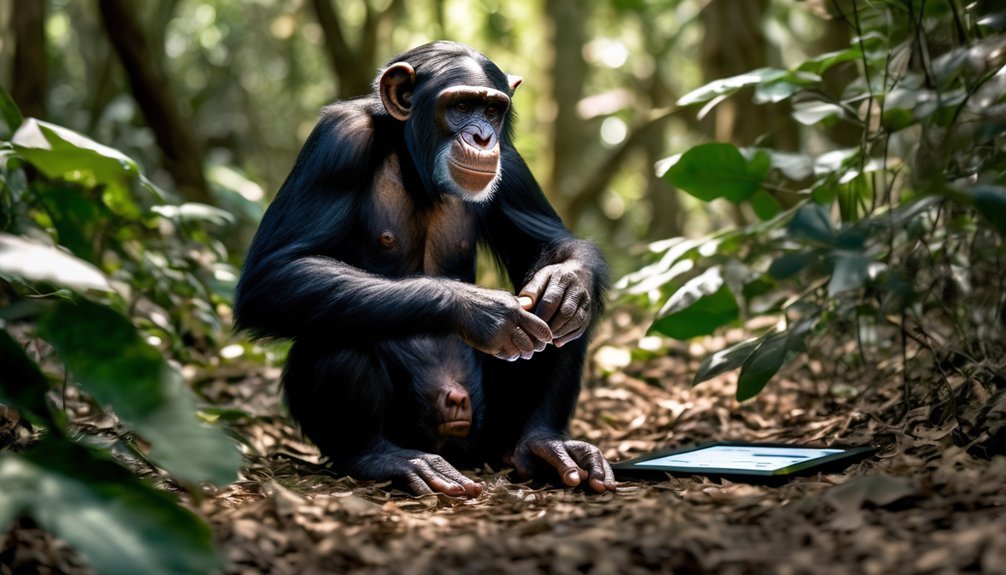
Animal intelligence refers to the measurable cognitive abilities that help nonhuman species perceive, learn, remember, solve problems, and adapt to their environments. You can assess it by examining sensory perception, learning mechanisms, and instinctual behavior across species.
Researchers look for evolutionary significance in tasks such as foraging, navigation, tool use, and cooperation, because these reveal environmental adaptation in real contexts. Brain size may correlate with some functions, but it doesn’t alone predict performance; social structures and ecological intelligence often shape outcomes more strongly.
You’ll notice clear species differences, since each animal faces distinct pressures and opportunities. In this way, animal intelligence is best understood as a practical, evidence-based capacity that supports survival, communication, and flexible action within a particular habitat.
How Animal Intelligence Compares
Compared with humans, many animals excel in specific cognitive domains even when they don’t match our broad symbolic reasoning, language, or abstract planning. You can see their cognitive abilities sharpened by evolutionary advantages that fit local challenges. Their sensory perception often outperforms yours in smell, hearing, or motion detection, while their learning methods rely on trial, imitation, or reinforcement shaped by environmental influences.

Animals often outshine us in specific minds, honed by evolution for the challenges they face.
- You’ll notice behavioral adaptations that solve immediate problems with efficiency.
- You’ll also see social dynamics guiding cooperation, rivalry, and signaling.
- Ethical considerations matter, because comparable intelligence calls for respect, careful study, and humane treatment.
When you compare species, you’re not ranking worth; you’re measuring how different minds thrive under different pressures.
Memory Skills in Animals and Humans
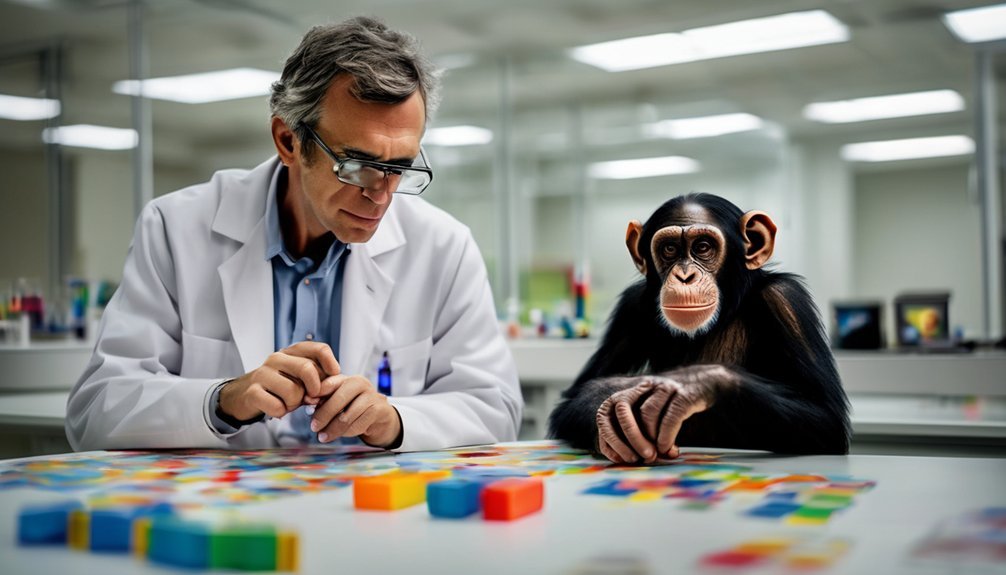
Memory often shows some of the clearest differences between species, because you can measure not just whether information is stored, but how it’s encoded, retained, and recalled.
In your memory comparison, you’ll see distinct memory types across humans and animals: spatial, episodic-like, and associative. Humans usually excel in flexible memory retrieval, while some animals show remarkable memory retention for locations, sounds, or social cues.
Memory testing reveals that environment and memory training can sharpen performance in both, but in different ways.
From an empirical view, memory evolution likely favored traits that fit survival pressures, not one universal standard.
That’s why memory applications in research and conservation matter: they let you judge each species on its own cognitive terms, not yours alone.
Problem-Solving and Tool Use in the Wild
When you examine problem-solving in the wild, the key question isn’t simply whether a species can solve a task, but how flexibly it can adapt when conditions change. You’ll see that tool making techniques, from bending twigs to shaping stones, often track local pressures rather than abstract planning alone.
- During natural foraging, you can measure problem solving strategies by how quickly animals adjust routes or methods.
- Environmental adaptation shows up when innovative behaviors improve resource management under drought, ice, or scarcity.
- Social cooperation can sharpen success, yet predator evasion still rewards rapid individual judgment.
Compared with humans, many animals excel in narrow contexts, but they rarely generalize as broadly.
Still, their practical skill can be striking, intimate, and efficient.
Animal Communication vs. Human Language
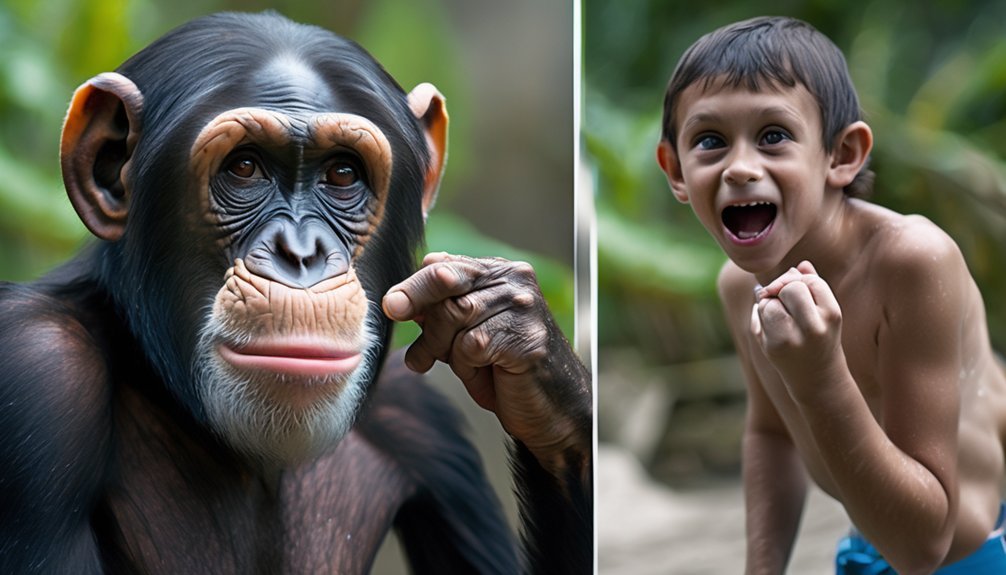
Animal communication is rich and often highly effective, but it usually differs from human language in one crucial way: it tends to signal immediate needs, emotions, or social status rather than expressing open-ended ideas.
Animal communication is rich, but it usually signals immediate needs and emotions, not open-ended ideas.
You can see this in vocal patterns, sign language, and non-verbal cues that carry strong emotional expression. Humans, by contrast, rely on symbolic communication with greater language complexity and layered grammar.
When you compare them, the gap isn’t just vocabulary; it’s context understanding and information transmission across time and distance. Researchers trace these differences to evolutionary origins, where practical survival mattered most.
Even so, some species show striking cultural significance in learned calls or gestures, reminding you that animal communication isn’t simple—it’s adaptive, nuanced, and often surprisingly intimate.
Do Animals Show Self-Awareness?
Self-awareness in animals is harder to measure than communication, because you can’t directly see subjective experience; instead, researchers infer it from behavior. You’ll often see the mirror test used as one clue, but it’s only one piece of evidence.
Careful behavioral observations reveal that some species track their own bodies, adjust actions, and show self-recognition under specific conditions. These findings suggest varied cognitive abilities rather than a single human-like standard.

- Mirror test results can reflect perception, not full consciousness indicators.
- Social interactions help you compare whether animals distinguish self from others.
- Species differences matter: dolphins, elephants, and some primates show stronger evidence than many others.
When you compare across species, you’ll notice that self-awareness looks graded, context-dependent, and closely tied to ecological demands.
Do Animals Show Emotion and Empathy?
Beyond self-recognition, researchers also ask whether animals feel emotions and respond to the emotions of others. You can see evidence in emotional bonding, where primates, elephants, and dogs adjust social behaviors after injury or separation.
Comparative studies measure empathy expressions such as grooming, consoling touches, and cautious proximity, which often accompany emotional responses in both the actor and receiver. You’ll also find compassion signals in vocalizations and posture, especially when a distressed companion needs support.
Physiological data show stress reactions rising in observers, suggesting shared arousal rather than simple mimicry. Different species display different attachment styles, yet many form stable preferences and protest loss. Some even show grief behaviors, lingering near the dead or altering feeding and movement.
Social Learning and Culture in Animals
If you look beyond instinct, you find that many species learn from one another and pass on group-specific behaviors that resemble culture. In primates, whales, and birds, you can trace cultural transmission through learned behaviors shaped by social hierarchy and group dynamics.
- You may notice chimp tool use spreading within troops.
- You can see cooperative hunting in orcas and wolves.
- You can compare mimicry skills in birds across regions.
These patterns show cultural variations without requiring human language. In interspecies interactions, some animals even adopt tactics from others when habitats overlap.
Compared with humans, their traditions are narrower, yet they’re still measurable, repeatable, and adaptive. When you study them closely, you see culture not as an abstraction, but as a living record of shared experience.
Where Human Intelligence Still Leads
Even when animals show impressive learning, human intelligence still leads in several key domains, especially in abstract reasoning, symbolic language, and cumulative innovation.
You can see this when you compare how you solve novel problems: you combine abstract reasoning with creative thinking to build ideas that aren’t tied to immediate experience. You also rely on future planning, weighing delayed outcomes and coordinating complex decision making across many variables.
In moral reasoning, you evaluate intentions, rules, and consequences with unusual flexibility. Humans also drive cultural evolution at scale, preserving knowledge across generations and improving it through writing, science, and institutions.
Measured against these benchmarks, animal cognition remains remarkable, but your species still outperforms others in breadth, integration, and long-range intellectual accumulation.
What Animal Intelligence Reveals About Us
Animal intelligence doesn’t just show what other species can do; it also clarifies how human cognition evolved and where its boundaries lie. You can see cognitive evolution in action when you compare survival strategies across species. Their instinctual behavior often matches environmental adaptation better than your own flexible planning.
Social structures, sensory perception, and emotional intelligence reveal which learning mechanisms produce evolutionary advantages.
- You notice parallels in cooperation and conflict.
- You measure neurological differences without romanticizing them.
- You test how context shapes behavior.
Frequently Asked Questions
Which Animals Have the Strongest Navigation Abilities?
You’d find birds, sea turtles, salmon, and bees among the strongest navigators; they use migration patterns, sensory navigation, environmental cues, cognitive mapping, instinctual behaviors, and spatial awareness, often outperforming you in repeated routes.
Can Animals Learn to Read Human Gestures?
Yes—you’re on the right track: many animals can learn gesture recognition and nonverbal communication cues from you, especially dogs and apes. Compared with humans, they usually infer fewer meanings and need repeated training.
Do Animals Sleep and Dream Like Humans?
Yes, many animals sleep, and some likely dream too. You can compare their sleep patterns to yours: mammals and birds show REM sleep, suggesting dream experiences, though scientists can’t yet confirm subjective content.
How Do Scientists Measure Intelligence Across Species?
You measure intelligence across species by comparing cognitive testing, problem solving, social learning, and tool use; like tuning forks, you’ll hear different minds’ strengths. Scientists score performance, control variables, and compare results cautiously.
Can Domestication Change Animal Intelligence?
Yes—domestication can change animal intelligence. You’d see shifts in cognitive evolution, problem solving, and social structures, shaped by training methods, environmental factors, and breed differences. Compared with wild relatives, domesticated animals often adapt differently.
Conclusion
When you compare the fox’s keen tracks to your own map, you see intelligence as a divided kingdom. Animals may outshine you in memory, sensing, or quick problem-solving, while you still rule in abstract thought and cultural inheritance. Like two travelers with different lanterns, you and other species illuminate distinct paths. The evidence suggests not a single ladder, but a landscape of minds, where your strength lies in building on what each generation learns.