
You may notice animal behavior that looks simple at first, yet resists clear explanation under close study. Some species migrate with remarkable accuracy, others seem to sense storms before any obvious signal changes, and pack animals often move with silent coordination that suggests more than instinct alone. These patterns challenge current models of perception, communication, and group decision-making, and the most puzzling cases still leave important questions open.
Key Takeaways
- Animals use many hidden cues, making behavior hard to explain from observation alone.
- Migrating animals navigate with stars, sun, magnetic fields, and memory in ways scientists still study.
- Many species seem to sense storms early by detecting pressure, humidity, vibrations, or electricity changes.
- Pack animals often move in silent, synchronized coordination without a clear leader.
- Animal communication, including mimicry, scent marking, and alarm calls, still hides many meanings.
What Makes Animal Behavior Hard to Explain?
Animal behavior is hard to explain because you rarely see all the causes at once. You watch a creature act, but you don’t see every internal signal, past experience, or immediate cue that shaped it. Genetic influences can bias responses, yet environmental factors can change how those biases appear in real time.
If you observe the same species in different habitats, you may record different routines, thresholds, or social choices. Small changes in temperature, crowding, food, or stress can shift behavior quickly. You also can’t always separate instinct from learning. That uncertainty makes your notes useful but incomplete.
To explain behavior well, you need repeated observation, careful controls, and patience. Even then, the pattern may stay partly hidden, right in front of you.

How Do Animals Navigate Long Migrations?
When you watch migration, the same problem of hidden causes becomes even more obvious: a bird, turtle, or whale can travel thousands of miles while using several navigation systems at once. You can track migration patterns, yet the full map stays partly invisible.
Scientists think animals sample navigational cues such as sun position, stars, landmarks, magnetic fields, and polarized light, then compare them with internal timing.
- You see route fidelity across seasons.
- You notice course corrections near coastlines.
- You measure compass-like orientation in darkness.
- You infer memory and inherited guidance.
Each clue helps, but no single explanation fits every species. In practice, you’re watching a layered process, not one simple compass. That’s why long-distance travel still feels both intimate and unresolved.
How Do Animals Sense Storms Early?
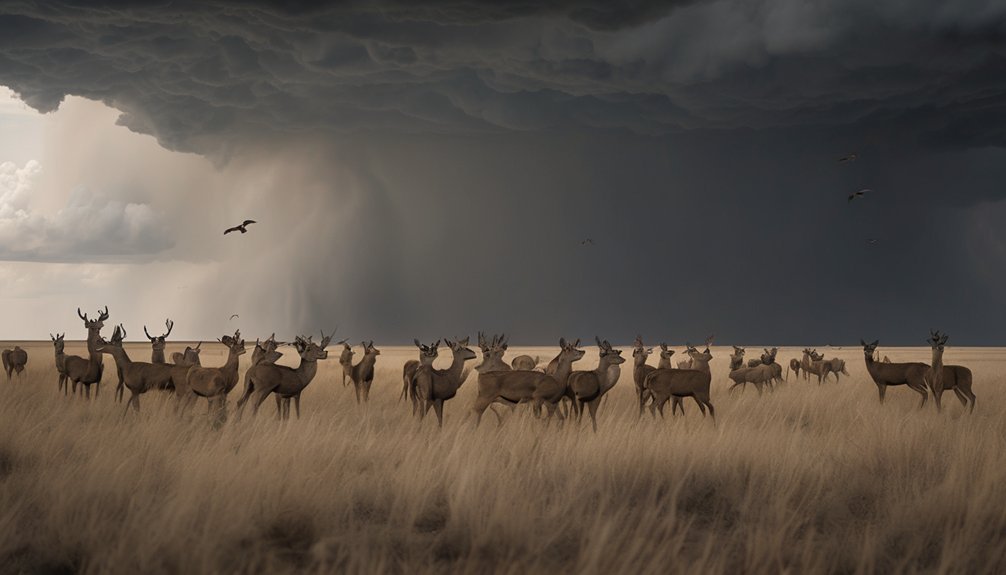
Long before a storm breaks, animals often change course, posture, or activity as if they’ve detected a signal you can’t yet feel. You may watch birds drop lower, insects quiet, or livestock grow tense hours before rain arrives.
Researchers think they respond to falling air pressure, shifting humidity, vibrating ground, and faint electrical changes in the atmosphere. These cues may combine into a form of storm prediction that’s far sharper than your own.
Researchers think animals detect falling pressure, shifting humidity, vibrating ground, and faint atmospheric electricity before storms arrive.
You can see animal instincts at work in these early adjustments: measured, immediate, and repeatable. Scientists still test which signals matter most, but the pattern is clear.
Animals don’t wait for clouds to darken; they react to the storm before you do, and that early warning remains one of nature’s most intimate mysteries.
Why Do Pack Animals Act So Mysteriously?
Why do pack animals seem to coordinate so silently, as if they’re sharing a plan you can’t hear? You watch pack dynamics unfold and notice tight spacing, matched pace, and sudden turns. These instinctual actions often look deliberate, yet they arise fast, with no obvious leader signaling each move.
- You see individuals adjust distance with remarkable precision.
- You notice one shift ripple through the group.
- You observe pauses that occur almost at once.
- You feel the pattern repeat under changing conditions.
Researchers suspect that body position, movement history, and local cues guide these choices. Still, the exact trigger behind each collective response remains hard to isolate.

What you witness feels intimate and ordered, but the mechanism stays partly hidden.
What Animal Communication Skills Still Puzzle Scientists?
How do animals send messages that seem too complex for the signals we can easily detect? You watch vocal mimicry and notice birds, whales, and primates copying sounds with striking precision. Such copying can reinforce social bonding, yet scientists still can’t map every cue.
| Signal | Observed use | Puzzle |
|---|---|---|
| vocal mimicry | contact, courtship | meaning shifts |
| scent marking | identity, range | timing rules |
| warning signals | alarm, coordination | caller intent |
Animals also use emotional expressions, subtle posture changes, and territorial displays that alter group behavior. You may detect a sequence, but not always its full context. Even scent marking can carry layered information about status, readiness, or kin. Researchers can measure frequency and response, but the message’s inner structure often remains partly hidden.
Which Animal Behavior Mysteries Remain Unsolved?
Despite decades of field study, several animal behavior mysteries remain unresolved because the visible action often hides the decision process behind it. You can observe patterns, yet the triggers stay hidden. Scientists still debate:
- Why elephants revisit specific bones.
- How birds navigate with such accuracy.
- Why dolphins form temporary alliances.
- What prompts mass strandings in whales.
These cases challenge your assumptions about animal instincts, because instinct alone doesn’t explain context-sensitive choices.
You also see social structures shaping behavior in ways that resist simple models. A wolf pack, for example, may shift roles quickly, and you can’t always tell whether learning, memory, or environmental pressure drives the change.
Each mystery shows how much remains concealed beneath apparently routine action, and how carefully you must interpret behavior.
Frequently Asked Questions
Why Do Some Animals Mimic Human Voices?
Some animals mimic your voice through vocal mimicry, which can improve social bonding, exploit communication methods, and offer evolutionary advantages. You’ll notice this in species that learn sounds from close contact with humans.
Can Animals Predict Earthquakes Before They Happen?
You can’t rely on them as exact heralds, but some animals seem to notice subtle earth tremors first. Their earthquake sensing and animal intuition may reflect keen hearing, vibration detection, and altered behavior before shaking.
Why Do Certain Species Play With Strange Objects?
You’re seeing play behavior, and you can’t yet know the full cause. Scientists think certain species may show object attachment, practicing skills, exploring novelty, or relieving stress, but the precise function often remains uncertain.
How Do Animals Recognize Individual Human Faces?
You’ll see animals recognize you by facial recognition, comparing your features with stored memories from human interaction. They notice eyes, shape, movement, and scent cues, then match patterns precisely, often with surprising individual accuracy.
Why Do Some Pets Stare at Empty Corners?
They may detect subtle sounds, light shifts, or scents you can’t. That corner gazing isn’t proof of ghosts; it’s pet intuition, a mysterious behavior, and, in cats, feline fascination with movement.
Conclusion
You can see the bigger pattern: animal behavior still resists neat explanations because nature rarely follows one cue. In one storm study, birds shifted activity hours before pressure dropped, hinting at sensors you can’t yet fully map. Like a compass in fog, these instincts point somewhere real, even when you can’t see the path. That’s why you should treat each mystery as data, not decoration: every unexplained movement is another clue in evolution’s field notebook.