
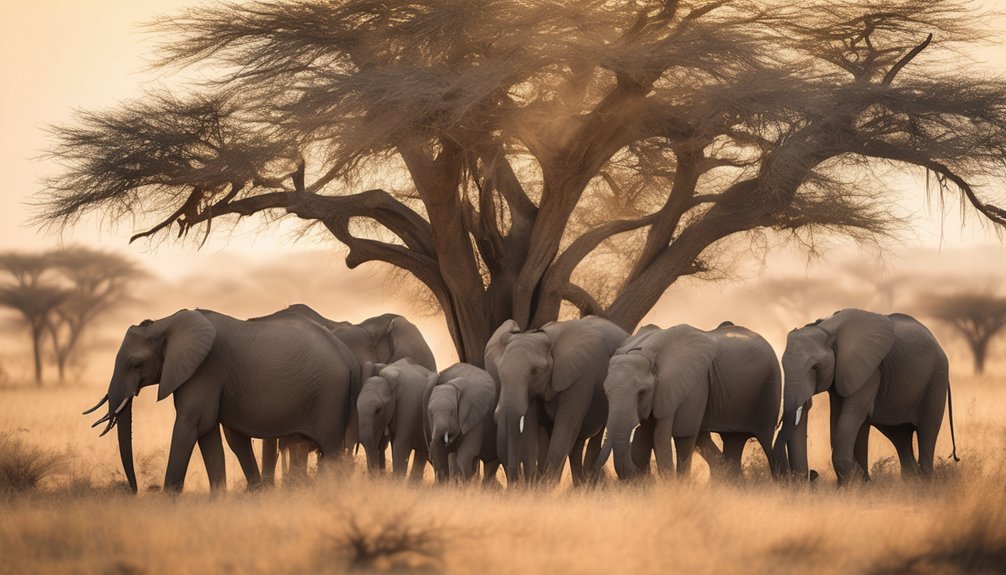
About 60% of observed elephant groups show prolonged attention to dead herd members, and you can see why researchers keep watching. When one dies, you’ll notice the herd slowing, clustering, and often touching the body with trunks or feet. They may stay nearby for hours, vocalize softly, and return later to the site. These patterns raise a larger question about what elephants seem to understand about loss.
Key Takeaways
- Elephants gather quietly around a dead herd member and often stand still for long periods.
- They touch the body or bones with trunks and feet, carefully exploring the remains.
- Herd members stay close together, with adults shielding younger elephants and slowing their movements.
- They make low rumbles and gentle trunk contact, showing altered social and emotional behavior.
- Elephants may return repeatedly to carcass sites, suggesting memory, recognition, and ongoing response to loss.
What Elephants Do When a Herd Member Dies
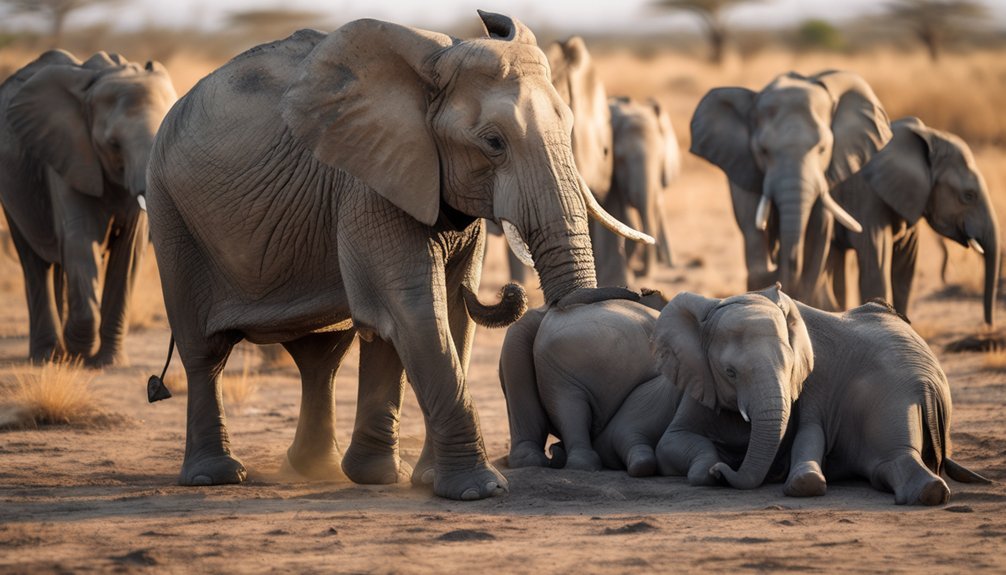
When a herd member dies, elephants often stop moving and gather quietly around the body, touching it with their trunks and feet.
You can observe how the group’s herd dynamics shift as adults close ranks and younger animals stay near trusted companions. Their movements stay slow and deliberate, and they often stand in place for long periods.
Adults close ranks and younger animals stay near trusted companions, their movements slow, deliberate, and filled with quiet attention.
You may see individuals remain close to the remains, then withdraw and return again, suggesting strong emotional bonds within the herd. These responses reflect a coordinated social structure, not random motion.

Each elephant seems to assess the situation through touch, scent, and proximity, while the group maintains contact and spacing.
In intimate terms, you’re watching a collective response shaped by memory, association, and shared social attention.
Behavioral Signs of Elephant Mourning
Those quiet gatherings around a dead herd member often lead to clear behavioral patterns that suggest mourning. You can observe elephants standing still, touching the body with trunks, and lingering longer than usual.
They often reduce normal movement, keep close family bonds, and maintain social connections through low rumbles and gentle trunk contact. These communication methods appear coordinated and deliberate, not random.
You may also notice repeated revisits, which hint at memory retention and ritual behaviors. Such actions suggest emotional intelligence, because the herd adjusts its spacing, pace, and attention around the loss.
In scientific terms, these responses show that elephants track death with sensitivity, and you can watch their behavior change in measurable, intimate ways.
How Elephants Respond to Their Dead
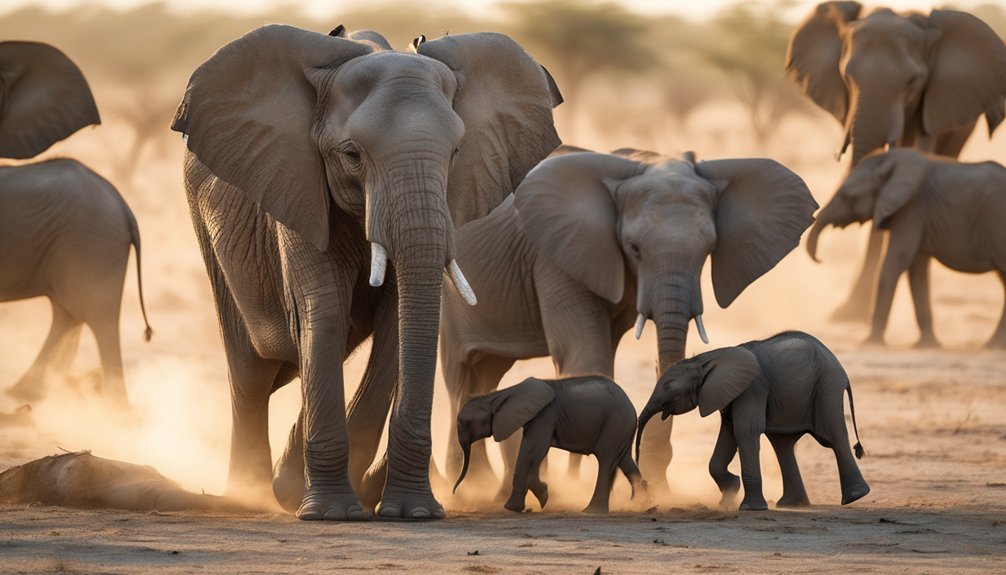
Elephants respond to their dead with a mix of caution, attention, and prolonged contact. You can observe them standing still, touching the body with trunks, feet, or tusks, and then stepping back to reassess. These actions suggest social bonds that don’t end abruptly.
You may also see repeated returns to the same site, as if the group is checking details and maintaining contact. In many cases, you’ll notice caregiving behaviors toward vulnerable individuals nearby, including close guarding and gentle trunk use.
Their emotional intelligence appears in the way they adjust posture, pace, and distance around the remains. This response often involves communal support, with multiple elephants staying close, coordinating movement, and sharing vigilance in a quiet, measured way.
Why Elephants Mourn Their Dead
The behaviors you see around elephant carcasses likely reflect more than simple curiosity or chance; they point to a set of social and cognitive processes that help explain why elephants mourn their dead.
You can interpret these actions as responses to disrupted social bonds, because elephants depend on stable family networks for safety, learning, and coordination. Their emotional intelligence likely helps them recognize absence, remember individuals, and attend to familiar remains with unusual focus.

When you observe them touching bones, pausing silently, or returning repeatedly, you’re seeing a species that tracks relationships over time. Those responses may not mirror human grief, yet they do suggest that death matters within elephant societies, where memory, affiliation, and social awareness shape behavior around loss.
What Research Reveals About Elephant Grief
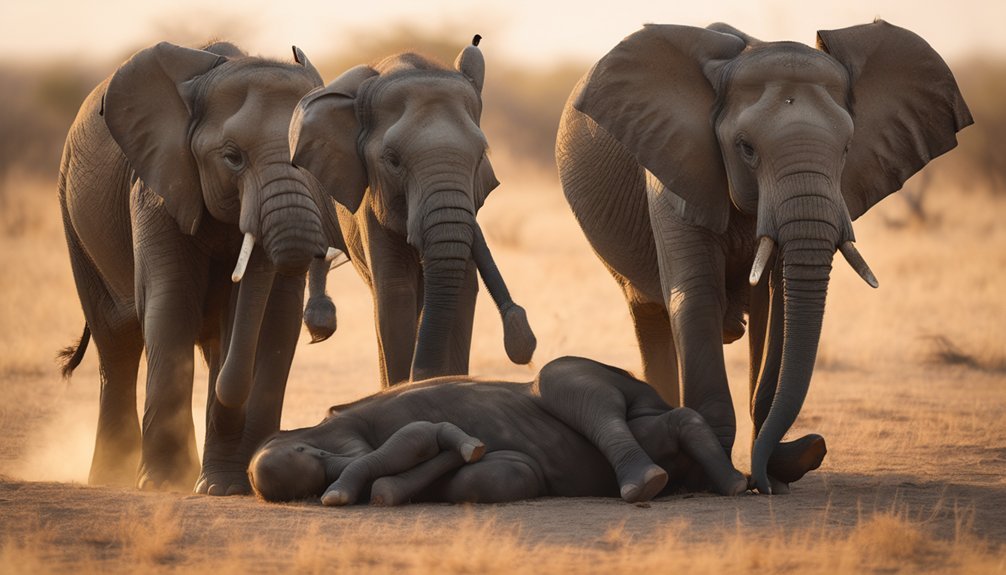
Research has shown that elephant responses to death aren’t random; in field studies, individuals have been observed approaching carcasses slowly, touching skulls and bones with trunks, standing quietly for long periods, and returning to the same remains days later.
You can see patterns that suggest emotional intelligence, especially when adults pause near the body while calves stay close. Researchers note that herd dynamics shift during these events: the group tightens, movement slows, and vocalizations often change.
You may also observe repeated attention to specific sites, which implies recognition rather than chance curiosity. These behaviors don’t prove humanlike grief, but they do show a consistent, measurable response to loss.
When you watch closely, you find a social species whose reactions are precise, restrained, and deeply relational.
What Elephant Mourning Teaches Us
From these observations, you can infer that elephant mourning teaches us how social intelligence shapes responses to death.
You see that elephants don’t react as isolated individuals; they gather, touch, and linger with clear purpose. Their behavior suggests emotional intelligence that helps them register loss, attend to distress, and maintain social bonds after a death.
When you watch them stand quietly around bones or return to a fallen companion, you observe memory, recognition, and restraint. These responses don’t prove human-like sorrow, but they do show that grief can arise within a structured community.
For you, the lesson is direct: death isn’t only a biological event. It also tests relationships, and the strength of those relationships influences how a species responds when life ends.
Frequently Asked Questions
How Long Do Elephants Remember a Deceased Herd Member?
You can expect elephants to remember a deceased herd member for years, possibly decades. Their elephant memory supports long-term recognition, and herd dynamics often change when they revisit remains or encounter familiar scents, sounds, or bones.
Can Elephants Recognize Bones From Different Species?
You can say elephants likely distinguish bones through bone recognition and species identification, using smell, texture, and shape cues. Researchers haven’t confirmed precise cross-species recognition, but they often investigate unfamiliar remains cautiously and visibly.
Do Elephants Visit Grave Sites Repeatedly?
Yes, you may see elephants revisit grave sites like tides returning to shore. Researchers observe grief behaviors, social dynamics, emotional bonds, and herd rituals, but repeated visits aren’t universal, and evidence remains observational, not definitive.
Which Senses Help Elephants Detect Death?
You’d notice elephants detect death mainly through smell, hearing, and touch. They use smell communication to inspect remains and rely on emotional bonding cues, trunk contact, and stillness to recognize something’s wrong.
Do Male Elephants Mourn Differently Than Females?
You’d likely notice males and females grieve somewhat differently: males often show more male bonding, staying near allies, while females may display broader emotional expression, lingering longer with the body and family group.
Conclusion
So, when you watch elephants stand over their dead, touch bones, and linger as if time itself has stalled, you’re seeing a species that refuses the convenient human habit of pretending loss is tidy. Their mourning is not decorative; it is observable, repeated, and social. If you still think grief belongs only to us, the elephants’ calm, measured mourning suggests otherwise. Nature, with dry irony, keeps offering evidence that emotion isn’t uniquely human after all.