When you compare animals by bite force, you’re really looking at one of nature’s most effective tools for feeding, defense, and survival. You’ll find that skull shape, jaw muscle size, and tooth structure all influence how much pressure an animal can generate. Crocodiles, hyenas, hippos, and big cats each solve the same problem in different ways, and the results aren’t always what you’d expect.
Key Takeaways
- Crocodiles and alligators have some of the strongest measured bite forces among living animals.
- Great white sharks use powerful jaws and leverage to grip and slice prey.
- Hyenas have bone-crushing bites that help them feed on tough carcasses.
- Jaguars rank among big cats with the strongest bite force because of their compact skulls and short jaws.
- Hippos generate massive bite force for defense and fighting, making their jaws extremely powerful.
What Is Bite Force?
Bite force is the amount of pressure an animal can generate with its jaws when it closes its mouth on a surface, prey, or object. You can think of it as a mechanical output shaped by jaw muscles, skull structure, and tooth arrangement.
In bite mechanics, force travels through leverage systems that can amplify or reduce power depending on jaw length and muscle placement. This trait matters because it helps you understand how predators crack bone, crush shells, or restrain struggling prey.
It also reveals evolutionary advantages, since stronger bites often support better feeding success, defense, and competition. When you compare species, you see that bite force reflects both anatomy and ecological role, making it a key measure of performance in animals.
How Scientists Measure Bite Force
Scientists measure bite force by placing a sensor, called a force transducer, between an animal’s jaws or at the point where the teeth close, then recording the peak pressure during a bite. You can think of this as precise force measurement, not guesswork.

Researchers then examine bite mechanics to see how jaw shape, muscle leverage, and tooth placement shape the result. To keep data reliable, they usually:
- calibrate the transducer,
- position it consistently,
- repeat bites,
- average the peaks.
You’ll notice that stress, motivation, and angle can change readings, so scientists control conditions carefully. This method lets you compare species with confidence while keeping the animal safe and the numbers meaningful.
Crocodiles and Alligators: Bite Force Champions
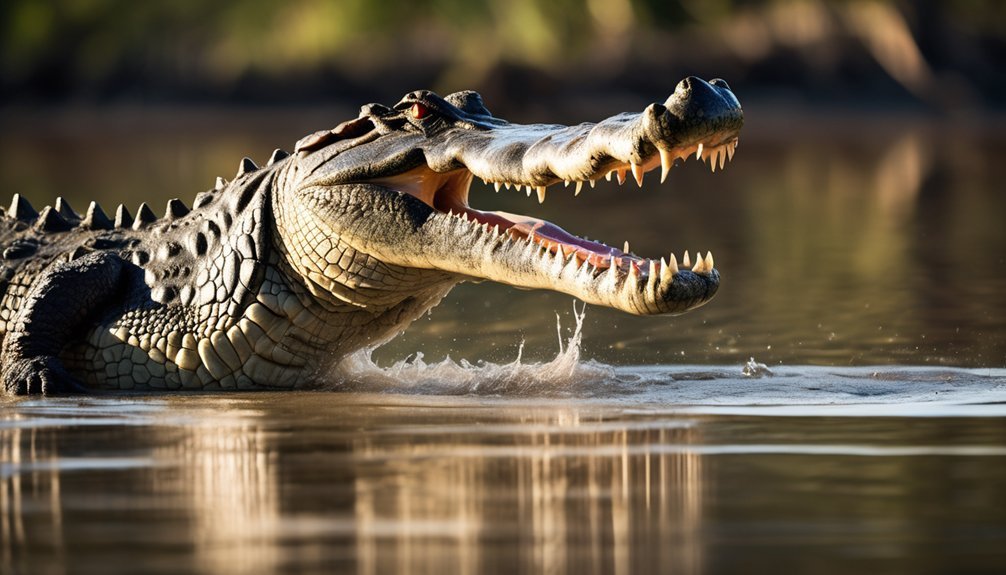
Among living animals, crocodiles and alligators stand out as the clearest bite-force champions, because their skulls and jaw muscles are built to generate extraordinary pressure. You can see why when you look at their crocodile adaptations: reinforced snouts, interlocking teeth, and massive jaw adductors that clamp with crushing efficiency.
| Species | Typical bite force | Main advantage |
|---|---|---|
| Saltwater crocodile | Highest recorded | Ambush power |
| Nile crocodile | Very high | Bone-crushing jaws |
| American alligator | Extremely high | Flexible alligator hunting |
| Black caiman | Powerful | Heavy head leverage |
When you stand near their habitat, you’re witnessing predators that rely on sudden strikes, not prolonged chases. Their force helps them seize prey, hold it underwater, and prevent escape.
Great White Sharks and Crushing Jaws
Great white sharks bring a different kind of power to the discussion of bite force, because their jaws combine speed, leverage, and rows of razor-sharp teeth designed to slice through tough tissue and bone.
You can see how their jaw structure helps them strike fast, clamp hard, and tear efficiently during great white hunting. Their bite doesn’t rely on pure crushing alone; it works as a precision tool adapted for ambush.
- Powerful jaw muscles drive rapid closure.
- Flexible cartilage absorbs impact and stabilizes the bite.
- Serrated teeth reduce resistance as they cut.
- A protruding upper jaw boosts gripping force.
When you study them closely, you’ll notice an animal built for efficient predation, not brute chewing.
Hyenas and Their Bone-Crushing Bite Force
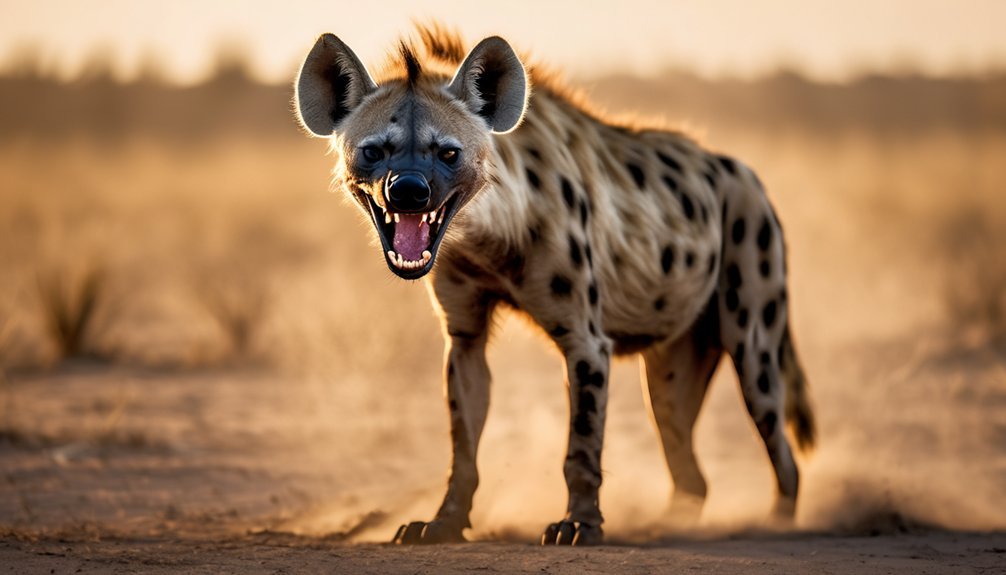
Hyenas deliver one of the most formidable bites in the animal kingdom, and their power comes from skulls and jaws built to withstand enormous stress while cracking open dense bones. You can see this in their hyena anatomy: broad cheek muscles, heavy zygomatic arches, and robust premolars that act like natural grinders.
Their bite force lets you exploit marrow-rich carcasses that other predators leave behind, giving hyenas access to nutrients locked inside bone. During social hunting, this strength becomes even more valuable, because you’re watching a highly coordinated predator secure food, defend kills, and reduce competition.
Their teeth don’t just puncture; they crush, splinter, and process tough tissue efficiently. That makes hyenas exceptional scavengers and hunters, perfectly adapted for survival in harsh, competitive ecosystems.
Why Jaguars Have Such a Strong Bite
Jaguars have such a strong bite because their skulls are compact, muscular, and built to deliver tremendous force through short jaws and thick jaw joints.
When you study jaguar anatomy, you see enlarged temporal muscles, robust zygomatic arches, and teeth aligned for piercing. That design lets you feel how they crush armored prey more efficiently than many big cats.
Their hunting strategies depend on ambush, close-range pounce, and a killing bite aimed at the skull or neck.
Ambush, close-range pounce, and a killing bite aimed at the skull or neck define the jaguar’s hunt.
- Short jaws increase leverage.
- Thick muscles generate power.
- Strong canines penetrate deeply.
- Stable joints resist stress.
You can appreciate how every feature works together, giving the jaguar a bite that’s precise, powerful, and deadly.
Hippos and Their Powerful Bite Force
While not built like a cat, a hippopotamus still has one of the most formidable bites in the animal kingdom, driven by enormous jaw muscles, a massive skull, and a wide gape that can open to about 150 degrees.

You can see how hippo jaws generate crushing force through thick temporal muscles and a reinforced hinge. Their teeth don’t just cut; they shear, puncture, and defend territory.
Water supports much of their body, so their aquatic adaptations help them move with less effort, yet their bite remains explosive on land or in shallow water.
When a hippo feels threatened, it can clamp down with frightening speed, making its mouth a major weapon. That power helps explain why you should never underestimate this bulky herbivore.
Gorillas and Other Primates With Strong Bite Force
Gorillas rank among the strongest-biting primates, with massive jaws, enlarged chewing muscles, and broad molars built to process tough plant material. You can see how primate evolution shaped this power through dietary adaptations that favor fibrous leaves, stems, and bark.
Their bite doesn’t just crush food; it helps you understand how anatomy supports survival.
- Gorillas use deep jaws for force.
- Orangutans rely on robust molars.
- Chimpanzees bite harder than many expect.
- Mandrills show extreme cranial reinforcement.
When you compare these primates, you notice that strong bite force often reflects chewing efficiency, not predatory violence. That distinction matters, because it reveals how intimate pressures of ecology sculpt skull form, muscle attachment, and tooth wear across lineages.
Big Cats Ranked by Bite Force
Among big cats, bite force varies with skull shape, jaw leverage, and prey size, and you can see those traits most clearly in lions, tigers, leopards, and jaguars.
Big cat bite force reflects skull shape, jaw leverage, and prey size, especially in lions, tigers, leopards, and jaguars.
You’ll usually rank jaguars first, because their compact skull and short jaws create exceptional pressure. Tigers follow closely, and their tiger strength shows in a powerful, muscular cranium built for gripping large prey.
Lions come next; the lion bite is strong, but its skull is optimized more for social hunting than peak crushing force. Leopards generally sit below lions, yet their bite stays efficient for smaller prey and climbing lifestyles.
If you compare them directly, you notice that absolute force isn’t everything; leverage, muscle attachment, and head size shape the numbers you see most.
Why Strong Bite Force Gives Animals an Edge
A strong bite force gives animals a clear survival advantage because it lets them seize, kill, and process food more efficiently. You can see the evolutionary benefit in four ways:
- You crack shells, bones, and tough hides.
- You subdue prey faster, lowering injury risk.
- You access nutrient-rich marrow and meat others can’t.
- You defend territory and resources with greater force.
When you compare species, this pressure shapes skull size, jaw muscles, and tooth structure over generations.
Stronger bites also help you exploit hard-to-eat foods during scarcity, which boosts survival in changing habitats. In that sense, bite force isn’t just power; it’s a biological tool that improves feeding success, competition, and long-term fitness.
Frequently Asked Questions
Which Animal Has the Strongest Bite Ever Recorded?
You’d identify the saltwater crocodile as the strongest ever recorded, with recorded measurements topping about 3,700 psi; comparison methods vary, but its jaw force still exceeds every other measured animal’s bite.
Do Venomous Animals Usually Have Strong Bite Force?
Not usually. You’ll see venomous animals rely on venomous adaptations, not crushing jaws; snakes and spiders often evolve evolutionary advantages through toxins, while some, like vipers, still have moderate bite force for prey capture.
Can Bite Force Be Estimated From Skull Shape?
Yes, you can estimate bite force from skull morphology by analyzing bite mechanics, jaw leverage, muscle attachment, and tooth placement. You’ll get a useful prediction, though behavior, size, and soft tissues still affect accuracy.
How Does Age Affect an Animal’s Bite Strength?
Like a growing engine, an animal’s bite strength usually rises with age as muscles, jaws, and bite development mature. You’ll also see evolutionary adaptations shape peak force, though wear and injury can reduce it.
Are Strong Bites Always Better for Hunting?
No, you don’t always benefit from the strongest bite. You’ll hunt best when bite force matches prey size, skull design, and hunting efficiency; excessive force can waste energy and alter ecological balance.
Conclusion
As you’ve seen, bite force isn’t just raw strength; it’s a finely tuned adaptation shaped by diet, anatomy, and survival needs. From crocodiles to hippos, each animal uses jaw power as a specialized tool for feeding, defense, or competition. When you compare these predators and herbivores, you can see that nature doesn’t build one perfect bite—it builds the right bite. In evolution’s toolkit, jaw pressure is a key that opens different ecological doors.