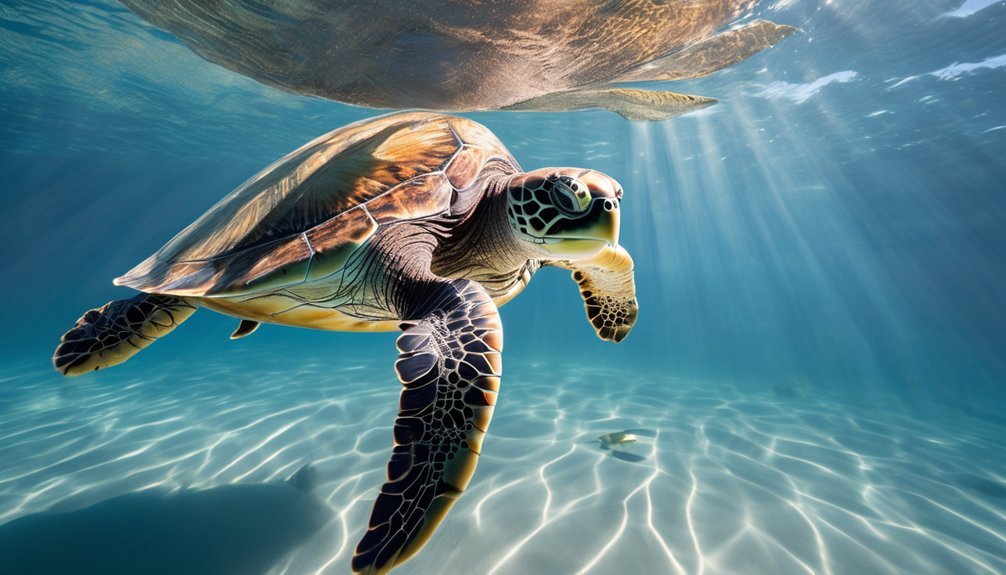
When you watch a sea turtle cross thousands of miles, you’re seeing navigation built on multiple cues at once. It uses vision, smell, wave direction, ocean currents, and the Earth’s magnetic field to stay oriented, then adjusts as conditions change. Hatchlings rely on light to reach the sea, while adults often return to familiar beaches. But that system isn’t foolproof, and some of the biggest threats may be altering it in ways you wouldn’t expect.
Key Takeaways
- Sea turtles navigate by combining vision, smell, wave direction, and water movement into a constantly updated mental map.
- They detect Earth’s magnetic field, using it as an internal compass and magnetic map for long-distance travel.
- Sun position and surface wave patterns help turtles maintain consistent direction across open ocean.
- Hatchlings rely on bright horizons, slope, and waves to reach the sea, but light pollution can disrupt them.
- Habitat loss and climate change can weaken navigation cues, making migratory routes less predictable and harder to follow.
How Sea Turtle Navigation Works
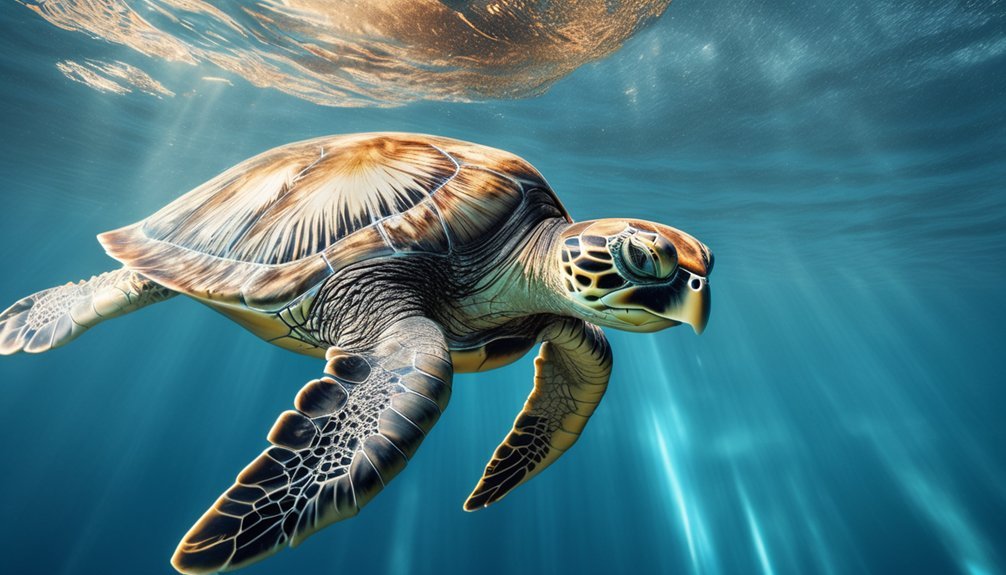
Sea turtle navigation works through a combination of inherited sensory abilities and environmental cues that help them orient across vast distances.
When you observe this process, you see navigation mechanisms that integrate vision, smell, wave direction, and water movement. These sensory cues give turtles useful information about coastlines, currents, and familiar routes, especially when they return to nesting beaches.
Sea turtles integrate vision, smell, waves, and water movement to follow coastlines, currents, and familiar nesting routes.
You can think of their behavior as a constantly updated map, not a single fixed instinct. Each cue reduces uncertainty and helps them adjust course in real time.
Because the ocean changes, turtles rely on flexible responses rather than one signal alone. Their travel depends on repeated sensing, comparison, and movement, which lets them stay aligned with long-distance destinations across shifting marine environments.

Sea Turtle Navigation and Earth’s Magnetic Field
Beneath the waves, turtles can also detect Earth’s magnetic field, and this ability gives them a stable reference system for orientation over open ocean. You can think of this as geomagnetic orientation: your sensory perception tracks magnetic cues that vary across oceanic pathways.
These cues help shape migratory patterns, letting turtles compare their position with learned magnetic maps. Environmental influences, such as local field strength and inclination, can alter how strongly navigation instincts respond, yet the overall signal remains reliable. As a result, you gain spatial awareness without relying on visible landmarks.
Researchers think turtles use this magnetic information to refine long-distance routes, especially during early life stages when they imprint on regional signatures. That internal compass keeps movement efficient, directed, and remarkably consistent.
How Sea Turtles Use the Sun and Waves
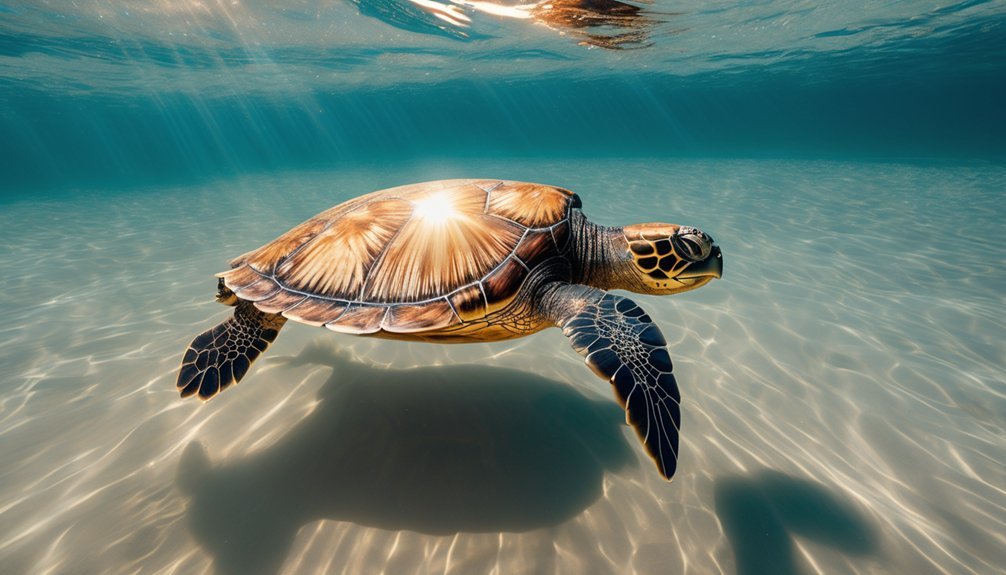
When daylight is available, sea turtles can use the sun as a compass cue to maintain a consistent heading during travel. You can think of this sun navigation as a time-sensitive reference: as the sun’s position shifts, the turtle adjusts its orientation to keep moving in the right direction.
At the water’s surface, you also see wave patterns providing another stable cue. Turtles often angle themselves relative to the direction waves approach, which helps them preserve course when visual landmarks are absent.
This isn’t random behavior; it’s a refined sensory response shaped by experience and biology. By combining solar position with wave patterns, you gain a clearer picture of how turtles reduce navigational error and stay oriented across open ocean distances.
How Ocean Currents Help Sea Turtles Drift
Ocean currents can carry sea turtles long distances, and turtles often use this passive drift to conserve energy while moving through open water. You can think of current patterns as moving roads that shape drift strategies and oceanic trails. When currents align, they help guide migration routes toward feeding zones, reducing energy conservation costs.
| Factor | Effect | Value |
|---|---|---|
| Current patterns | Direct drift | Route support |
| Drift strategies | Passive transport | Lower effort |
| Oceanic trails | Link habitats | Spatial continuity |
| Environmental cues | Signal position | Course correction |
| Navigation challenges | Add uncertainty | Adaptive response |
You’ll see that turtles don’t rely on currents alone; they respond to environmental cues and adjust when flow shifts. This interaction makes movement efficient, but it also creates navigation challenges in changing seas.
Why Hatchlings Head for the Sea
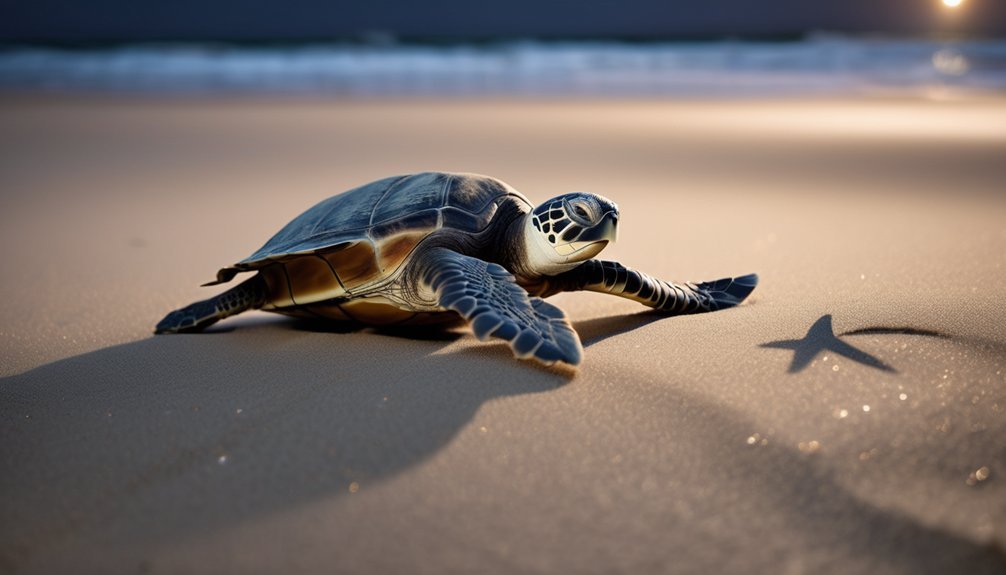
Hatchlings head for the sea because instinct and environmental cues push them toward the brightest, open horizon after they emerge from the nest. You can see how hatchling instincts favor movement away from darker land and toward the reflective, moonlit surf.
This ocean orientation depends on light contrast, slope, and wave direction, which together guide their first crawl. You’re observing a rapid survival response: reaching water quickly reduces exposure to predators, heat, and dehydration.
In laboratory and field studies, turtles exposed to altered lighting often lose this alignment, showing how sensitive their navigation cues are. Once in the surf, they begin swimming continuously, using inherited programs that keep them directed seaward while they’re still too young to rely on later-map navigation.
How Adult Sea Turtles Return to Nesting Beaches
As adults, sea turtles return to nesting beaches by combining long-distance navigation cues with local sensory guidance that lets them recognize familiar coastlines. You see this fidelity in their nesting behaviors, where females often revisit the same region across decades.
Their migratory patterns trace ocean routes shaped by currents, temperature, and geography, yet they still converge on beaches that match their reproductive needs.
- Moonlit waves meeting a dark, quiet shore
- A turtle’s broad track crossing damp sand
- Repeated arrivals to one coastal stretch
This precision lowers search costs and increases reproductive success. You can think of it as a learned route reinforced by biology, allowing adults to move from open water to the exact beach zone where nesting can begin.
How Sea Turtles Use Their Senses
Sea turtles rely on multiple senses to orient themselves, including vision, smell, touch, and possibly magnetic detection. You can see how sensory adaptations help them read environmental factors during long swims. They use olfactory cues to recognize water chemistry, and visual landmarks near coasts guide movements when light is available. Auditory signals may matter less, but vibrations can still inform you about nearby disturbances. Their skin and flippers detect current, temperature, and texture, shaping migratory patterns.

| Sense | Function | Example |
|---|---|---|
| Smell | Detects olfactory cues | Reef water |
| Vision | Uses visual landmarks | Shoreline cues |
| Touch | Senses environmental factors | Currents and temperature |
How Scientists Track Sea Turtles
Scientists track sea turtles to study movement patterns, migration routes, and habitat use across oceans. You can follow individuals with tracking technology that records position, depth, and speed.
Satellite monitoring sends signals from tags, letting you map migration patterns and compare them with behavioral studies. During data collection, you can link each route to environmental factors such as temperature, currents, and seasonal light.
- A turtle gliding beneath a blue surface
- A satellite beam linking sea and sky
- A chart revealing habitat preferences
You’ll see how scientists build conservation strategies by combining repeated tracks from many turtles. This analytical approach shows where animals feed, rest, and travel, and it helps you understand how ocean conditions shape their choices.
What Disrupts Sea Turtle Navigation?
Even when sea turtles follow inherited and learned navigation cues, several disturbances can throw them off course.
You can see how light pollution near beaches masks natural horizon cues, and coastal development removes the dark shoreline contrast hatchlings use.
Shipping traffic and noise pollution add stress, while ship wakes can alter local currents.
Plastic pollution and fishing nets don’t just injure turtles; they can impede movement and force detours.
Climate change also shifts ocean temperatures and currents, which can change the signals turtles rely on over long migrations.
Habitat destruction reduces nesting and foraging areas, making routes less predictable.
When these pressures overlap, they weaken the sensory map turtles use to travel, increasing the chance that you’ll find them delayed, displaced, or unable to reach familiar sites.
Why Sea Turtle Navigation Matters for Conservation
Understanding how sea turtles navigate is essential for conservation because their movements connect nesting beaches, feeding grounds, and migratory corridors across entire ocean basins.
You can protect habitat more effectively when you track migratory patterns and identify nesting sites that need safeguards from human interference. Their routes also reveal climate impact, since warming seas and shifting currents can alter survival and reproduction.
Tracking migratory paths and nesting sites helps protect habitats, revealing how warming seas and shifting currents affect survival.
- Moonlit sand at nesting sites
- A green turtle crossing a blue current
- Hatchlings entering a reflective surf line
These observations guide conservation strategies, from habitat protection to policy advocacy, and help you preserve ecosystem balance.
When you understand where turtles go and why, you can target monitoring, reduce bycatch, and support laws that keep connected habitats intact across generations.
Frequently Asked Questions
Do All Sea Turtle Species Navigate the Same Way?
No, you don’t see all sea turtle species navigate identically. You’ll find they use magnetic orientation, and some may also rely on celestial navigation, but species differences, life stage, and habitat shape their strategies.
How Far Can Sea Turtles Travel in One Migration?
You can see sea turtles travel thousands of kilometers in one migration, sometimes over 2,000 miles. Their migration patterns and ocean currents help you understand why these journeys can span entire ocean basins with precision.
Can Sea Turtles Navigate at Night?
Yes, you can see sea turtles navigate at night; they use night navigation and celestial cues to orient themselves. They also detect waves, magnetic fields, and coastal light patterns, which help them travel accurately.
Do Baby Sea Turtles Learn Routes From Adults?
No, you won’t see hatchlings learn routes from adults; they rely on instinctive navigation techniques. Like a medieval compass in sand, each baby turtle uses Earth’s magnetic cues, ocean currents, and celestial light to orient itself.
How Accurate Is a Sea Turtle’s Return to Its Birthplace?
You’d find sea turtles return surprisingly accurately, often within a few kilometers of their birthplace. Hatchling homing and magnetic navigation help guide them, though currents and habitat changes can shift exact nesting beaches slightly.
Conclusion
You can see that sea turtles navigate oceans with a precise toolkit of magnetic sensing, sun and wave cues, ocean currents, and sensory input. You also see how hatchlings use light to reach the sea and how adults return to familiar nesting beaches. Like a living compass, each turtle integrates multiple signals to stay oriented. Yet habitat loss and climate change can disrupt these systems, so protecting coastal and marine environments is essential for their survival.