
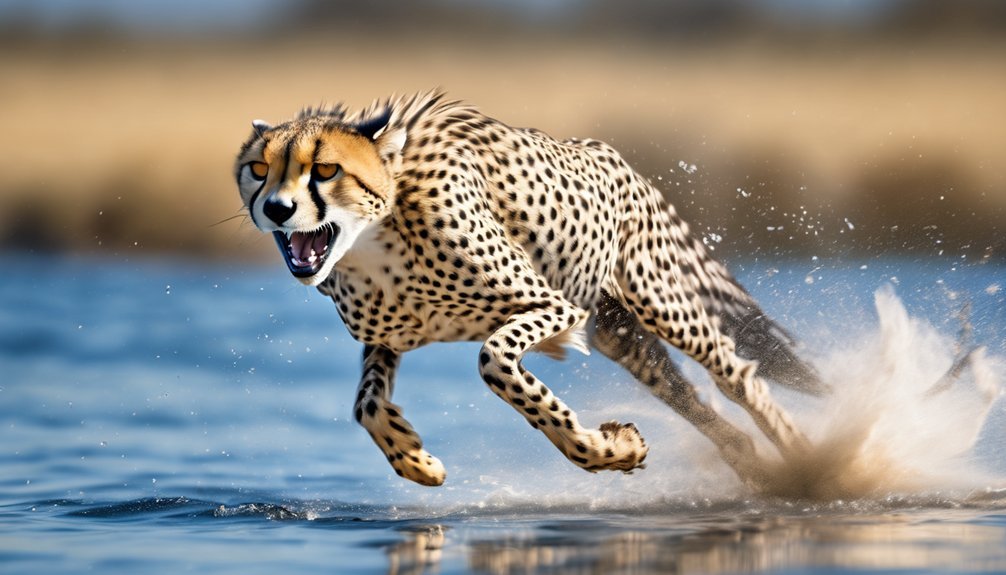
On land, in air, and under water, speed depends on very different body designs. You can see how a cheetah’s flexible spine, a peregrine falcon’s narrow wings, and a shark’s streamlined shape each solve the same problem in distinct ways. These animals don’t just move quickly; they reveal how physics, anatomy, and survival pressures shape motion, and one of them may be even more specialized than you expect.
Key Takeaways
- The cheetah is the fastest land animal, reaching over 100 km/h in short bursts.
- The pronghorn is the fastest long-distance runner, sustaining about 90 km/h.
- The peregrine falcon is the fastest bird, diving at extreme speeds in flight.
- In water, sharks and dolphins use streamlined bodies and powerful tails for rapid movement.
- Speed depends on muscle power, body shape, coordination, and low drag.
What Makes Animals So Fast
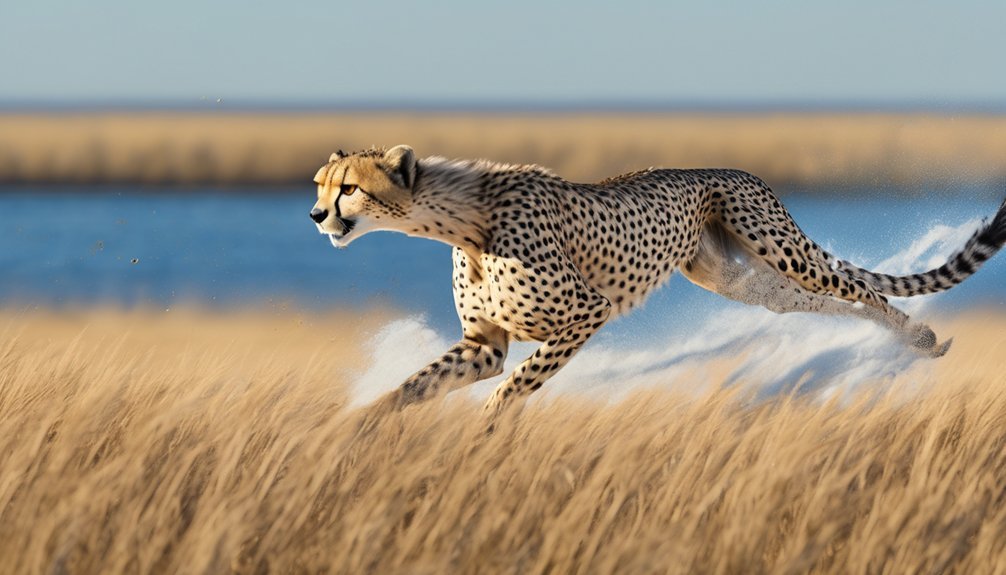
Animals move at extreme speeds when their bodies combine powerful muscles, streamlined shapes, and efficient energy transfer.
You can see speed emerge from long muscle fibers that contract rapidly and from tendons that store and release elastic energy. A narrow body reduces air or water resistance, so each stride or stroke wastes less force.
You also benefit from precise coordination: the nervous system times movements to maximize acceleration and stability. High energy efficiency matters because fast motion demands sustained output without rapid fatigue.
Heart and lungs deliver oxygen quickly, supporting repeated contractions. When body mass stays low and force travels efficiently through limbs, you get greater speed with less expenditure.

This design lets animals respond instantly to threats, prey, and changing terrain.
The Fastest Land Animals
On land, speed depends on how efficiently an animal converts muscle power into forward motion. You can compare the elite runners below:
| Animal | Top speed |
|---|---|
| Cheetah | 100+ km/h |
| Pronghorn | 90 km/h |
| Wildebeest | 80 km/h |
| Lion | 80 km/h |
These animals show distinct antelope strategies and other locomotor adaptations shaped by evolutionary pressures. You notice long limbs, lightweight frames, flexible spines, and strong tendons that reduce energy loss. Pronghorns sustain high speeds over distance, while lions rely on short bursts. In each case, stride length, stride frequency, and traction determine performance. If you study them closely, you’ll see that land speed isn’t just raw power; it’s a precise balance between anatomy, terrain, and survival demands.
Why the Cheetah Leads on Land
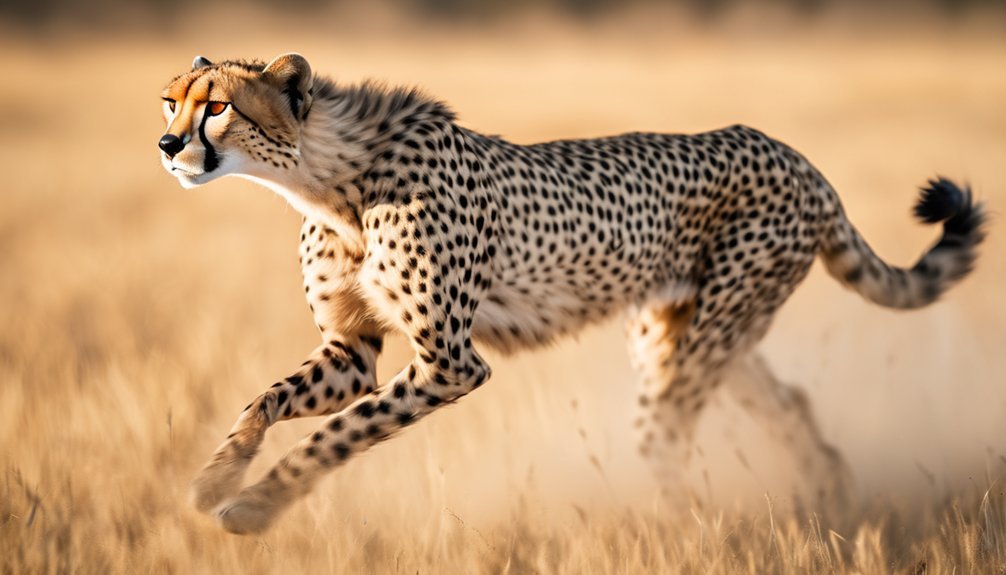
The cheetah leads on land because its body is built to maximize acceleration, stride length, and rapid limb turnover.
You can see cheetah adaptations in its flexible spine, lightweight frame, enlarged nasal passages, and semi-retractable claws, all of which support traction and airflow. Its long tail helps you track how it balances during sharp turns at speed.
In sprinting mechanics, the cheetah uses a double-suspension gallop, so all four feet leave the ground twice each stride. This reduces ground contact time and lets you accelerate quickly over short distances.
Strong hindlimb muscles generate the force, while a supple body transfers it efficiently. That combination gives the cheetah unmatched land speed, even though it can’t sustain top speed for long.
The Fastest Birds in the Sky
Although cheetahs dominate the land, the fastest birds achieve remarkable speeds in the air through specialized body shapes and powerful flight muscles. You can see how bird adaptations reduce drag, increase lift, and support rapid acceleration during flight.
These traits matter most when birds travel long distances or engage in aerial hunting, where timing and control decide success.
- Narrow wings help you notice efficient airflow.
- Strong chest muscles let you understand sustained power.
- Streamlined feathers help you appreciate low resistance.
You’ll find that speed in birds isn’t just brute force; it’s a precise balance of anatomy, metabolism, and behavior.
When you study these hunters, you’re observing evolution tuned for efficiency, accuracy, and survival in open skies.
How Peregrine Falcons Break Speed Records
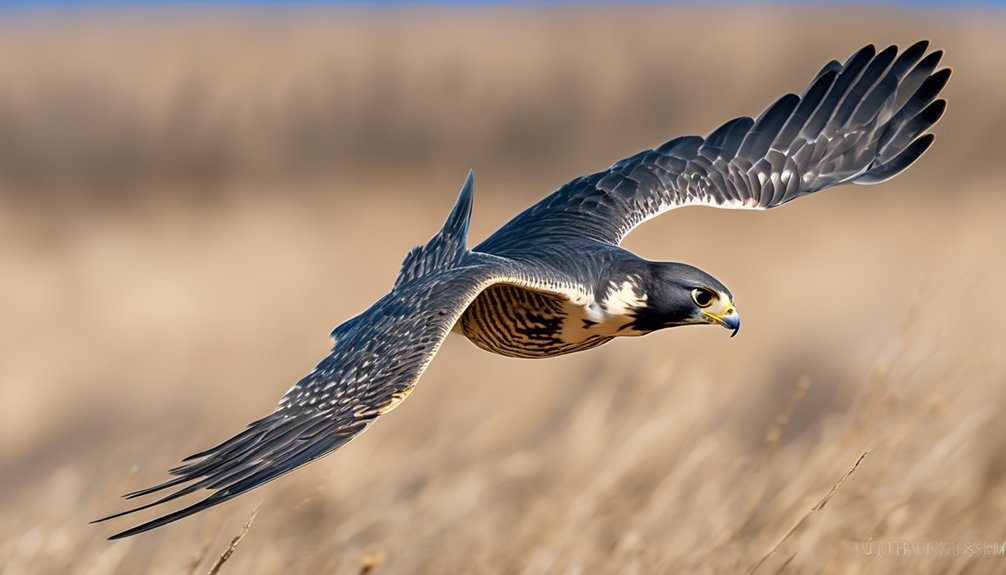
Peregrine falcons set the standard for bird speed, reaching extreme velocities by combining a compact body, pointed wings, and exceptional control in a steep hunting dive.
You can see how their hunting techniques rely on height, momentum, and precise timing rather than raw power alone. As they fold their wings and streamline the body, drag drops sharply, letting gravity accelerate them past 300 kilometers per hour in some dives.
Their nostrils and feather structure help manage airflow, while strong vision tracks prey with remarkable accuracy.
You’ll also notice their aerial agility, which lets them correct course instantly and strike with controlled force.
These adaptations don’t just make them fast; they make them efficient predators capable of breaking speed records consistently.
The Fastest Animals in Water
In water, speed depends on minimizing drag, generating thrust efficiently, and maintaining a streamlined body shape.

When you compare marine swimmers, you’ll notice that shark speed comes from a powerful tail beat, stiff fins, and a fusiform body that cuts through resistance. You’ll also see that dolphin agility reflects flexible control, rapid turns, and strong muscles that let them accelerate with precision.
- You can picture a shark conserving motion with each sweep.
- You can imagine a dolphin pivoting cleanly in open water.
- You can measure speed by how little turbulence they create.
In both cases, you’re seeing evolution balance force and efficiency. These animals don’t just move fast; they move with control, which helps them hunt, evade threats, and travel long distances.
Which Fish Outswim Almost Everything?
The sailfish is often regarded as the fastest fish in the ocean, capable of short bursts that can exceed 68 mph under ideal conditions. You should note that this speed comes from a streamlined body, a rigid tail, and powerful muscle contractions that reduce drag and increase thrust.
When you compare it with swordfish speed, sailfish still ranks among the most agile predators in open water.
You’ll also see that tuna migration reflects endurance rather than peak velocity; tunas sustain high cruising speeds over long distances, but they don’t usually match the sailfish’s top burst.
In your reading, keep the distinction clear: maximum speed, sustained travel, and hunting style measure different performance traits.
Speed Vs. Size in Animals
Although size can influence absolute speed, body design usually matters more than mass in animal movement. You can see this size influence when comparing large runners with small sprinters: heavier bodies often need more force to accelerate, while lighter ones can change direction quickly.
Yet speed evolution doesn’t favor smallness alone. In water, air, or on land, efficiency, limb proportion, and drag shape performance more than simple body weight.
- Bigger animals may keep momentum better.
- Smaller animals often reach top speed sooner.
- Both can be fast when their form matches the environment.
Adaptations That Make Animals Faster
Speed depends on more than muscle power; streamlined bodies, flexible joints, and efficient movement patterns let animals reduce drag and convert energy into forward motion.
You can see that fast species rely on fast-twitch muscle fibers, aerodynamic shapes, and body structure that minimizes resistance. Their metabolic efficiency lets them sustain bursts without wasting energy, while environmental adaptations tune performance to terrain, water, or air.
Sensory adaptations sharpen reaction time, and behavioral strategies optimize acceleration, turning, and pacing. These traits support hunting strategies that close distance quickly and create evolutionary advantages when speed matters.
In many species, the same design also aids predator avoidance, because rapid escape depends on coordinated limbs, balance, and precise timing.
Together, these features make speed a measurable product of form and function.
How Fast Animals Survive in the Wild
When predators and prey meet, survival often depends on whether an animal can accelerate, evade, or reposition faster than its rival. You can see speed as a biological tool that supports survival strategies in real time.
A fleeing antelope may zigzag to break pursuit, while a cheetah uses predator tactics like short bursts and timing. In many species, quick acceleration reduces capture risk, but endurance and awareness matter too.
You’ll notice that speed works best with sharp senses, camouflage, and terrain use.
- Sudden turns can force a chaser to overshoot.
- Rapid takeoff helps you escape during the first second.
- Group movement can confuse an attacker and lower danger.
Frequently Asked Questions
Which Animal Has the Fastest Top Speed Ever Recorded?
You’d identify the peregrine falcon; its dive has the fastest top speed ever recorded, exceeding 200 mph. A cheetah sprinting reaches about 70 mph, but that’s far slower than this precise aerial plunge.
Can Any Insects Outrun the Fastest Birds or Mammals?
No, you generally can’t. Even with insect adaptations and efficient flight mechanics, insects don’t outrun the fastest birds or mammals overall, though some beat them in short bursts or relative body-speed terms.
Do Young Animals Learn Speed From Their Parents?
Yes—young animals often pick up speed through parent offspring dynamics, watching, following, and practicing. You’d see speed learning behaviors shaped by guidance, genetics, and environment, with parents nudging safer, smoother bursts rather than teaching outright.
How Do Scientists Measure an Animal’s True Speed?
You measure true speed with speed measurement tools like GPS, radar, or high-speed video, then you compare recorded distance over time during straight, controlled movement for accurate speed comparison, minimizing wind, terrain, and acceleration effects.
Which Fast Animals Are Endangered in the Wild?
You’re looking at endangered species like the cheetah, peregrine falcon, and saola; conservation efforts target them because habitat loss, poaching, and low population sizes still threaten these swift animals in the wild.
Conclusion
As you’ve seen, speed in animals depends on sleek shapes, strong muscles, and specialized systems that suit each habitat. You can trace terrestrial thrust in the cheetah, aerial acceleration in the peregrine falcon, and aquatic agility in streamlined fish and marine mammals. These fast forms help creatures hunt, evade predators, and survive. In nature, velocity isn’t just impressive—it’s a precise product of adaptation, anatomy, and environment.