You may think you know the animal kingdom, but its most unusual facts often sound like myth. You’ll find frogs that survive freezing, octopuses with three hearts, and jellyfish that may not age in the usual way. These traits aren’t curiosities alone; they show how species solve survival problems with striking precision. As you move through them, one question keeps growing: what else have you underestimated?
Key Takeaways
- Wood frogs can survive being frozen by filling cells with glucose and slowing their heart and breathing almost to a stop.
- Ants can carry up to 50 times their own weight because of their small size, strong muscles, and efficient joint leverage.
- Tardigrades can survive extreme conditions, even in space, by entering a dormant state that reduces water, oxygen, and energy needs.
- Dolphins use unique signature whistles like names, while elephants detect low-frequency vibrations through the ground for communication.
- Octopuses have three hearts and blue blood, and some animals like starfish and certain jellyfish can regenerate or reverse aging.
Why Animal Facts Surprise Us
Animal facts surprise us because they often overturn what you think you know about a species, revealing behaviors, abilities, or adaptations that are far more complex than they first appear.
You may expect a familiar pattern, then encounter unexpected discoveries that challenge your assumptions. When you study animal behavior closely, you notice how each species solves problems, survives pressure, and communicates in ways that feel both alien and deeply organized.
That gap between expectation and reality is what makes learning feel intimate: you’re not just collecting trivia, you’re meeting a living system on its own terms.
These surprises also sharpen your attention, because they remind you that nature rarely fits simple labels. Instead, it asks you to stay curious, precise, and open to revision.
Animal Facts That Sound Fake
Some animal facts seem implausible at first because they conflict with everyday expectations of how bodies and behavior should work. You may feel the same hesitation when you hear claims that sound like mythical creatures or old animal superstitions. Trust that discomfort; it’s a healthy response to unusual data.
- A blue whale’s tongue can weigh as much as an elephant.
- Some frogs can freeze solid and survive.
- A shrimp’s heart sits in its head region.
- Octopuses can taste with their arms.
When you verify these facts, you replace doubt with clarity. You also see how nature often exceeds folklore without losing precision.
That’s the point: the facts aren’t fake, even when they feel intimate, strange, and almost impossible to hold.
The Weirdest Animal Adaptations
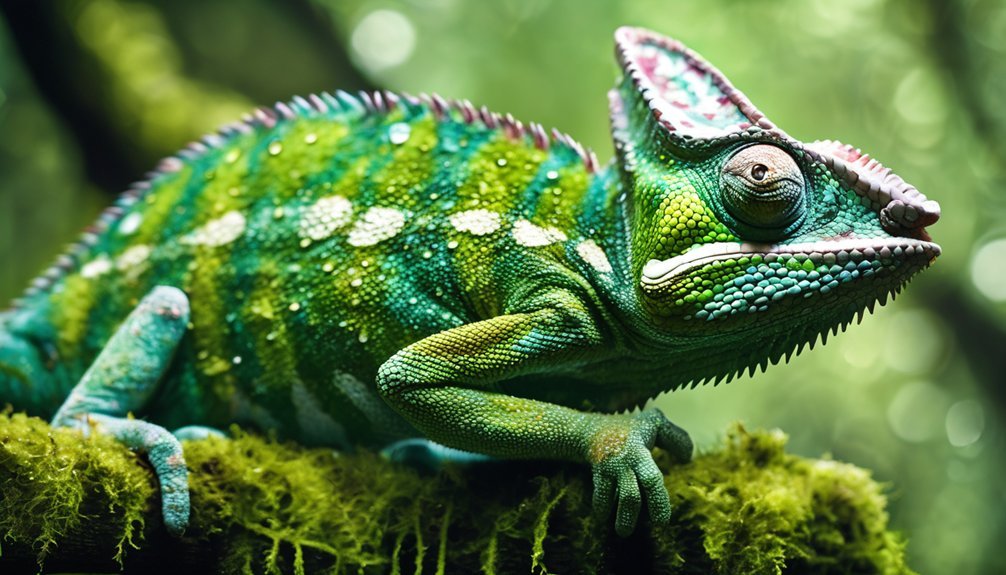
When you look closely at evolution, the strangest adaptations often make the most sense for survival. You can see Adaptive Evolution fitting an Ecological Niche with remarkable efficiency, whether through Sensory Enhancement, Color Camouflage, or Mimicry Strategies that confuse predators.
Some animals rely on Physical Transformation to improve Predator Evasion, while others use Behavioral Survival to avoid danger without wasting energy. Extreme Longevity can support Environmental Resilience when conditions stay harsh for years.

These traits aren’t random; they’re precise responses to pressure, scarcity, and threat. If you pay attention, you’ll notice how each body tells a quiet story of necessity, adaptation, and survival. In that story, odd traits feel less strange and more deeply humane.
A Frog That Freezes and Survives
In winter’s grip, the wood frog can survive a state that would kill most vertebrates: its body freezes almost solid, then thaws in spring and resumes normal function. You can picture frogs in winter as living laboratories of restraint, not drama. Their survival mechanisms include loading cells with glucose, which protects tissues, and slowing metabolism until oxygen demand drops sharply.
- Ice forms outside cells, not inside them.
- Blood flow nearly stops, reducing damage.
- Organs tolerate temporary inactivity.
- Warmth restores movement without lasting harm.
If you’ve ever felt winter’s pressure, this frog’s biology can feel oddly reassuring. It doesn’t escape the cold; it endures it with precision. That quiet resilience shows how life can persist, even when conditions seem impossibly harsh.
An Octopus With Three Hearts
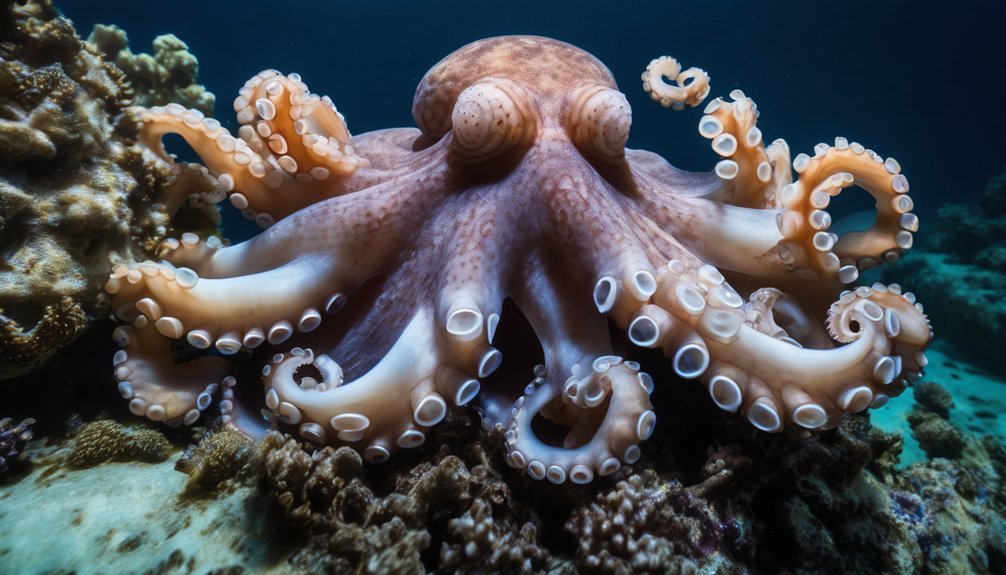
If the wood frog shows how life can pause and return, the octopus shows a different kind of adaptation: it keeps moving with three hearts. In octopus anatomy, two hearts pump blood to the gills, while the third supports circulation to the rest of the body. You can see how this heart function helps an animal meet high oxygen demands in cold, dim water.
| Heart | Role |
|---|---|
| 2 gill hearts | Send blood to the gills |
| 1 systemic heart | Moves blood through the body |
| Blue blood | Carries oxygen efficiently |
| Extra support | Sustains movement and recovery |
When one heart slows during swimming, you’re seeing a precise trade-off, not a flaw. That design can feel strangely intimate: survival built into every beat.
A Dolphin That Uses Names
A dolphin’s signature whistle can function like a name, allowing individuals to identify and call to one another with remarkable precision. You’re hearing sophisticated dolphin communication in action, not random noise. Each whistle carries a unique acoustic pattern, and dolphins can learn it with strong name recognition.
A dolphin’s signature whistle works like a name, carrying identity through sound with remarkable precision.
When one dolphin calls, another can respond specifically, even across distance and turbulence.
- You benefit from seeing identity encoded in sound.
- You notice fast, selective responses.
- You observe social bonds strengthened by recall.
- You recognize communication with emotional nuance.
This system feels intimate because it supports reunion, coordination, and trust. If you listen closely, you can appreciate how carefully dolphins maintain contact, and how their vocal signatures help them stay connected in complex marine groups.
A Penguin That Proposes With Pebbles
When a penguin presents pebbles to a potential mate, you’re seeing a courtship ritual that doubles as practical nest building.
In penguin courtship, you’ll notice the bird approaches with deliberate care, then offers stones one by one as if asking permission to share a future.
Pebble selection matters: the right piece must fit the nest, resist cold water, and signal effort without waste.
If the mate accepts, you’re watching trust form through small, exact gestures.
This exchange isn’t sentimental in a human sense, but it’s intimate in its own way.
Each pebble says, “I can help keep our eggs safe.”
You can feel how tenderness and utility merge, making this tiny proposal both strategic and deeply personal.
A Shrimp That Punches Like Lightning
You’d never expect such a small animal to strike with that much force, yet the mantis shrimp can launch its club-like appendage with enough speed to create a shockwave.
When you look closely, shrimp anatomy reveals a spring-loaded limb, rigid segments, and a latch that stores energy until release. It doesn’t punch randomly; it targets with exacting control, almost like a lightning strike in miniature.
- The club accelerates faster than many bullets.
- Water around it briefly vaporizes, intensifying impact.
- The blow can crack shells and stun prey.
- Its eyes track motion with remarkable precision.
If you feel amazed, that’s reasonable. Nature built this hunter to be efficient, not gentle, and you’re seeing power refined into a compact body.
A Sloth That Moves in Slow Motion
After a creature built for explosive force, a sloth offers the opposite design: it moves so slowly that each step seems measured in frames. You can read this as sloth behavior shaped by low-energy muscle use, careful grip, and a body that favors caution over speed. In slow motion, it still reaches leaves, rests often, and saves effort.
| Trait | Effect |
|---|---|
| Metabolism | Conserves energy |
| Limbs | Support steady climbing |
| Movement | Reduces strain |
| Posture | Holds balance |
| Pace | Lowers detection |
When you watch closely, you may feel impatience fade. Its slowness isn’t weakness; it’s a precise adaptation, and it asks you to value restraint as a survival strategy.
A Wood Frog’s Built-In Freeze Alarm
Even in freezing weather, a wood frog doesn’t simply endure; it actively triggers a built-in freeze alarm that shifts its body into survival mode. You can picture its cells responding with clinical efficiency, as glucose floods tissues and protects them from ice damage. This is one of nature’s most intimate freeze tolerance mechanisms, precise and spare.
- Its heart slows dramatically.
- Its breathing nearly stops.
- Its tissues tolerate partial freezing.
- It thaws and resumes activity.
These seasonal hibernation strategies aren’t passive sleep; they’re controlled physiological choices that keep the frog alive through harsh nights. When you study this animal, you see resilience with no excess, only necessary adaptation.
An Ant That Carries 50 Times Its Weight
An ant can haul loads up to 50 times its own body weight by relying on a compact body plan and exceptionally efficient muscle power. You can think of this ant strength as a precise weight comparison: tiny frame, remarkable output. Its exoskeleton supports stress, while leg joints distribute force with minimal waste.
| Trait | Effect | Result |
|---|---|---|
| Small size | Low body mass | Easier lifting |
| Strong muscles | High force output | Greater carry capacity |
| Flexible joints | Efficient leverage | Stable movement |
When you watch an ant, you’re seeing engineered efficiency, not brute force. That can feel surprising, even comforting: nature often solves hard problems with elegant simplicity.
A Tardigrade That Survives Space
When exposed to the vacuum of space, a tardigrade can survive by entering a dormant state that sharply reduces its need for water, oxygen, and energy. You can think of this as tardigrade resilience made visible: the animal folds into a protected form, then waits.
In harsh radiation, extreme cold, and dehydration, its cells stay remarkably stable. That stability supports cosmic survival without drama or excess movement.
- You see a body less than a millimeter long.
- You notice it tolerates conditions that would kill most life.
- You understand dormancy as a precise biological pause.
- You appreciate how little damage can occur.
This tiny creature doesn’t ask for attention, yet it offers you a quiet lesson in endurance, intimacy, and adaptation.
A Starfish That Regrows Lost Arms
If a starfish loses an arm, you may expect lasting damage, yet many species begin regenerating the lost limb through tightly controlled cell growth and tissue remodeling.
In Starfish regeneration, you can see how cells near the wound shift roles, divide, and rebuild structures with remarkable precision. Marine biology shows that this isn’t a crude patch job; it’s coordinated healing guided by local signals and energy demands.
You might imagine the animal as fragile, but it often continues feeding and moving while recovery unfolds. That resilience can feel intimate, almost reassuring, because it reveals how life repairs itself after injury.
For you, the lesson is simple: even severe loss doesn’t always mean an ending; sometimes, it’s the start of careful restoration.
A Giraffe’s Surprisingly Dark Tongue
From one remarkable adaptation to another, the giraffe’s tongue stands out for a very different reason: its dark blue-black color. When you picture a giraffe tongue, notice the dark pigmentation that protects it during hours of feeding.
- It helps shield delicate tissue from intense sunlight.
- It supports repeated contact with thorny leaves.
- It lets you see how evolution solves daily stress.
- It keeps the tongue resilient while browsing high branches.
You’re looking at a structure that often reaches 18 inches, yet it stays nimble and controlled. That dark pigmentation isn’t accidental; it reflects a practical, well-tuned response to exposure.
If you feel curious, remember that this subtle feature serves a protective role, letting the giraffe feed with less damage and more efficiency.
Koala Fingerprints That Fool Detectives
Koalas carry fingerprints so eerily similar to human ones that they can confuse even trained detectives. If you touch a koala’s paw, you’re meeting a surface shaped by fine ridges, loops, and whorls that closely match your own.
This oddity matters because detective methods often rely on fingerprint patterning, and koala prints can muddy a scene when investigators expect an obvious animal trace.
In daily life, koala behavior keeps them slow, deliberate, and mostly solitary, so their hands rarely explain their value until science looks closer.

You might feel a quiet unease hearing that nature can mimic you this precisely, but it’s also a reminder that evolution solves problems with startling elegance.
The Honeybee Waggle Dance
Honeybees don’t just return to the hive and silently announce a food source; they perform the waggle dance, a precise figure-eight motion that encodes direction and distance.
When you watch closely, you see waggle communication work like a calibrated map, helping nestmates locate nectar with remarkable accuracy. You can feel the elegance of bee navigation in each vibrating pass.
- The waggle run points toward the target.
- The duration signals how far you’ll need to travel.
- The sun’s angle gives orientation.
- Nearby bees decode the message by touch and motion.
This system’s precision can seem intimate, because your survival may depend on shared information.
In that small, humming space, cooperation becomes a measured act of care.
Cat Whiskers That Detect Tiny Changes
Even in low light, a cat’s whiskers give it a detailed sense of space. You can think of them as fine sensory tools that detect tiny air shifts, edge distances, and nearby movement.
Each whisker connects to nerves at the follicle, so even slight bending sends clear information to the brain. That whisker sensitivity helps you understand why your cat can slip through narrow gaps or pause before a jump with such accuracy.
In feline navigation, whiskers support confidence, especially when vision can’t do all the work. If you live with a cat, you’ll notice how carefully it tests its surroundings.
You’re watching a precise system at work, one that keeps your companion calm, oriented, and quietly in control.
A Shark That Can Live for Centuries
Some animals seem built for finely tuned awareness, while others are remarkable for sheer longevity, and the Greenland shark is one of the oldest known vertebrates on Earth.
You may be looking at a true lesson in shark longevity: this cold-water species can live for centuries, growing slowly and maturing late. Its body chemistry helps it endure darkness, pressure, and near-freezing seas with quiet efficiency.
- You notice a low metabolism.
- You see delayed reproduction.
- You observe steady growth over time.
- You meet an ancient predator adapted to harsh habitats.
If you feel small beside it, that’s understandable; these ancient predators remind you that survival can mean patience, not speed.
A Bat That Eats Hundreds of Insects a Night
A single bat can consume hundreds of insects in one night, turning darkness into a feeding ground. You’re watching one of nature’s most efficient nocturnal hunters, using rapid flight and echolocation to locate prey with striking accuracy.
Its insect consumption helps reduce mosquitoes, moths, and beetles before they can disrupt your evening or damage crops. You may never notice the work, but the effect is real and immediate.
Each pass through the air is a calculated search, not random motion. This bat’s small body demands constant fuel, so it feeds often and with purpose.
Every pass is a precise search for fuel, as this small bat feeds with relentless purpose.
If you’ve ever appreciated a quieter night outdoors, you’ve already benefited from its careful, relentless service.
An Elephant That Hears Through Its Feet
From a bat’s silent night work to an elephant’s far-reaching awareness, animal senses can operate in surprising ways.
When you watch an elephant stand still, you’re seeing a sophisticated receiver at work. Its feet detect foot vibrations traveling through soil, letting it notice distant movement, thunder, or other elephants. This isn’t guesswork; it’s elephant communication carried through the ground and interpreted with remarkable accuracy.
You can think of it as a tactile hearing system that supports safety and social contact.
- It senses low-frequency signals.
- It responds before you’d hear anything.
- It helps maintain group cohesion.
- It reduces panic in uncertain terrain.
If you’re near one, its calm may reflect information you can’t perceive, yet it still can.
A Platypus That Glows Under UV Light
Under ultraviolet light, a platypus’s fur can emit a blue-green glow, a phenomenon called biofluorescence.
If you see it in UV light, the platypus glow looks subtle, not neon, and it comes from pigments in the hair rather than from the skin itself.
You won’t notice this effect in normal daylight, so the animal still appears brown and familiar.
Scientists study this response to learn how mammals interact with light and why some species retain unusual optical traits.
For you, the detail matters because it shows how much biology hides in plain sight.
A quiet body can still carry a vivid secret, and this one reveals itself only when the environment changes.
A Sea Otter That Holds Hands
When sea otters sleep, they often link paws with a partner, a behavior that keeps them from drifting apart in moving water. You’re seeing otter behavior that’s both practical and tender, a small act of marine bonding.
In this floating rest, your focus can rest on four details:
- A paw grip limits separation.
- Body contact conserves warmth.
- Mutual alertness reduces risk.
- Social closeness supports group stability.
You may feel how this simple gesture mirrors human need for connection. The animals choose proximity without noise or display, and that restraint makes the bond feel intimate.
In clinical terms, the behavior improves survival; in emotional terms, it shows care. If you watch closely, you’ll notice that holding hands isn’t romance here—it’s coordinated trust.
A Jellyfish That May Be Biologically Immortal
If conditions turn harsh, the tiny jellyfish *Turritopsis dohrnii* can reverse its life cycle and return from an adult stage to a younger one, a process that has earned it the nickname “biologically immortal.”
You’re looking at a remarkable survival strategy, not true invincibility: the animal can still die from disease, predation, or environmental stress, but it can sometimes reset its body by transforming its cells into an earlier form.
In jellyfish biology, this ability fascinates you because it blurs the usual boundary between growth and decline.
For immortality research, it offers a rare natural model for studying cellular reprogramming and repair.
You can see why scientists watch it closely: this delicate creature suggests that aging, in some bodies, may be more flexible than you once thought.
More Animal Facts That Defy Expectations
Nature keeps producing edge cases that challenge your assumptions, and some of the most surprising ones come from animals with unusual bodies, behaviors, or survival strategies. You can see animal intelligence in crows that solve problems, and in octopuses that remember.
- Unexpected behaviors often help them avoid danger.
- Unique communication can be as subtle as scent, color, or vibration.
- Social dynamics shift when animals cooperate, compete, or raise young together.
- Habitat diversity shapes reproductive quirks and ecosystem roles.
When you notice these patterns, you’re seeing adaptation, not novelty for its own sake. Each species responds to pressure with precision, and that response can feel almost intimate.
Nature isn’t random here; it’s exacting, responsive, and full of quiet solutions that keep life moving.
The Wildest Animal Fact of All
The wildest animal fact of all is not a single extraordinary trait, but the fact that life repeatedly solves the same problems in radically different ways. When you watch wild animal behaviors, you’re seeing tailored answers to hunger, danger, and care.
| Problem | Mammal | Bird |
|---|---|---|
| Find food | Dig | Probe |
| Avoid threats | Hide | Flee |
| Raise young | Nurse | Feed |
| Problem | Fish | Insect |
| Navigate | Sense current | Follow scent |
| Communicate | Signal | Dance |
| Survive | School | Swarm |
That pattern reveals astonishing animal intelligence. You don’t need myth; you need attention. Each species tests the same reality, and each body writes a different solution, with efficiency, restraint, and quiet grace.
Frequently Asked Questions
Why Do Some Animals Have Such Unusual Survival Abilities?
You see unusual survival abilities because evolution favors traits that improve survival and reproduction; these environmental adaptations give animals evolutionary advantages. You’re witnessing nature’s precise, intimate response to harsh pressures, scarcity, predators, and changing habitats.
How Do Scientists Verify Animal Facts That Seem Impossible?
Scientists verify impossible-sounding animal facts by combining animal behavior observation with scientific methods, like a detective’s magnifying glass. You’ll see controlled experiments, repeated measurements, and peer review, so extraordinary claims become careful, trustworthy evidence.
What Makes Certain Animal Adaptations so Effective?
Certain animal adaptations work because you’ll see precise camouflage techniques and sensory adaptations matching specific habitats, letting animals detect danger, find food, and conserve energy efficiently, which improves survival while minimizing unnecessary stress and exposure.
Are There Animals With Abilities Humans Still Can’T Fully Explain?
Yes, you’ll find animals with mysterious abilities and unexplained behaviors, like navigation, communication, and sensing fields. You can study them closely, but you still can’t fully explain every mechanism behind their remarkable precision and adaptability.
Which Animal Fact Surprises Experts the Most?
You’d likely be most surprised that octopuses can edit their RNA, with millions of changes; that 70% stat fuels awe. Their unbelievable behaviors and extraordinary senses challenge your assumptions, and you can’t fully explain them yet.
Conclusion
So, you’ve just learned that a frog can freeze, an octopus can juggle three hearts, and a jellyfish might outlive your bad decisions. Nature doesn’t bother with your idea of “normal”; it runs its own strange, efficient laboratory. If these facts unsettle you, good. You’re paying attention. The animal kingdom isn’t cute background noise — it’s a master class in survival, absurdity, and adaptation, and you’re still just trying to keep your phone charged.